
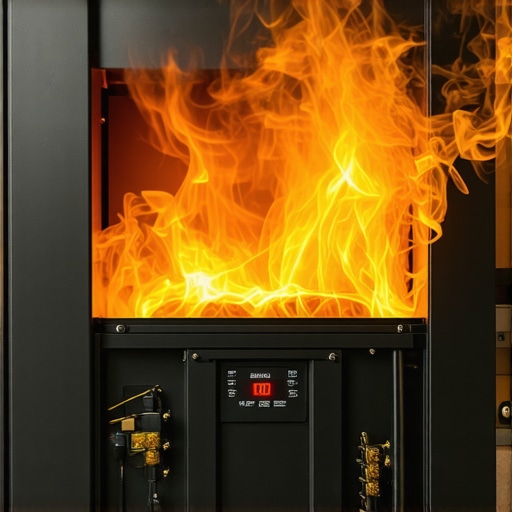
The Sound of a Mechanical Heart Attack
You’re lying in bed at 3 AM in the dead of a Chicago-style winter, the house is finally quiet, and then it happens. BOOM. It sounds like a 12-gauge shotgun went off in the basement, followed by the metallic rattle of ductwork and the low hum of the blower motor. To the untrained ear, it’s just another house noise. To an HVAC veteran who’s spent thirty years smelling singed eyebrows and cleaning soot off heat exchangers, that sound is a frantic SOS from your furnace. It’s not just a ‘thump.’ It’s delayed ignition, and if you ignore it, you’re not just risking a furnace repair bill; you’re risking the structural integrity of your heat exchanger and the safety of your family.
The Physics of the Explosion: Why the Delay?
My old mentor used to scream at me until he was blue in the face, ‘You can’t burn what isn’t mixed, and you can’t heat what you can’t touch!’ This is why airflow matters more than horsepower. In a gas furnace, the sequence of operations is a delicate dance of physics and chemistry. When the thermostat calls for heat, the inducer motor pulls a vacuum, the pressure switch proves the draft, the igniter glows cherry red, and then the gas valve opens. In a perfect world, the gas hits that hot surface and lights instantly. But when that ‘Gas’ (refrigerant techs call it juice, but we’re talking combustible fuel here) pools up because the burners are dirty or the igniter is weak, you get a mini-explosion. The gas builds up in the combustion chamber for three, four, maybe five seconds. When it finally catches, it’s a localized detonation. That loud boom is the sound of thousands of BTUs expanding faster than the heat exchanger was designed to handle.
“Delayed ignition is most often caused by dirty burners, weak igniters, or incorrect gas pressure, leading to an accumulation of fuel before combustion occurs.” – ACCA Manual G Selection of Residential Equipment
The Forensic Diagnosis: Anatomy of a Boom
If we look at this through a Forensic Diagnosis lens, we treat the furnace like a patient. First, we check the burners. Over time, rust and dust—what we call ‘scale’—clog the crossovers. These are the little metal pathways that carry the flame from the first burner (where the igniter sits) to the last one. If those crossovers are blocked, the first burner lights, but the others have to wait for the gas to cloud up and reach the flame. That’s your boom. Second, we look at the ‘Sparky’ side of things. If your hot surface igniter is cracked or failing, it might not reach the 2500°F required to instantly combust the gas. It’s like trying to light a campfire with a damp match. Finally, we check the ‘Tin Knocker’s’ work. If your return air is restricted, the heat exchanger gets too hot, causing the metal to expand and contract violently, which can mimic or exacerbate the sound of delayed ignition.
The Climate Factor: Northern Grime and Carbon Monoxide
In cold northern climates, your furnace is a high-performance engine running for 2,000 hours a season. This isn’t like an AC installation in a dry climate where dust is the only enemy. Here, we deal with combustion byproducts. The ‘Soot’ and ‘Acid’ from the burning gas eat away at the burner orifices. If you haven’t had a heating service in two years, your burner ports are likely restricted. This is dangerous. Every time your furnace ‘booms,’ it stresses the heat exchanger—the metal wall that separates your breathing air from the lethal carbon monoxide. A cracked heat exchanger isn’t a repair; it’s a death sentence for the unit. You can’t just slap some ‘Pookie’ (mastic) on a heat exchanger and call it a day. It’s a full replacement at that point.
“All gas-fired central furnaces shall be installed in accordance with the manufacturer’s instructions and must provide for the proper venting of combustion products to prevent CO infiltration.” – ASHRAE Standard 103
The Math: Repair vs. Replace in the Modern Era
So, you’ve got the boom. Do you call for furnace repair or start looking at AC installation combos? A gas valve or an igniter is a $300 to $600 fix. But if that boom has already cracked your heat exchanger, you’re looking at $3,000 for a part that might not even be in stock. This is where we talk about the 2025 regulatory cliff. We are moving toward A2L refrigerants and higher AFUE (Annual Fuel Utilization Efficiency) standards. If your furnace is a 15-year-old 80% AFUE dinosaur, it’s venting money up the chimney. Upgrading to a 96% modulating furnace, or even supplementing with a mini-split for those shoulder seasons, can cut your gas bill by 40%. Don’t let a ‘Sales Tech’ push you into a $15,000 system if your burners just need a $20 cleaning, but don’t be the homeowner who pours $2,000 into a unit that’s legally old enough to drive.
Preventive Maintenance vs. The Emergency Call
The best way to stop the boom is to never let it start. A real technician—not a salesman with a clipboard—will pull your burners, scrub the crossovers with a wire brush, and check your manifold gas pressure. We use a manometer to ensure you aren’t ‘over-firing’ the furnace. If the gas pressure is too high, it’s like putting a racing engine in a minivan; things are going to break. We check the flame sensor to ensure the unit isn’t ‘short cycling’ (turning on and off rapidly), which kills the igniter. Remember, your HVAC system is a sealed ecosystem. If the airflow is bad, the combustion is bad. If the combustion is bad, the heat exchanger dies. If the heat exchanger dies, you’re buying a new system. It’s physics, not magic. Keep your filters clean, keep your vents open, and for the love of all things mechanical, if you hear a boom, turn it off and call a pro before you turn your basement into a blast zone.