The Anatomy of a Mechanical Scream
My old mentor, a man who spent forty years breathing in brazing fumes and fiberglass, used to grab me by the shoulder and bark, ‘You can’t cool what you can’t touch!’ He wasn’t talking about the air—he was talking about the physics of heat transfer. When your AC unit starts sounding like a blender full of gravel, it isn’t just an annoyance; it is a desperate cry from a machine struggling against the laws of thermodynamics. As a veteran of thirty years in the field, I can tell you that a change in decibels is the most honest diagnostic tool we have. Whether it is a standard split system or a modern mini-split, noise is the language of mechanical failure.
“The most expensive equipment in the world cannot overcome a bad duct system.” – Industry Axiom
The Mechanical Autopsy: Why the Hum Turned into a Howl
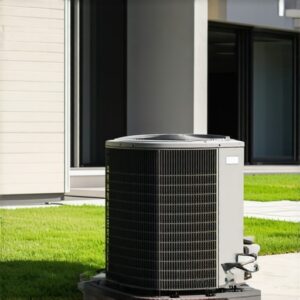
Let’s perform a forensic diagnosis on that outdoor condenser. If you are hearing a high-pitched squeal, we are likely looking at the bearings in the condenser fan motor. In the dry, punishing heat of a Southwest summer, where ambient temperatures regularly hit 110°F, those bearings are cooked in their own grease. This is sensible heat at its most destructive. When the fan can’t pull air through the coils, the head pressure inside the suction line skyrockets. The compressor, the heart of your system, starts to labor. If that hum turns into a rhythmic ‘thunk,’ you might be looking at a compressor that is ‘slugging’ liquid—a death sentence caused by poor AC installation or a massive restriction in airflow.
The Capacitor and the Contactor: The Electrical Pulse
Sometimes the noise isn’t mechanical; it’s electrical. That loud ‘buzz’ you hear before the fan kicks on? That’s usually a failing run capacitor. It’s trying to provide the torque needed to start the motor, but it’s weak. If you ignore it, the motor will overheat and trip the internal thermal overload. I’ve seen ‘Sales Techs’ try to sell a whole new heating service and cooling package for $12,000 when all that was needed was a $40 capacitor and a Sparky with a multimeter. This is why you never trust a guy who doesn’t have a manifold gauge set in his hand within five minutes of arriving.
“A system’s ability to reject heat is directly proportional to the mass flow rate of air across the condenser coils.” – ASHRAE Fundamentals
Static Pressure: The Silent Killer of Airflow
If the noise is coming from your vents—a whistling or a deep ‘whoosh’—you aren’t looking at a broken part; you’re looking at a physics problem. This is Static Pressure. Think of it like high blood pressure for your house. If a tin knocker undersized your return air duct, the blower motor has to work twice as hard to move the gas. It creates a vacuum effect that pulls on the cabinet doors. This is why we use Pookie (mastic) to seal every joint. Tape fails under that kind of pressure. A loud indoor unit is often just a blower wheel that has become unbalanced by dust because someone didn’t change a five-dollar filter. It’s not magic; it’s maintenance.
The 2025 Regulatory Cliff and Your Wallet
We are entering a phase where furnace repair and AC maintenance are becoming more expensive due to the R-410A phase-out. If your unit is screaming and it’s over twelve years old, we have to do the math. A repair involving a compressor swap might cost $3,000, but with the new A2L refrigerants coming in 2025, parts for older ‘juice’ machines will become scarce. However, don’t let a salesman scare you into a new unit just because of a rattling panel. Sometimes, the solution is as simple as a hard-start kit to help that compressor during the initial ‘monsoon’ humidity spikes. We look for the suction line to be ‘beer can cold’—if it’s not, and the unit is loud, the compressor is starving. True comfort is physics, and physics doesn’t care about your budget. It only cares about airflow and pressure differentials.
The Final Verdict
If your AC is louder today than it was last week, shut it down and check the filter first. If that’s clean, look at the outdoor coil. If it’s caked in dirt, the system is choking. Cleaning those coils drops the head pressure, quietens the compressor, and saves the bearings. Don’t wait for the ‘clunk’ that signals total failure. A quiet system is an efficient system, and in this industry, efficiency is the only thing that keeps the lights on without breaking the bank.