The Ghost in the Ductless Machine: Why Your Mini-Split Fan Won’t Settle Down
You’re sitting in your living room, trying to enjoy a quiet evening, when you hear it—that subtle, rhythmic ramping up and down of the indoor blower. It sounds like the unit is indecisive, hunting for a gear it can’t quite find. Most homeowners think the motor is dying or the ‘Sparky’ who wired it messed up the voltage. But after thirty years of crawling through spider-infested crawlspaces and baking on black rubber roofs, I can tell you: that fan isn’t broken. It’s thinking. It is performing a complex dance of thermodynamics that most ‘Sales Techs’ couldn’t explain if their commission depended on it.
My old mentor, a man who smelled permanently of burnt oil and R-22, used to grab me by the shoulder and bark, ‘You can’t cool what you can’t touch!’ He was obsessed with the boundary layer of air on the fins of an evaporator coil. He knew that if the air didn’t stay in contact with that copper long enough, you weren’t actually moving heat; you were just moving air. This is the fundamental truth of AC installation: airflow is the master, and the equipment is just its servant.
“Equipment shall be selected such that the total sensible capacity is not less than the calculated sensible load, and the latent capacity is not less than the calculated latent load.” – ACCA Manual S
The Inverter’s Brain: Why ‘Auto’ is a Command, Not a Suggestion
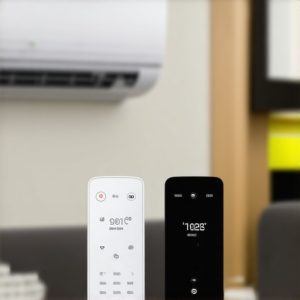
Unlike a traditional central air system that’s either ‘on’ or ‘off,’ a mini-split uses inverter technology. Think of it like a dimmer switch versus a standard light switch. When you set that fan to ‘Auto,’ you are handing over control to a PID (Proportional-Integral-Derivative) loop. The unit is constantly measuring the delta—the difference—between the return air temperature and your set point. If you are only two degrees away from your target, the board tells the DC fan motor to throttle back. This increases dwell time on the coil, which is crucial for removing latent heat (humidity). If the fan stayed at high speed, it would satisfy the thermostat too quickly, leaving your room feeling like a cold, damp basement. This is especially true in humid climates where the ‘juice’ (refrigerant) needs to wring the water out of the air before the room gets too cold.
The Heating Cycle and ‘Cold Draft Prevention’
If you are using your unit for heating service during a cold snap, the fan speed fluctuations are even more pronounced. This is a safety feature, not a bug. Mini-splits are programmed with ‘Cold Draft Prevention.’ Before the indoor blower ramps up, the indoor coil must reach a specific temperature—usually around 90°F to 100°F. If the outdoor unit goes into a defrost cycle to melt ice off the fins, the indoor fan will slow down or stop entirely. If it didn’t, it would blast you with 40°F air while the system is technically in ‘heat’ mode. When you hear that fan shifting speeds, it’s often the system waiting for the ‘gas’ to get hot enough to provide actual comfort rather than a chilly breeze.
The Physics of the Thermistor: The Unsung Hero
Inside that plastic head on your wall are tiny sensors called thermistors. One measures the air coming in, and another is clipped directly to the copper piping. When these sensors detect a rapid change in pipe temperature—perhaps because the electronic expansion valve (EEV) just opened up to flood the coil with more refrigerant—the logic board reacts by adjusting the fan speed. It’s trying to maintain a specific ‘superheat’ or ‘subcooling’ value to protect the compressor from liquid slugging. If the fan didn’t change speeds, the compressor might take a hit of liquid refrigerant, which is a death sentence for the unit. Most people would rather have a fluctuating fan than an $8,000 furnace repair or AC replacement bill.
“Proper airflow across the indoor coil is essential for maintaining the pressure-temperature relationship required for efficient heat transfer.” – ASHRAE Fundamentals
When the Hunting Becomes a Problem: The Maintenance Factor
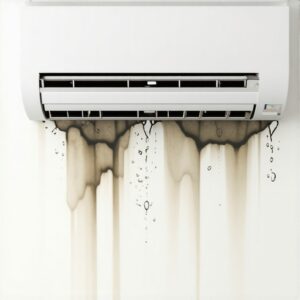
Now, if that fan is surging wildly or making a ‘whooshing’ sound that feels uneven, we need to talk about static pressure. As a ‘Tin Knocker’ will tell you, airflow hates resistance. If your filters are even slightly glazed with dust, the blower motor (which is often a variable-speed ECM) will fight to maintain its programmed CFM (Cubic Feet per Minute). It will ramp up to overcome the resistance, realize it’s drawing too many amps, and then throttle back down. It’s a cycle of stress. This is why I tell people that ‘Pookie’ (mastic) and clean filters are more important than the brand name on the box. If you haven’t had a pro look at the coil in two years, that fan is probably screaming for help through a layer of biological growth that’s choking the airflow. [image_placeholder_1] Ensuring your coil is clean is the simplest way to stop the ‘hunting’ and keep the system operating within its design parameters.
The Verdict: Precision Over Power
Stop looking at your mini-split like it’s a window unit from 1985. It’s a sophisticated piece of laboratory equipment. The speed changes you hear are the system’s way of balancing sensible heat (temperature you feel) and latent heat (moisture in the air). If you want a static fan speed, you can manually set it to ‘High’ or ‘Medium,’ but you’ll sacrifice the efficiency and dehumidification that you paid for. Trust the physics. Trust the sensors. And for heaven’s sake, keep the filters clean so the ‘gas’ can do its job properly.