The Sound of a Slow-Motion Mechanical Suicide
I’ve spent three decades crawling through insulation that feels like fiberglass needles and balancing on rooftops so hot they’d sear a steak. In that time, I’ve seen it all. But nothing grinds my gears more than walking up to a job site and seeing a high-efficiency condenser leaning at a ten-degree angle like the Tower of Pisa. Most homeowners look at a tilted pad and see a minor cosmetic flaw. To me? That’s the sound of a compressor’s internal bearings screaming as they’re starved of oil. It’s the visual representation of a looming four-figure repair bill that didn’t have to happen. If your AC installation was done by a ‘hack-and-go’ crew, they probably just tossed a plastic pad on top of loose dirt and called it a day. Thirty years in the trade has taught me one thing: if the foundation is trash, the mechanicals will follow. We’re going to look at the physics of why a level pad is the difference between a unit that lasts twenty years and one that burns out before the warranty expires.
The Narrative Matrix: The Six-Inch Level vs. The $18,000 Quote
I remember following a ‘Comfort Consultant’—which is just a fancy name for a salesman who can’t hold a pipe wrench—out to a house in a swampy part of the county. The customer was a retired teacher on a fixed income, and this kid had quoted her $18,000 for a full system replacement including a new mini-split for her sunroom. His ‘diagnosis’? The outdoor unit was vibrating so hard it was ‘shaking itself to death’ and had likely suffered internal frame failure. I walked out to the condenser and didn’t even need my gauges to see the problem. The pad had sunk into the soft clay on the left side, causing the fan motor to sit at an angle. The vibration wasn’t ‘frame failure’; it was the fan blade being out of balance because gravity was pulling it toward the shroud. I spent forty-five minutes with a pry bar, a bag of crushed limestone, and a four-foot level. I reset that pad, stabilized the earth, and the unit purred like a kitten. I caught that sales tech in the driveway and told him to find a new career before I reported his license. He didn’t know the difference between a bad compressor and a bad base. Most don’t.
“All mechanical equipment must be installed and supported in accordance with the manufacturer’s instructions to ensure proper drainage and vibration isolation.” – ACCA Manual S
The Thermodynamic Zoom: Why Gravity Dictates Your Electricity Bill
Let’s talk about what’s actually happening inside that box when it’s not level. We aren’t just ‘moving air’; we are managing a complex phase-change cycle. Inside your compressor, there’s a specific amount of oil designed to lubricate the scrolls or the piston. This oil travels through the system with the ‘juice’ (refrigerant). When the unit is level, gravity allows the oil to pool correctly in the crankcase where the pump can pick it up. If the unit is tilted, the oil pools on one side. This can starve the top bearings of the compressor. When those bearings run dry, they create friction. Friction creates heat. Heat cooks the refrigerant and turns it acidic. I’ve opened units where the oil smelled like a sourdough starter that went bad in a dumpster—that’s a ‘burnout.’ Once that acid is in your lines, it’s like cancer; it’s hard to get out without a total system flush and a new heating service call that’ll break the bank. Furthermore, in humid climates, your evaporator coil is constantly dumping latent heat by turning water vapor into liquid. This condensate has to drain. If the outdoor unit is part of a heat pump system and it’s tilted the wrong way, the defrost runoff in winter can pool and turn the whole base into an ice block, eventually crushing the delicate aluminum fins of the coil.
The South/Humid Physics: The Latent Heat Trap
In regions where the humidity stays at 90%, the ‘monsoon effect’ isn’t just about rain; it’s about soil stability. When the ground becomes saturated, a heavy concrete pad can shift. If you have a high-efficiency unit, it likely has a large footprint. An unlevel unit in the South means the condensate from the ‘sweating’ suction line (it should be beer can cold, by the way) won’t drip off the service valves; instead, it runs back along the copper, soaking your insulation and eventually rotting out the ‘Pookie’ (mastic) seal where the lineset enters the house. This lets ants and moisture into your wall cavity. It’s a domino effect of failure. Proper AC installation requires a compacted sub-base of gravel, not just dirt. Dirt moves. Stone stays put.
“Condensing units must be placed on a solid, level foundation of non-combustible material that will not settle over time.” – International Mechanical Code (IMC)
The Forensic Diagnosis: How to Level a Pad Properly
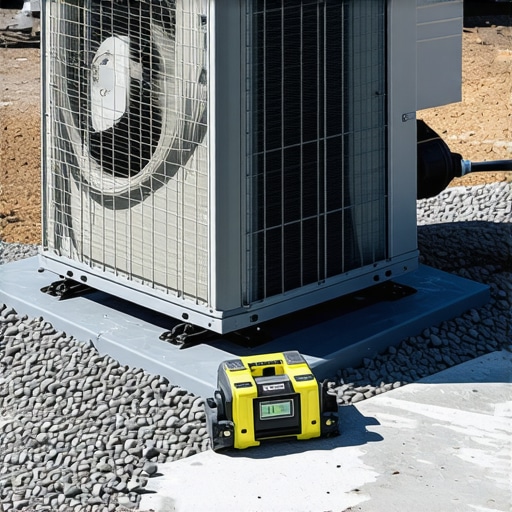
If you find your unit is listing like a sinking ship, don’t just shove a brick under it. That’s what a ‘Sparky’ (electrician) would do if he was trying to fix a fence. You need to do it right. First, you check the lineset. If the unit has sunk significantly, the copper lines are under tension. If you just jack the unit up, you might snap a brazed joint and dump the entire charge of gas into the atmosphere. You have to gently lift the pad, not just the unit. I use a long pry bar and a few pieces of scrap 4×4. Once the pad is lifted, you don’t use dirt to fill the gap. You use 3/4-inch crushed stone or ‘fines.’ Pack it in tight with a hand tamper. You want the pad to be perfectly level across the width, but I actually prefer a 1/8-inch slope away from the house’s foundation. This ensures that any rain or ‘juice’ sweating off the suction line moves away from the building. Once the pad is stabilized, check the vibration pads. Those little rubber sandwiches between the unit feet and the pad aren’t just for show—they prevent the ‘Tin Knockers’ (duct guys) from hearing the compressor hum through the floorboards of the house. Finally, check your furnace repair records; if your outdoor unit has been struggling due to poor airflow or vibration, your indoor blower motor has likely been working overtime to compensate for the pressure imbalances.
The Math: Repair vs. Replace
Resetting a pad is a $200 to $500 job depending on the labor involved. Replacing a compressor that died because it was starved of oil? You’re looking at $2,500 minimum. If the unit is more than ten years old, the sales tech will tell you it’s a ‘dinosaur’ and try to sell you a new $10,000 SEER2 compliant system. Don’t let a $20 bag of gravel turn into a $10,000 capital expense. Leveling your pad is the most boring, yet most essential, part of preventive maintenance. It’s not flashy, it doesn’t involve smart thermostats or ‘seamless’ integration, but it’s the physics that keeps the lights on and the air cold. Respect the level, or get ready to write a big check. [HowTo: Leveling an AC Pad] {“@context”: “https://schema.org”, “@type”: “HowTo”, “name”: “How to Level an Outdoor AC Condenser Pad”, “step”: [{“@type”: “HowToStep”, “text”: “Inspect the lineset for tension before lifting.”}, {“@type”: “HowToStep”, “text”: “Use a pry bar to lift the low side of the condenser pad.”}, {“@type”: “HowToStep”, “text”: “Clear out organic debris and loose soil from under the pad.”}, {“@type”: “HowToStep”, “text”: “Fill the void with crushed stone or gravel and compact it.”}, {“@type”: “HowToStep”, “text”: “Check for level using a 4-foot carpenter’s level, ensuring a slight slope away from the foundation.”}]}