The Maps Audit Every Commercial HVAC Fleet Needs to Run to Fix Their Service Area Coverage
It is a sweltering Tuesday afternoon, and the thermometer has just hit 95 degrees. In a sprawling industrial park thirty miles from your headquarters, a commercial facility manager’s chiller has just suffered a catastrophic failure. Tens of thousands of dollars in temperature-sensitive inventory are at risk. The manager pulls out their phone and searches for “commercial HVAC repair near me” or “emergency chiller service [City Name].”
If your fleet isn’t in the top three results of that search – the coveted Local Map Pack – you don’t exist to that customer. You might have ten service vans equipped with the latest diagnostic tools currently idling at a red light just two blocks away from that facility, but if your digital footprint is invisible, those trucks are effectively ghosts. This is what we call the “Service Area Coverage Gap.” It is the disconnect between where your trucks physically operate and where Google thinks you are relevant.
In the high-stakes world of commercial HVAC, the “95-degree scenario” is where fortunes are made or lost. Research consistently shows that the top three results in Google Maps capture over 90% of the total click-through rate for high-intent local searches. If you are struggling with why your service trucks are in one town but your Google ranking is stuck in another, it is time for a professional Maps audit. As an expert in google business profile seo, I have seen multi-million dollar fleets lose market share simply because their map pins were “drifting” away from their most profitable service zones.
The 2026 Local Ranking Framework: Relevance, Proximity, Prominence
To fix your coverage, you must first understand the trinity of Google’s local algorithm. While the algorithm is constantly evolving, it remains anchored to three core pillars: Relevance, Proximity, and Prominence. For commercial HVAC fleets, Proximity is almost always the biggest hurdle.
Google’s primary goal is to provide the most convenient and reliable solution to the user. If a user is in a specific suburb, Google will naturally favor businesses with a physical office in that suburb. However, as a commercial HVAC provider, you likely serve a massive radius. This creates a friction point. Google’s guidelines suggest that service areas should generally not extend more than two hours of driving time from your base of operations. If you attempt to claim an entire state, you dilute your local authority everywhere.
To dominate the local pack, you need a google maps ranking service that can measure how these pillars are performing across your entire territory. You cannot simply rely on “gut feeling” or checking the search results from your office computer. Proximity bias means you will always rank well when you are sitting in your own shop, but that doesn’t reflect what the facility manager thirty miles away sees. Many businesses are unaware of the one map algorithm shift that’s hurting small furnace repair shops right now, which focuses heavily on localized “neighborhood” signals rather than broad city-wide relevance.
The SAB Audit: Auditing Your Service Area Settings
The first step in our audit is a deep dive into your Google Business Profile (GBP) dashboard. For commercial HVAC companies, there is often confusion regarding whether they should be a “Service Area Business” (SAB) or a “Hybrid Business.”
- Service Area Business (SAB): You visit customers at their location and do not serve them at your business address (e.g., your shop is a warehouse/dispatch center). You hide your address on Google.
- Hybrid Business: You serve customers at your location (perhaps you have a parts counter) AND you visit them. Your address is visible.
The Audit Step: Navigate to the “Service Areas” tab in your GBP. Google allows you to list up to 20 locations, which can be cities, counties, or zip codes. A common mistake I see is “Zip Code Stuffing,” where a fleet manager adds 20 disparate zip codes across three states. This is a red flag to the algorithm.
As I often tell my clients at Local Grow 360: “Many fleets dilute their authority by selecting too many zip codes. It’s better to dominate five key zones than be invisible in twenty.” If you want to rank higher on google maps, you must be strategic. Use a google business profile audit tool to identify which of your current service areas are actually producing leads and which are dead weight. If you are claiming a city where you haven’t sent a truck in six months, you are wasting “ranking juice” that could be consolidated elsewhere.
Refining Your Service Radius
If you operate a commercial fleet, your “Prominence” is built through consistent service. If your audit reveals that you are trying to cover a 100-mile radius from a single location, you are likely failing in the outer 70 miles. To rank google business profile listings effectively in those outer rings, you may need to consider satellite offices or, at the very least, a much more aggressive local content strategy.
Fixing the “Map Pin Drift”: Fleet Signals
One of the most overlooked aspects of google business profile optimization is the use of real-world fleet signals. Google’s AI is incredibly sophisticated; it no longer relies solely on the text you type into your profile. It looks at the metadata and visual cues of the photos you upload.
If your profile is filled with stock photos of pristine AC units or generic office shots, you are missing a massive opportunity. To combat the issue of how to fix the map pin drift that’s stealing your commercial HVAC leads, you must turn your trucks into mobile SEO beacons.
The Power of Geo-Contextual Photos
When your technicians are on-site at a commercial facility, they should be taking photos of the branded truck parked in front of recognizable local landmarks or street signs. While it is a known fact that Google often strips EXIF (location) data from photos upon upload, their visual AI is more than capable of recognizing local geography. By posting photos of your actual service vans in the specific cities you want to target, you are providing “proof of presence” to the algorithm.
Audit Checklist for Fleet Photos:
- Are there photos of your branded fleet in the target service cities?
- Do you have photos of your team performing “Commercial HVAC” specific work (chillers, boilers, RTUs)?
- Are you uploading at least 2-3 new photos per week to show active “Service Area Business SEO” engagement?
The Website Connection: City Landing Pages That Don’t Suck
Your Google Business Profile does not exist in a vacuum. It is tethered to your website. If your GBP says you serve “Arlington,” but your website never mentions Arlington, Google will experience a “relevance mismatch.” This is a primary reason why many local seo services fail; they focus only on the map and ignore the foundation.
To rank higher on google maps, your website needs dedicated city landing pages. However, most HVAC companies do this poorly. They create “thin” pages that are just copies of each other with the city name swapped out. This results in “doorway page” penalties.
A high-performing city landing page for a commercial HVAC fleet should include:
- Specific commercial services offered in that city (e.g., “Industrial Refrigeration in [City]”).
- Local testimonials from businesses in that specific area.
- A Google Map embed showing your service area for that specific zone.
- Schema Markup: This is the “Invisible Code” that tells Google exactly what your business does and where.
If you aren’t sure if your technical SEO is up to par, check out the exact schema moves that help your furnace repair site show up locally. Furthermore, you must ensure you aren’t falling into the trap of why most city landing pages for furnace repair are failing homeowners (and facility managers) by being too generic and providing zero local value.
Tracking & Tools: Stop Guessing Where Your Trucks Rank
The biggest mistake commercial HVAC owners make is checking their own rankings. If you are standing in your shop and search for “HVAC repair,” you will likely see yourself at #1. This is a false positive caused by proximity. To truly understand your coverage, you need to see a geogrid map.
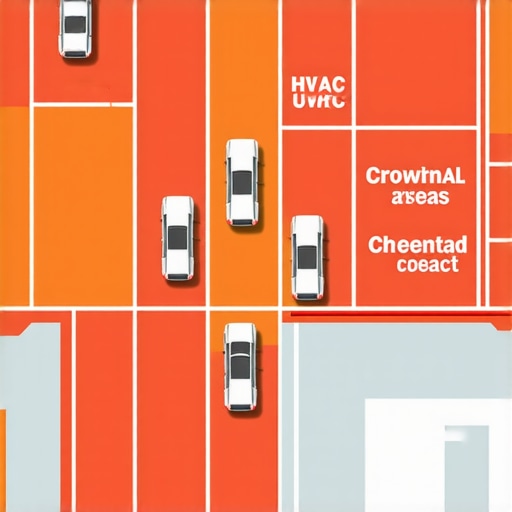
A geogrid shows you exactly where your ranking “drops off.” You might be #1 within a 2-mile radius of your shop, but at 5 miles, you drop to #8. At 10 miles, you are #20. This “ranking heat map” is the only way to visualize your google maps lead generation potential. You should stop checking your own map rankings from the shop and do this instead: use a professional google maps rank tracker.
By using local seo software, you can see exactly where the “border” of your visibility lies. If you see a sharp drop-off in a high-value industrial corridor, you know exactly where to focus your review generation and photo-uploading efforts. This data-driven approach is what separates the market leaders from the companies that are just “getting by.”
Conclusion & Your 4-Step Action Plan
Fixing your commercial HVAC service area coverage is not a “one and done” task. It is a continuous process of proving your relevance and physical presence to an algorithm that is designed to be hyper-local. If your fleet is currently invisible in the areas that matter most to your bottom line, follow this audit action plan:
- Clean Up Your Service Areas: Limit your GBP service areas to the 20 most critical zip codes or cities. Do not exceed a 2-hour drive time from your base.
- Update Your Fleet Signals: Start a protocol where technicians take 2-3 photos per job site of the branded trucks and equipment. Upload these to your GBP weekly.
- Optimize Your City Pages: Ensure every major city you serve has a dedicated, high-quality landing page with LocalBusiness Schema.
- Track with Precision: Stop using standard search results to judge your success. Use a grid-based tracker to see your real-world “ranking radius.”
The goal of local seo for hvac is to ensure that when the next heatwave hits, your fleet is the first one called. Don’t let a “Map Pin Drift” or a poorly configured profile steal your commercial leads. For a deeper dive into the technical requirements of ranking, consult the one checklist that actually ranks your HVAC business on Google maps and consider investing in professional local seo services to reclaim your territory.
Your fleet is ready to work. It’s time to make sure Google knows exactly where they are. By leveraging a comprehensive google maps ranking service, you can turn your “invisible fleet” into a dominant market force.
Author: Faisal Rehman ( AI SEO Expert ) | Founder @ Local Grow 360
Connect on LinkedIn