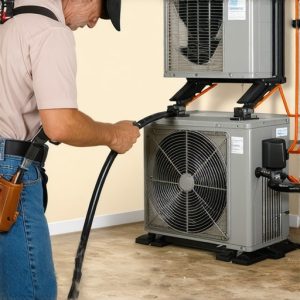

The Whistle of a Dying System
I’ve spent the better part of thirty years dragging my tool bag through fiberglass-filled attics and cramped crawlspaces, and if there is one sound that makes my skin crawl more than a compressor internal bypass opening, it is the high-pitched, harmonic whistle of a furnace gasping for air. It’s a sound most homeowners ignore, or worse, they think it means the system is ‘working hard.’ In reality, that whistle is the sound of your AC installation or furnace crying out for mercy because you decided to put a ‘hospital-grade’ MERV 16 filter into a system designed for a MERV 8. You aren’t cleaning the air; you are strangling the life out of your equipment.
The Mentorship of Static Pressure
My old mentor, a grizzled tin knocker named Gus who could calculate duct CFM in his sleep, used to grab a piece of tissue paper and hold it against a return grill. He’d say, ‘Kid, you can’t cool what you can’t touch, and you can’t heat what won’t move.’ He was talking about airflow. He taught me that the blower motor in your furnace or air handler isn’t a magical infinite-pressure machine. It’s a fan with a specific rating, usually measured in inches of water column. When you shove a high-MERV filter into a standard 1-inch slot, you are essentially putting a plywood board in your return. The motor has to work twice as hard to pull the same volume of air. This increases the Total External Static Pressure (TESP) beyond the manufacturer’s specs, usually rated at 0.5″ w.c. I’ve seen ‘high-performance’ filters that take up 0.4″ on their own before they even get dirty. That leaves 0.1″ for the entire duct system, the evaporator coil, and the heat exchanger. It’s mechanical suicide.
“The most expensive equipment in the world cannot overcome a bad duct system.” – Industry Axiom
The Thermodynamic Zoom: Why Airflow is King
Let’s talk physics, specifically latent vs. sensible heat. In a cooling cycle, your evaporator coil needs a specific volume of air—usually 400 CFM per ton—to transfer heat effectively. When a high-MERV filter restricts that flow, the coil temperature drops below the design dew point. The juice (refrigerant) inside the coil doesn’t boil off completely. This leads to liquid slugging back to the compressor, which is designed to pump vapor, not liquid. You’ll hear that distinct clack-clack-clack before the valves shatter. In heating mode, the restriction is even more dangerous. Without enough air to carry the heat away, the heat exchanger in your furnace repair scenario will overheat. The metal expands and contracts violently until it cracks. Now you aren’t just looking at a high electric bill; you’re looking at a carbon monoxide risk and a $5,000 replacement bill.
The Climate Trap: The Northern Winter & Cracked Iron
In the North, where we rely heavily on heating service during the polar vortex, the high-MERV filter is a silent killer. When the airflow is restricted, the ‘Limit Switch’—the safety device that keeps your house from burning down—starts cycling. It shuts the burners off because the heat exchanger is glowing red hot. The system cools down, the switch resets, and the cycle repeats. This ‘short cycling’ wears out the inducer motor and the gas valve, but more importantly, it stresses the heat exchanger. I’ve seen 80% AFUE furnaces that should have lasted 25 years die in seven because the owner wanted to filter out every speck of dust. If you’re using a mini-split, you might think you’re safe, but those tiny blowers are even more sensitive to static pressure. Block those small plastic filters with pet hair and high-density mesh, and you’ll burn out the DC inverter board faster than a sparky can pull a permit.
The Scam of the ‘Healthier Home’
I despise the ‘Sales Techs’ who push these filters as a health solution without checking the ductwork. I once followed a guy who sold a MERV 13 filter package to a family in a house with a 10-inch return drop. The AC installation was basically sucking air through a straw. The system was freezing up every afternoon, and the previous tech told them they needed a new $12,000 evaporator coil. I walked in, pulled the $30 filter out, and replaced it with a $5 pleated MERV 8. The suction line went ‘beer can cold’ in minutes, the pressures stabilized, and the house dropped five degrees in an hour. The ‘expensive’ filter was the only thing wrong. They didn’t need a new system; they needed someone who understood that the HVAC system is a breathing machine, not a vacuum cleaner.
“Airflow is the lifeblood of the vapor compression cycle; without it, thermodynamics simply ceases to work in your favor.” – Adapted from ASHRAE Standard 62.2
The Solution: If You Want Clean Air, Get a Media Cabinet
If you genuinely need high-level filtration—maybe you have severe allergies or live near a construction site—don’t try to force it through a 1-inch slot. You need a 4-inch or 5-inch media cabinet. By increasing the surface area of the filter, you lower the face velocity and the pressure drop. It’s simple math: more surface area equals less resistance. You get the MERV 11 or 13 filtration without the Pookie-melting heat or the motor-burning static. It requires a heating service professional to modify your return plenum, but it’s the only way to do it right. Otherwise, stick to the cheap filters and change them every 30 days. Your compressor, your blower motor, and your bank account will thank you. Comfort isn’t a magic trick performed by a fancy filter; it’s a result of proper physics, balanced air, and a tech who knows that ‘topped off’ is just another word for ‘I didn’t find the leak.’