The Sound of a $3,000 Mistake: Why Your Wall is Weeping
You’re sitting on your couch, the humidity is thick enough to chew, and you’re basking in the localized glory of your ductless system. Then you hear it. Drip. Drip. Slop. You look up, and your expensive designer paint is bubbling. A dark, ugly Rorschach test of a water stain is spreading behind the indoor head of your mini-split. Most homeowners panic and call for a generic heating service or a furnace repair guy who doesn’t know a thermistor from a toaster. But if you’ve spent thirty years in the trade like I have, you know that water on the wall isn’t a mystery; it’s a failure of physics and often, a failure of AC installation fundamentals.
My old mentor, a guy we called ‘Iron Lung’ Larry, used to shove my head into a dark attic and scream, ‘The level doesn’t lie, kid! If the water isn’t moving, you’re losing!’ He was right. I remember a job back in ’96, a high-end gallery where a mini-split was crying all over a literal masterpiece. The previous tech told them they needed a whole new system—standard ‘Sales Tech’ move. I pulled the cover and found that the unit was exactly 1/8th of an inch off-level. That tiny fraction was enough to overcome the surface tension of the condensate, sending the ‘juice’ (water, in this case) backwards into the blower housing instead of out the drain. Larry’s voice echoed in my head: ‘You can’t cool what you can’t touch, and you can’t drain what you can’t pitch.’
“The most expensive equipment in the world cannot overcome a bad duct system—or in the case of ductless, a disregard for the laws of gravity and condensate management.” – Industry Axiom (derived from ACCA Manual J principles)
Thermodynamic Zooming: The Latent Heat War
To understand the leak, you have to understand the ‘sweat.’ In a humid environment like the South, the mini-split isn’t just dropping the air temperature (sensible heat); it’s wringing water out of the air like a wet rag (latent heat). As the warm, moist air hits the freezing evaporator coil—which is often buried under a layer of dust because nobody changes those tiny filters—it hits the dew point instantly. Water molecules transition from a gas to a liquid on the aluminum fins. This water is supposed to gravitate into a narrow plastic trough called the drain pan. In a humid zone, a 9,000 BTU unit can pull over a gallon of water out of the air in a few hours. If that water hits a roadblock, it has nowhere to go but out the front or back of the unit.
The Forensic Diagnosis: Three Culprits Behind the Waterfall
1. The Biological ‘Gloop’ and the Drain Line: This is the most common reason I see. It’s a cocktail of skin cells, pet dander, and household dust that bypasses the flimsy mesh filters. When this organic matter meets the constant moisture in the drain pan, it creates a bio-film—a thick, snot-like sludge. Eventually, this sludge reaches the 5/8-inch drain outlet and plugs it. Now, the pan overflows. I’ve seen ‘Sales Techs’ try to sell a full AC installation for a clogged drain. All it usually needs is a high-pressure CO2 blow-out and some pan treatment tablets. If you see your tech pull out a vacuum instead of a sales brochure, you’ve found a good one.
2. The ‘Sparky’ and the Condensate Pump: Not every mini-split can gravity-drain. If the unit is on an interior wall with no direct path to the outside, we install a miniature condensate pump. These things are the bane of my existence. They are small, mechanical, and prone to failure. When the ‘Sparky’ (electrician) or the installer doesn’t wire the safety switch into the indoor unit’s communication line, the pump can fail, but the AC keeps running. The unit keeps making water, the pump can’t move it, and suddenly you have a waterfall behind your TV.
“Condensate disposal systems shall be provided for equipment and appliances that produce condensate in order to prevent damage to the structure.” – ASHRAE Standard 62.1 (Modified)
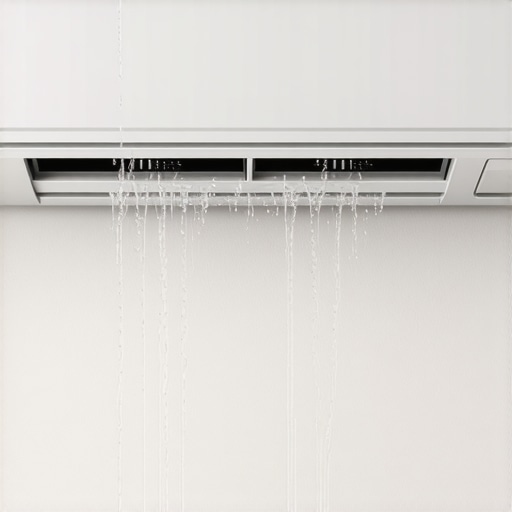
3. The Negative Pressure Trap: This is where it gets technical. If the installer didn’t trap the drain line properly or if the internal blower is running at a high static pressure due to dirty coils, the unit can actually create a vacuum effect. It literally sucks the water back into the cabinet instead of letting it flow out. You’ll see water spitting out of the louvers like a misty morning in Seattle. It’s not a broken unit; it’s a physics problem that a little ‘Pookie’ (mastic) and proper venting would have solved during the initial AC installation.
The Math of Repair vs. Neglect
Ignoring a leaking mini-split is a fast track to mold remediation and structural rot. A standard service call to clear a drain and treat the coil might run you $200-$400. Replacing the drywall, repainting, and potentially remediating black mold behind the unit? You’re looking at $3,000 to $5,000. If your unit is over 12 years old and the evaporator coil is starting to look like a rusted-out tailpipe from a ’74 Chevy, then we talk about replacement. But 9 times out of 10, the leak is a maintenance failure. Don’t let a ‘Sales Tech’ talk you into a new system when your current one just needs a ‘tin knocker’ or a real tech to fix the pitch. Whether it’s a heating service in the winter or a cooling crisis in July, the mechanics of water management remain the same. If the suction line is ‘beer can cold’ but the floor is soaking wet, the refrigeration cycle is working—your plumbing isn’t.