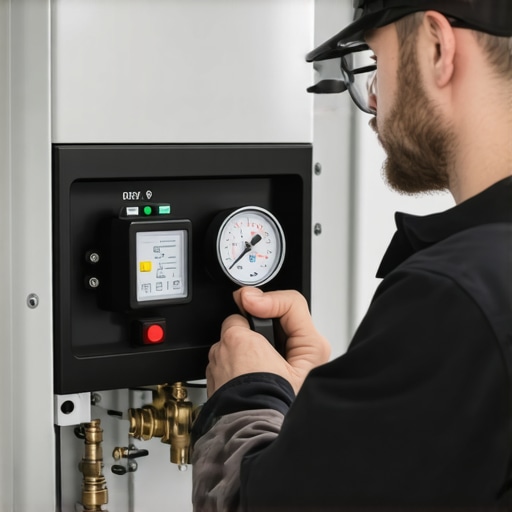
The Sound of a Thumping Furnace: A Forensic Diagnosis
You wake up at 3 AM in the dead of a January freeze. The wind is howling against the eaves, and inside, you hear it—a deep, resonant whoof every time the furnace tries to kick over. It sounds like a muffled explosion in the basement. Most homeowners ignore it until the heat stops entirely, but to an HVAC veteran who’s spent thirty years crawling through spider-infested crawlspaces and baking on black-shingle roofs, that sound is a diagnostic fingerprint. It’s the sound of delayed ignition, and more often than not, it’s the result of a technician who was too lazy to pull a manometer out of his bag.
The Narrative Matrix: The $12,000 ‘Bad Burner’ Scam
Last winter, during a polar vortex that had every heating service company in the city booked three weeks out, I followed a ‘Sales Tech’—one of those guys who gets a commission for every unit he condemns—into a home where a young couple was shivering in parkas. The previous tech had told them their burners were ‘shot’ and the heat exchanger was ‘likely cracked,’ quoting them $12,000 for a rush AC installation and furnace replacement. They were terrified. I walked down to that basement, pulled the service panel, and looked at the flame. It was lazy, orange, and licking the top of the combustion chamber like a tired dog. I didn’t reach for a sales brochure; I reached for my digital manometer. I found the manifold pressure was sitting at a staggering 5.5 inches of water column (WC) on a valve rated for 3.5. The unit was over-firing, choking on its own fuel. I adjusted the regulator, cleaned the orifices, and for a $200 furnace repair, they had a safe, quiet system again. That tech wasn’t just wrong; he was a predator. This is why you need to understand the physics of what’s happening inside that metal box.
“The most expensive equipment in the world cannot overcome a bad duct system or improper gas pressure settings.” – Industry Axiom
Thermodynamic Zooming: The Chemistry of the Flame
When we talk about gas pressure, we aren’t just talking about how much ‘gas’ is flowing. We are talking about the stoichiometric balance of combustion. In a modern 2026 furnace, the tolerances are razor-thin. If the gas pressure is too low, you get ‘under-firing,’ which leads to condensation in the heat exchanger—and since that condensate is acidic, it eats the metal from the inside out. If it’s too high, you get ‘over-firing,’ which creates excessive sensible heat that the blower can’t strip away fast enough. The metal expands and contracts too violently, leading to the dreaded cracked heat exchanger. You can’t see 3.5 inches of water column with your eyes. You can’t ‘feel’ it with your thumb. You need a manometer. We measure the pressure in ‘Inches of Water Column’ because gas pressure in a residential line is incredibly weak—about 1/4 of a pound per square inch. A manometer measures the displacement of fluid (or a digital sensor’s equivalent) to ensure the pressure is exactly what the manufacturer specified on the rating plate.
The 2026 Regulatory Cliff: Why It Matters Now
As we move into 2026, the industry is shifting. New high-efficiency standards mean furnaces are using modulating gas valves that adjust their output based on the outdoor temperature. These aren’t your grandpa’s ‘on-off’ switches. These valves require a ‘Sparky’ (electrician) to ensure the control board is sending the right voltage, but more importantly, they require a ‘Tin Knocker’ (duct guy) to ensure the airflow is sufficient to handle the heat. If you’re considering a mini-split for supplemental heat, you might think you’re escaping the gas pressure headache, but even those systems rely on precise refrigerant ‘gas’ pressures. In the world of forced air, however, the gas valve is the heart of the beast. Modern A2L refrigerants and high-efficiency gas standards mean that ‘eyeballing it’ is a recipe for a house fire or carbon monoxide poisoning.
“Proper manifold gas pressure is foundational to the safe operation of any atmospheric or power-vented appliance.” – NFPA 54 National Fuel Gas Code
The Forensic Anatomy of the Gas Valve
A gas valve is a mechanical marvel. It’s a regulator, a safety shut-off, and a flow controller all in one. When the thermostat calls for heat, the ‘Juice’ (electricity) hits the solenoid, opening the valve. But the pressure coming from the street (the ‘Inlet Pressure’) is often inconsistent. It might be 7 inches WC one day and 9 the next. The valve’s job is to take that ‘Inlet’ and drop it to a steady ‘Manifold’ pressure. Without a manometer test during your annual heating service, you have no idea if your valve’s internal regulator has failed. I’ve seen ‘Pookie’ (mastic) dripped into gas lines by careless installers that partially blocked an orifice, causing a pressure drop that made the furnace vibrate like a freight train. A manometer identifies these restrictions instantly. It turns guesswork into physics.
The Airflow Manifesto: Why Static Pressure is King
You can have the most perfectly tuned gas pressure in the state, but if your ductwork is undersized, that furnace will still die a premature death. This is the ‘Airflow Manifesto.’ If the heat exchanger can’t get rid of the heat it’s producing, the internal limit switch will trip. This is called ‘short cycling.’ I’ve walked into homes where the owner complained the furnace was ‘broken,’ only to find they had installed one of those 1-inch thick high-MERV filters that’s basically a brick. It choked the airflow, the heat exchanger overheated, and the system shut down to prevent a fire. When I perform a furnace repair, I’m looking at the Total External Static Pressure (TESP). I’m checking if the return air drop is big enough to feed the beast. Combustion is a two-way street: you need the right amount of fuel (gas pressure) and the right amount of cooling (airflow) to keep the metal happy.
The Verdict: Precision vs. ‘Topping it Off’
If a technician walks up to your furnace without a tool bag and says, ‘It looks like you need a new one,’ show them the door. If they don’t know the difference between ‘sensible heat’ and ‘latent heat,’ they shouldn’t be touching your gas line. A real professional—a veteran who knows the acidic smell of a failing flue pipe and the specific screech of a dry inducer motor bearing—will always start with a manometer. Whether you are looking at a full AC installation or just a seasonal tune-up, demand the numbers. Ask them: ‘What is my manifold pressure in inches of water column?’ If they look at you like you’re speaking Greek, find a real tech. Because in 2026, with energy costs rising and equipment becoming more complex, physics is the only thing that will keep you warm without breaking the bank. Comfort isn’t a feeling; it’s a measurement.