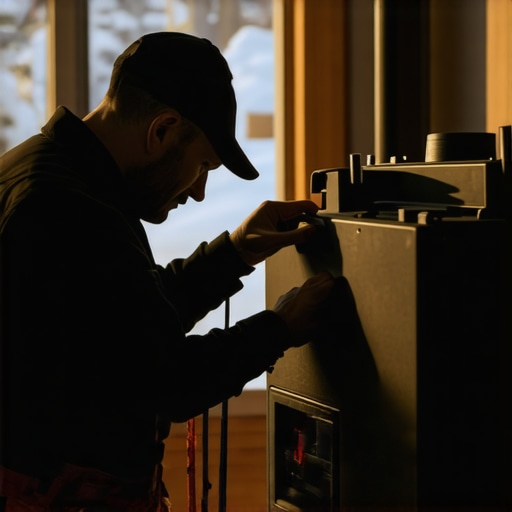
The Sound of a Dying Flame in the Dead of Winter
Listen, if you are waiting for a ‘Sales Tech’ in a shiny, branded van to tell you the truth during a sub-zero freeze, you have already lost. Those guys are trained to look at your furnace, see a 10-year-old sticker, and quote you fifteen grand for a new system before they even pull the service panel. I have spent three decades in the trenches—melting in summer attics and losing feeling in my fingers on winter rooftops—and I can tell you that 90% of the time, your furnace isn’t dead; it’s just being strangled by physics or neglected by some ‘Sparky’ who didn’t know his way around a multimeter.
“Proper sizing and airflow are not suggestions; they are the fundamental laws of thermodynamics that govern equipment longevity.” — ACCA Manual J Standards
My old mentor, a grizzled tin knocker named ‘Iron Lung’ Pete, used to scream at me in drafty Minneapolis basements: ‘You can’t heat what you can’t touch!’ He was talking about airflow. If the air isn’t moving across that heat exchanger at the right velocity, the whole system becomes a paperweight. This is the core of Thermodynamic Zooming: we aren’t just ‘burning gas.’ We are initiating a chemical reaction where methane and oxygen create thermal energy, which must be efficiently transferred through a steel boundary to the air stream. If that transfer fails, the metal fatigues, the high-limit switch trips, and you’re left shivering while some kid tries to sell you a financing plan.
The Forensic Diagnosis: Why the 2026 Freeze is Different
The 2026 winter freeze isn’t your standard cold snap. We are seeing record-low temperatures that push AFUE (Annual Fuel Utilization Efficiency) ratings to their breaking point. In high-efficiency 90% plus furnaces, the secondary heat exchanger is where the real magic—and the real nightmares—happen. This is where we extract the latent heat of vaporization by condensing water vapor out of the flue gases. In extreme cold, that condensate becomes the enemy. It freezes in the drain lines, backs up into the inducer housing, and shuts your world down. Here are three specific tricks to keep the ‘Juice’ flowing and the ‘Gas’ burning when the mercury hits the floor.
Trick 1: The Inducer Port Reaming (The Pressure Switch Fix)
When your furnace starts up, you hear that small motor (the draft inducer) whirring. Its job is to pull the combustion gases through the heat exchanger and vent them outside. But there is a tiny, often overlooked diaphragm called a pressure switch that has to ‘prove’ that airflow exists before the gas valve will ever think about opening. I have followed ‘Sales Techs’ who quoted a full furnace replacement because ‘the board is bad,’ when in reality, the tiny nipple on the inducer motor was just clogged with a bit of crusty oxidation. Take a paperclip or a small drill bit and manually clear that port. If the switch can’t ‘sense’ the vacuum, the system stays dead. It’s a five-minute fix that saves you five thousand dollars. This is why a real tech carries a manometer, not a sales brochure.
Trick 2: The Flame Sensor Scouring (The ‘Short Cycling’ Killer)
Does your furnace light for five seconds and then quit? That is the flame sensor talking. In the world of HVAC physics, we use flame rectification. The furnace sends a small AC current to the sensor, and the flame itself acts as a diode, converting it to a DC microamp signal back to the board. Over time, silica from the gas builds up a microscopic glass-like coating on that rod. The board can’t ‘see’ the flame, so it cuts the gas for safety. Don’t buy a new one. Pull the sensor and scrub it with a dollar bill or a piece of light steel wool. You’re restoring the electrical path so the ‘brain’ knows it’s safe to keep the fire going. It’s a sensory thing—you can almost smell the ozone when a board is hunting for that signal.
“A furnace is not a heater; it is a complex heat exchanger that requires precise static pressure to prevent premature component failure.” — ASHRAE Standard 103
Trick 3: The Condensate Trap Bypass (For the Polar Vortex)
In a 90% plus furnace, you are basically running a high-tech plumbing system. If your furnace is in an unconditioned space like a crawlspace or a vented attic, that condensate water will freeze in the trap. When the water can’t exit, it backs up into the secondary heat exchanger. You’ll hear a gurgling sound—that’s the sound of your furnace drowning. The trick for 2026? Ensure your condensate lines are wrapped in heat tape and pitched perfectly. If you are in a pinch during a freeze, you can sometimes carefully drain the inducer housing into a bucket just to get the system to fire for a cycle, but you better be calling a pro who knows how to use ‘Pookie’ (mastic) and proper insulation to prevent a re-freeze. Heating service isn’t about parts; it’s about managing the phase changes of water in sub-zero temps.
The Trap: Repair vs. Replace in the Era of R-454B
We are standing at a regulatory cliff. By 2025/2026, the industry is moving away from R-410A refrigerant to A2L refrigerants like R-454B. This makes AC installation more complex and expensive due to ‘mildly flammable’ labels and new sensor requirements. If your furnace is part of a package system, the ‘Sales Tech’ will use this transition to scare you into a full system swap. Don’t bite unless your heat exchanger is actually cracked. A cracked heat exchanger is a death sentence—carbon monoxide doesn’t care about your budget—but a bad capacitor, a dirty flame sensor, or a clogged drain are just flesh wounds. A real HVAC veteran looks for the ‘Beer can cold’ suction line in the summer and the ‘Microamp truth’ in the winter. We deal in physics, not commissions. Don’t let a lack of airflow turn your home into a cold swamp this winter. Check your filters, clear your vents, and remember: if the air can’t move, the heat can’t stay.