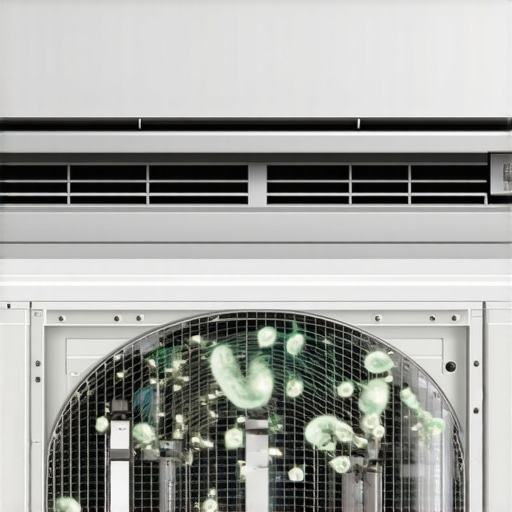
The Silent Slime: Why 2026 Efficiency Standards Changed the Maintenance Game
If you think your 2026-compliant mini-split is the same as the clunky box hanging on your neighbor’s wall from ten years ago, you’re dead wrong. We are currently navigating the most significant shift in HVAC history since the phase-out of R-22. With the transition to A2L refrigerants like R-454B and the obsession with SEER2 ratings, these machines have become high-performance Ferraris. And just like a Ferrari, if you put cheap gas in it—or in this case, ignore the bio-organic buildup on your evaporator—you’re looking at a $4,000 boat anchor. My old mentor, a guy who could smell a leak from the driveway, used to scream at me, ‘You can’t cool what you can’t touch!’ He was talking about the thermal exchange. If a layer of microbial slime is insulating your coil, the physics of heat transfer simply stop working. This isn’t just about ‘clean air’; it’s about the fundamental thermodynamics of your mini-split.
“The most expensive equipment in the world cannot overcome a bad duct system—or a fouled heat exchanger.” – Industry Axiom
The Physics of the ‘Snotty’ Coil
In a humid climate, your mini-split is essentially a massive dehumidifier. As the indoor blower pulls warm, moisture-laden air across the evaporator coil, the refrigerant inside—which we in the trade call the ‘juice’—absorbs that heat. This causes the moisture to hit its dew point and condense into liquid water. In the older days, coils were spaced wide enough that the water just rolled off into the pan. But to hit the 2026 efficiency mandates, manufacturers have crammed more fins per inch (FPI) into the same footprint. This creates a microscopic jungle where dust, skin cells, and moisture mix to create a microbial biofilm. It looks like gray snot, and it’s the number one killer of AC installation efficiency. When this ‘snot’ bridges the gap between those tight fins, static pressure skyrockets. Your fan motor works harder, the ‘beer can cold’ suction line starts to sweat excessively, and eventually, the system chokes to death.
The A2L Transition: Why Cleaner Choice Matters Now
We are now dealing with R-454B and R-32. These are ‘mildly flammable’ refrigerants. While they are safe when handled by a pro, they operate at different thermal profiles than the old R-410A. A fouled coil on an A2L system doesn’t just mean a higher power bill; it can lead to erratic pressure spikes that trip the new, highly sensitive leak detection sensors built into 2026 models. If those sensors detect a ‘leak’ because your coil is so clogged that the pressure is fluctuating wildly, it will shut your heating service or cooling down entirely. You’ll be calling a sparky or a tech just to find out your unit is fine, it’s just filthy. This is why a specific microbial cleaner—one that is non-corrosive to the thinner aluminum alloys used in modern microchannel coils—is mandatory. If you use a generic, high-acid foam from a big-box store, you will eat through the coil walls, causing a microscopic leak that is impossible to furnace repair or patch.
“Maintenance of HVAC systems is essential for the preservation of indoor air quality and the longevity of the equipment.” – ASHRAE Standard 62.1
The Static Pressure Nightmare
Airflow is the lifeblood of your home’s comfort. When I walk into a house where the customer complains that one room is a ‘cold swamp,’ I don’t look at the thermostat. I look at the blower wheel. On a mini-split, that cylindrical fan gets weighed down by the same microbial growth that hits the coil. Even a 1/16th of an inch of buildup on those blades changes the aerodynamics, reducing CFM (Cubic Feet per Minute) by up to 30%. You might think you’re saving money by skipping the specialized microbial treatment, but you’re actually paying the utility company a 30% ‘ignorance tax’ every month. Modern systems use ECM motors that try to compensate for this resistance, but they eventually burn out. Replacing an ECM motor in a 2026 head unit is a nightmare that involves disassembling the entire plastic chassis. Avoid it. Treat the coil, keep the airflow laminar, and let the physics do the work.
Pro-Tip: The ‘Pookie’ and the Pan
When we do a fresh AC installation, we ensure the line set penetrations are sealed with ‘pookie’ (mastic) to prevent unconditioned air from entering the back of the unit. But even with a perfect seal, the condensate pan is a breeding ground. A specialized microbial cleaner doesn’t just rinse the coil; it leaves a residual barrier in the pan that prevents the ‘death clog’—that gelatinous mass that plugs your drain line and sends water pouring down your wallpaper. Don’t be the homeowner who spends $15,000 on a heating service upgrade only to have it ruined by a $5 microbial colony. Get the right cleaner, keep the fins clear, and respect the thermodynamics.