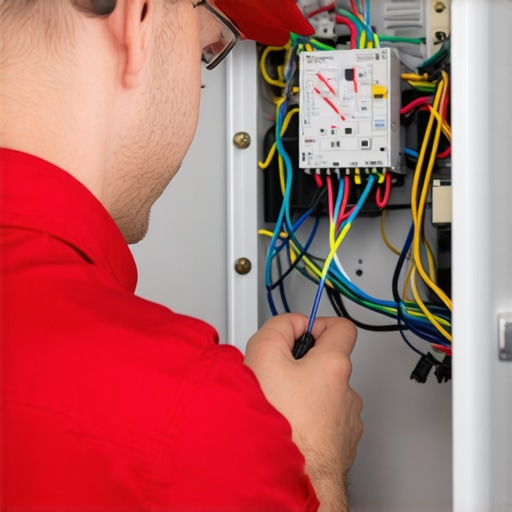
The Invisible Constraint: Physics Doesn’t Care About Your Budget
I’ve spent thirty years dragging my tool bag through fiberglass-filled attics and across blistering asphalt rooftops, and if there is one thing I’ve learned, it’s that the ‘in-and-out’ sales techs are going to be the death of this industry. We are staring down the barrel of the 2026 regulatory cliff, where R-410A is a memory and A2L refrigerants like R-454B are the new law of the land. But everyone is so worried about the ‘juice’—the refrigerant—that they are completely ignoring the copper veins that feed the heart of the system. If you think you can just slap a high-efficiency 2026 AC installation onto the same thin wiring that fed your old 10-SEER clunker, you aren’t just mistaken; you’re a fire hazard waiting to happen.
The Physics Lesson: Why Airflow and Amps are Blood Brothers
My old mentor, a grizzly veteran who could diagnose a TXV failure just by touching the liquid line, used to scream at me, ‘You can’t move heat you can’t touch, and you can’t touch heat without the right speed!’ He wasn’t just talking about the tin knockers and their ductwork. He was talking about the synergy between the blower motor and the compressor.
“The most expensive equipment in the world cannot overcome a bad duct system, nor can it survive a starved electrical circuit.” – Industry Axiom
This is the ‘Airflow Manifesto’ in its purest form. When we talk about furnace repair or a new heating service, we are talking about a delicate dance of thermodynamics. In the North, where we deal with the ‘Polar Vortex’ every few years, your system is under immense stress. A 2026 heat pump or AC unit isn’t the simple ‘on-off’ machine of the 1990s. These are complex, inverter-driven beasts that require stable, clean voltage. If your wire gauge is too small (too high of a gauge number), you get voltage drop. Voltage drop creates heat at the motor windings. Heat kills insulation. And when that insulation dies, your expensive new compressor becomes a very heavy paperweight.
The Regulatory Cliff: The A2L Transition and Electrical Interference
As we transition to mildly flammable refrigerants (A2L), the engineering has changed. New units are packed with sensors—leak detectors, pressure transducers, and variable-frequency drives (VFDs). These components are incredibly sensitive to electrical ‘noise’ and voltage fluctuations. If your ‘Sparky’ (electrician) or a lazy AC installation tech tries to reuse a 14-gauge wire where a 10-gauge is required for the Minimum Circuit Ampacity (MCA), you are begging for a logic board failure.
“Branch-circuit conductors supplying a single motor-compressor shall have an ampacity not less than 125 percent of either the motor-compressor rated-load current.” – NEC Article 440.32
This isn’t just a suggestion; it’s the code that keeps your house from burning down. When the mercury drops and your heating service involves a mini-split or a heat pump in a cold climate, that unit is working at its absolute limit. If the wire is undersized, the resistance increases, the voltage at the unit drops, and the compressor has to draw even more current to compensate. It’s a death spiral of sensible heat gain where you don’t want it—inside your electrical box.
The Thermodynamic Zoom: Latent Heat and the 2026 Standard
In our climate, we aren’t just fighting the temperature; we are fighting the dew point. A proper AC installation in 2026 must account for latent heat—the energy required to turn water vapor into liquid. This happens at the evaporator coil. If your furnace repair tech didn’t check your static pressure, your new high-tech blower might be ramped up to max RPM just to push air through a choked duct system. This increases the amp draw. If your wire gauge is already on the edge, this extra load causes the ‘Suction Line’ to lose its ‘beer can cold’ sweat, the coil temperature rises, and suddenly your house feels like a cold swamp because the system isn’t running long enough to dehumidify—it’s just short-cycling and cooking the capacitor.
Mini-Split Nuances and the Communication Cable Trap
Don’t even get me started on mini-split systems. I’ve seen so many ‘Sales Techs’ tell homeowners they are ‘plug and play.’ They aren’t. Most of these units require a specific 14/4 stranded, shielded wire for communication between the outdoor unit and the indoor head. I’ve walked onto jobs where some ‘Sparky’ used leftover Romex, and the homeowner wonders why their unit is throwing an E6 error code and won’t kick on. The electrical interference from the power lines disrupts the data signal. It’s not magic; it’s physics. You need the right copper to ensure the brain can talk to the muscles.
The Forensic Diagnosis: When to Pull the Plug
If you are looking at a $1,200 furnace repair on a unit that’s 15 years old, you need to look at the ‘Mechanical Anatomy’ of your whole home. Is the heat exchanger pitted? Is the inducer motor screeching like a banshee? If you decide to upgrade to a 2026-compliant system, do not let the contractor skip the electrical inspection. If they don’t open the breaker panel, they aren’t doing an installation; they are doing a ‘slam-and-go.’ Make sure they calculate the voltage drop, especially if the condenser is a long run from the panel. Using ‘Pookie’ to seal the ducts is great for airflow, but no amount of mastic will save a compressor being fed through a ‘straw’ of thin wire. Insist on a new whip, a new disconnect, and a verified wire gauge that matches the MOCP (Maximum Overcurrent Protection) on the new unit’s nameplate.