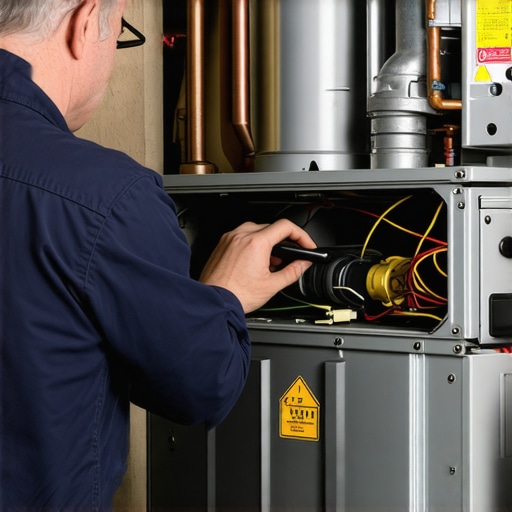
The silence of a dead furnace at 3 AM in the dead of January has a specific weight to it. It’s not just the absence of sound; it’s the heavy realization that the thermal mass of your home is currently losing its battle against the second law of thermodynamics. I’ve spent thirty years crawling through crawlspaces and balancing on joists, and I’ve seen the industry change from simple cast-iron burners to the complex, computerized air-movers we see in 2026. Most of what people call a ‘bad unit’ is actually a failure of physics or a victim of a ‘Sales Tech’ who’s more interested in a commission check than a combustion analysis.
The Anatomy of a Scam: Why Your Heat Really Failed
I followed one of these ‘Comfort Consultants’ last week. He’d told a young couple their eight-year-old high-efficiency furnace was a ‘ticking time bomb’ because of a cracked heat exchanger. He quoted them twelve thousand dollars for a full replacement. When I got there, I didn’t see a crack. I saw a clogged condensate trap and a pressure switch tube that had a tiny bit of spider silk blocking the vacuum. A twenty-minute fix. This is why you need to understand the machine, not just the marketing. The furnace repair industry is full of guys who can’t tell a capacitor from a contactor, and they’ll try to sell you a new furnace when yours just needs a little TLC and some proper airflow.
“The most expensive equipment in the world cannot overcome a bad duct system.” – Industry Axiom
Thermodynamic Zooming: The Physics of Your Warmth
In a cold climate, your furnace isn’t just ‘making heat.’ It’s a chemical processing plant. We are taking natural gas or propane, mixing it with oxygen in a stoichiometric ratio, and igniting it to produce sensible heat. That heat is transferred across the heat exchanger—a thin wall of aluminized steel or stainless steel—to the air your blower is pushing through. If that blower can’t move the air because your ‘Tin Knocker’ didn’t size the return air drops correctly, the heat exchanger will overheat, expand, and eventually fail. This is the ‘Static Pressure’ monster that kills 90% of systems. When the static pressure is too high, the motor works harder, the ‘Gas’ (refrigerant) in hybrid systems doesn’t phase change correctly, and your heat exchanger cooks itself to death.
1. Harmonic Resonance in the Inducer Motor
In 2026, we’re seeing more variable-speed inducer motors. A rare sign of impending failure isn’t just a loud screech; it’s a specific harmonic resonance—a low-frequency hum that vibrates the ductwork. This happens when the bearings start to lose their lubrication, changing the torque requirements of the motor. If you hear a ‘thrumming’ sound that seems to vibrate your floorboards before the main blower even starts, your inducer is on its way out. This motor is responsible for pulling the combustion gases through the heat exchanger and venting them outside. If it fails, the pressure switch won’t close, and you’ll be left in the cold.
2. The ‘Ghost’ Limit Switch Trip
This is a subtle one. You might notice your furnace runs for five minutes, shuts off the burners, but keeps the fan running, then starts again. It’s ‘short cycling,’ but not in the way most people think. Often, this is caused by a limit switch that has become ‘soft.’ It’s tripping at a lower temperature than it’s rated for. Why? Because years of low airflow have caused the switch to cycle too often, weakening the bimetal strip inside. It’s a rare sign because the house still gets warm, but your utility bill is skyrocketing, and you’re putting unnecessary wear on the igniter and gas valve.
“Proper sizing and design of the distribution system are essential for the equipment to deliver its rated capacity and efficiency.” – ACCA Manual J
3. Capacitor Drift in High-Efficiency Blowers
While many 2026 models use ECM (Electronically Commutated Motors), many standard units still rely on PSC motors with run capacitors. A ‘rare’ sign of failure is the ‘lazy start.’ The blower starts, but it takes thirty seconds to reach full speed. This is ‘Capacitor Drift.’ The capacitor is losing its microfarad rating, and the motor is pulling high amps to compensate. If you don’t catch this, the heat inside the motor windings will melt the insulation, and you’ll be calling a ‘Sparky’ to fix a short or, worse, replacing the entire blower assembly. This often happens because ‘Pookie’ (mastic) was never applied to the plenum, causing the motor to work in a high-heat, high-resistance environment.
4. The Scent of ‘Sweet’ Oxidation
Most people know the smell of a gas leak (mercaptan), but few recognize the sweet, almost metallic scent of a failing secondary heat exchanger in a 90%+ AFUE furnace. These secondary coils are made of stainless steel to handle the acidic condensate. When they begin to fail, the ‘juice’ (condensate) can leak and hit the hot primary heat exchanger, creating a distinct, cloying odor. This isn’t just a repair issue; it’s a safety issue. If that secondary is plugged, you’re looking at incomplete combustion and potential carbon monoxide issues.
Repair or Replace: The 2026 Math
If you’re looking at a five-hundred-dollar repair on a twelve-year-old unit, you have to weigh that against the new 2026 efficiency standards. We’re moving toward hybrid systems—mini-split heat pumps paired with gas furnaces. This ‘dual fuel’ setup is the gold standard for cold climates. It uses the heat pump’s efficiency down to about 30°F, then kicks over to the furnace when the ‘Polar Vortex’ hits. If your heat exchanger is toast, don’t just swap in another basic furnace. Look at the total system static pressure. If your ductwork is undersized, even the most expensive furnace will die in seven years. Balance the air, seal the leaks with ‘Pookie,’ and ensure your ‘Suction Line’ is insulated. That’s how you get twenty years out of a system instead of ten.