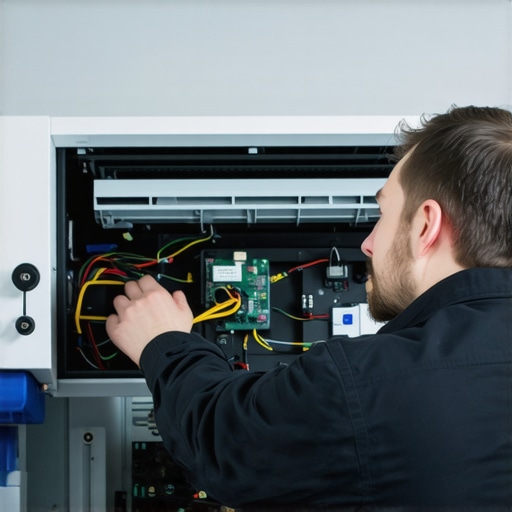
The Anatomy of a Hiss: Why Your 2026 Mini-Split is Screaming for Help
You’re sitting in your living room, the desert sun is beating down on your roof at a relentless 114°F, and you hear it. A faint, rhythmic hiss-hiss-hiss coming from the indoor head of your ductless system. Most folks ignore it. They think it’s just the plastic housing expanding. But I’ve spent thirty years crawling through blown-in insulation and dragging my gauges across scorching rooftops, and I’m telling you: that sound is the ghost of your bank account leaving the building. In the HVAC trade, we call that the ‘refrigerant swan song.’ If you’re hearing that in one of the new 2026 models, you aren’t just losing cooling; you’re dealing with a high-pressure A2L system that demands surgical precision, not a ‘Sales Tech’ with a shiny truck and a clipboard.
The Narrative Matrix: The $15,000 ‘Small’ Leak
I remember following one of those ‘Comfort Consultants’—which is just a fancy name for a salesman who can’t tell a capacitor from a contactor—out to a house in Henderson last summer. He’d quoted this retired schoolteacher $15,000 for a full AC installation because her three-year-old mini-split was ‘shot.’ He told her the compressor had ‘internal bypass failure’ and the ‘juice’ was contaminated. I walked in, heard that exact same hissing sound, and pulled out my electronic leak detector. It wasn’t the compressor. It was a $0.50 flare nut that hadn’t been torqued to spec by the original installer. A 20-minute repair and a proper vacuum pull saved her fifteen grand. That’s the difference between a tech who knows the physics and a ‘Sparky’ or a salesman looking for a commission. Don’t be the person who buys a new furnace repair or a whole system when a flare nut is the culprit.
Thermodynamic Zooming: Sensible Heat vs. The Expansion Valve
To understand the hiss, you have to understand how these 2026 mini-splits actually move heat. We aren’t ‘creating cold’; we are removing sensible heat. In a dry climate like the Southwest, our goal is to move massive amounts of BTUs from the indoor air into the liquid refrigerant. The hissing you hear is often the Electronic Expansion Valve (EEV) struggling. As the liquid refrigerant hits that EEV, it flashes into a vapor-liquid mix. If the system is low on ‘gas’—refrigerant—the pressure drop across that valve becomes erratic. Instead of a steady flow, you get a turbulent, gaseous scream. This is physics, not magic. If your system is low on gas, the evaporator coil won’t drop below the dew point, and in the rare moments of a monsoon, your house will turn into a humid, miserable swamp because the unit can’t pull out the latent heat.
“The most expensive equipment in the world cannot overcome a bad duct system—or a poorly executed refrigerant circuit.” – Industry Axiom
The 2026 Regulatory Cliff: R-454B and the A2L Transition
If you bought a system recently, you’re likely running on R-454B or R-32. These are ‘mildly flammable’ A2L refrigerants. The industry shifted away from R-410A because of GWP (Global Warming Potential) regulations. These new systems operate at higher pressures and require specialized sensors. That hissing sound could actually be the sound of the refrigerant escaping through a micro-leak in the evaporator coil. Unlike the old days where we’d just ‘top it off’ (which is illegal under EPA Section 608, by the way), these new blends can fractionate. If you have a leak, the different components of the refrigerant leak at different rates, meaning you can’t just add more. You have to recover the remaining gas, fix the leak, and weigh in a fresh charge. It’s technical, it’s expensive, and it’s the only way to do it right.
“No person maintaining, servicing, repairing, or disposing of appliances may knowingly vent or otherwise release into the environment any class I or class II substance used as a refrigerant.” – EPA Section 608 Regulation
The Forensic Diagnosis: Tracking the Leak
When I show up for a heating service or a cooling call and hear that hiss, I start at the flares. Mini-splits are notorious for leak points at the mechanical connections. If the ‘Tin Knocker’ who ran the line set didn’t use a torque wrench, that copper is going to expand and contract until it fails. I look for the ‘oil slick.’ Refrigerant carries oil to lubricate the compressor. Where there is a hiss, there is usually a faint coating of oil that acts like a dust magnet. If I see a black, grimy buildup on your indoor unit’s service valves, I don’t need a sensor to tell me you’ve got a problem. I’m looking at the lifeblood of your system leaking out. This is why proper AC installation is more important than the brand of the box. A Trane, a Mitsubishi, or a Carrier is only as good as the vacuum the tech pulled during the install. If they didn’t hit 500 microns, there’s moisture in there, and that moisture is turning into acid right now, eating your compressor from the inside out.
The Math: Repair ($500) vs. Replace ($12,000)
Should you pull the plug when you hear the hiss? If the system is under 10 years old and the leak is at a flare, fix it. If the leak is in the middle of the evaporator coil (the ‘guts’ of the indoor unit), and the system is out of warranty, you’re looking at a $2,000+ repair. At that point, you’re halfway to a new unit. But beware the ‘Sales Tech’ who tries to sell you a whole new furnace repair and AC combo just because of a minor leak. Demand a nitrogen pressure test. If they can’t show you where the leak is with bubbles or an electronic sniffer, they’re guessing with your money. Real HVAC work is about static pressure, sub-cooling, and superheat—not sales pitches and financing plans.
Conclusion: Airflow is King
At the end of the day, your mini-split is a breathing machine. That hissing is a sign of respiratory distress. Whether it’s a clogged filter causing the EEV to hunt or a physical hole in the line, ignoring it will eventually kill the compressor. And trust me, you don’t want to smell a compressor burnout. It’s an acidic, pungent stench that lingers in your nostrils for days. Keep your coils washed, keep your filters clean, and for the love of all things holy, if you hear a hiss, call a technician who carries a manifold, not a sales brochure. Comfort is a result of applied physics, and physics doesn’t take shortcuts.
This post hits home for me; I recently heard a faint hiss from my mini-split, which initially seemed minor. Reading your detailed breakdown of the refrigerant system and the importance of proper installation really made me think. I’ve always wondered, though, how often do these micro-leaks occur in systems that were installed correctly? It seems that even with professional help, the high pressure and new refrigerant blends increase the likelihood of tiny leaks over time. I’ve dealt with a technician who used a soap bubble test, and it turned out to be a slow leak at a flare connection. Maintaining these systems seems complex but critical—especially with newer refrigerants that fractionate and require precise handling. Has anyone experienced a slow but persistent hiss that got worse over months? What was your experience, and how did you decide whether to repair or replace? I’d love to hear more insights on how to best monitor early signs of refrigerant issues without expensive diagnostics.