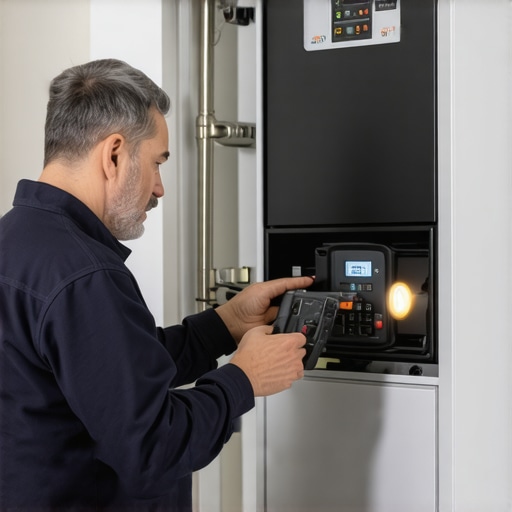
The 3:00 AM Metallic Symphony: Why Your Furnace is Screaming for Help
It is January 2026, the temperature outside is hovering near zero, and your furnace just decided to join a heavy metal band. That rhythmic, rhythmic clack-clack-clack echoing through your floor vents isn’t just annoying—it is the sound of mechanical stress looking for an expensive way out. As a tech who has spent three decades dragging my manifold gauges through cramped crawlspaces and over-heated attics, I can tell you one thing: a rattle is never ‘just a noise.’ It is a diagnostic roadmap. In this industry, we see too many ‘Sales Techs’—those guys who look like they stepped out of a cologne commercial—who will hear that rattle and immediately try to sell you a $12,000 AC installation or a whole-house mini-split system. But before you sign away your kid’s college fund, we need to look at the physics of the machine.
The Mentor’s Lesson: Airflow is the Alpha and Omega
My old mentor, a grizzled tin knocker named Sarge, used to scream at me until his face was the color of a cherry-red heat exchanger. He used to say, ‘You can’t heat what you can’t touch! If the air doesn’t move, the heat stays in the metal, and the metal dies!’ This is the fundamental law of heating service. Most people think a furnace is just a box that makes fire. It isn’t. It is a thermodynamic exchange engine. If your furnace is rattling, it is often because the balance between the blower’s centrifugal force and the static pressure of your ductwork has been compromised. Sarge taught me to listen to the frequency of the rattle. A high-pitched screech? That is a dry bearing in the inducer. A low-frequency thud? That is an imbalanced blower wheel that’s collected enough dust to act as a weighted blanket.
“The blower shall be capable of delivering the required airflow at the design external static pressure specified in the manufacturer’s instructions.” – ACCA Manual S
Fix 1: The Inducer Assembly—The ‘Jet Engine’ of Your Furnace
The first place I look when a client calls for furnace repair because of a rattle is the inducer motor. This is the small motor that clears the combustion chamber of residual gases before the burners ignite. In 2026, these motors are more efficient than ever, but they are also more sensitive. If you hear a rattle the moment the heat cycle starts—but before the big blower kicks in—it is the inducer. Often, it is just loose mounting screws. The constant thermal expansion and contraction of the furnace cabinet can back those screws out over time. Grab a nut driver and tighten the housing. However, if the rattle sounds like a handful of pebbles in a blender, you might have a cracked plastic impeller inside the motor. This happens when the furnace hasn’t been leveled properly, causing acidic condensate to pool in the housing and eat away at the components. Thermodynamic Zooming: When that motor fails, your pressure switch won’t close, and your furnace becomes a very expensive paperweight to prevent carbon monoxide rollout.
[IMAGE_PLACEHOLDER]
Fix 2: Blower Wheel Imbalance and the ‘Heavy Dust’ Theory
If the rattle starts a minute or two after the flames ignite, you are looking at the main blower. This is the heart of your system. In many botched AC installation jobs, the installer doesn’t calibrate the blower speed to the ductwork’s static pressure. Over time, dust bypasses a cheap filter and sticks to the ‘cup’ of the blower blades. Just a few grams of debris can throw the wheel out of balance, causing it to wobble on its shaft. This wobble vibrates the entire cabinet. Before calling for a professional heating service, turn off the power, pull the blower panel, and check the wheel. If it looks like it’s covered in gray felt, that’s your culprit. Cleaning it is tedious, but it saves the motor’s bearings. A rattling blower wheel is basically a hammer hitting your motor’s internal components 1,200 times a minute. Eventually, the ‘Sparky’ will have to come out and replace the whole motor because you ignored a ten-cent vibration.
“All fuel-burning appliances shall be inspected annually for proper venting, combustion air, and physical integrity of the heat exchanger.” – NFPA 54 / ANSI Z223.1
Fix 3: Ductwork ‘Oil Canning’ and Static Pressure
Sometimes the rattle isn’t in the furnace at all—it’s in the ‘tin.’ When the furnace kicks on, the sudden change in pressure can cause the metal ductwork to pop or rattle. We call this ‘oil canning.’ It’s a sign that your ductwork is undersized for the 2026 high-efficiency blower you’ve got under the hood. If the return air drop is too small, the blower tries to pull air that isn’t there, creating a vacuum that pulls the metal inward. When the blower stops, the metal ‘pops’ back out. The fix? You need more ‘Pookie’ (mastic) and perhaps some transverse bracing. I’ve seen mini-split installs where the homeowner kept the old furnace for backup, and the mismatched airflow nearly rattled the house off its foundation. Don’t let a tin knocker tell you that tape fixes everything; you need structural rigidity to handle the sensible heat loads of a modern home.
The Math of 2026: Repair vs. Replace
Is a $400 furnace repair worth it on a 15-year-old unit? If the heat exchanger is intact, yes. But if that rattle is accompanied by a sour, acidic smell, your heat exchanger is likely cracked. At that point, you aren’t just looking at a noise; you are looking at a life-safety issue. 2026 regulations have made high-efficiency units the standard, and while the upfront ‘juice’ (refrigerant) and equipment costs are higher, the long-term AFUE savings are real. If your system is rattling because the cabinet is rusting out from 20 years of neglect, it might be time to look at a mini-split or a high-stage variable furnace. Just remember: the most expensive unit in the world will run like garbage if it is hooked up to a bad duct system. Airflow is king, and it always will be.