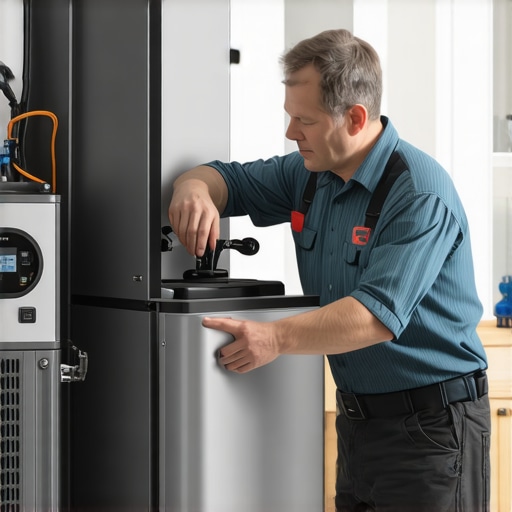
The Sound of a Dying Winter: A Forensic Diagnosis
It is 3:00 AM in the dead of January, and the silence is deafening. In the HVAC world, silence is the sound of a failure. You wake up not because of a noise, but because the absence of the rhythmic thrum of your blower motor has allowed the creeping chill of a northern winter to seep through your floorboards. This isn’t just a minor inconvenience; it is a thermodynamic emergency. As a technician who has spent three decades crawling through frozen crawlspaces and sniffing out cracked heat exchangers, I can tell you that most ‘dead’ furnaces are just victims of neglected anatomy. We are approaching a massive regulatory cliff in 2026, and if you aren’t prepping your current iron now, you’re going to be staring at a $12,000 replacement bill when a $100 part could have saved your skin.
The Narrative: The $14,000 Lie
Last season, I followed a ‘Sales Tech’—one of those guys in a pristine white uniform who carries a tablet instead of a pipe wrench—into a brick bungalow during a lake-effect snowstorm. He had quoted the young couple living there $14,000 for a full furnace and AC installation because the unit was ‘unrepairable.’ I stepped in, pulled the door switch, and watched the diagnostic LED. It gave me a slow, rhythmic flash: a limit switch error. The ‘unrepairable’ fault? A filthy 1-inch pleated filter that had choked the airflow so badly the primary heat exchanger was hitting 200°F and tripping the safety. I replaced the filter, wiped the soot off the sensor, and the house was at 72°F in twenty minutes. That technician wasn’t looking for a heating service solution; he was looking for a commission. This is why you need to know the guts of your machine before the 2026 mandates change the game forever.
“Equipment shall be sized to meet the calculated loads… but even the most efficient furnace will fail if the internal safety components are compromised by lack of preventative maintenance.” – ACCA Manual S
Part 1: The Flame Sensor (The Heartbeat Monitor)
The flame sensor is a deceptively simple rod of Kanthal or stainless steel, but it performs a complex feat of physics called flame rectification. When the gas valve opens and the ‘gas’ (refrigerant guys call it juice, but we’re talking methane here) ignites, the flame creates a bridge for a tiny electrical current—measured in microamps. If that sensor is coated in a microscopic layer of carbon or silica, the ‘sparky’ signal never reaches the control board. The furnace thinks it hasn’t lit, shuts down the gas for safety, and leaves you shivering. Before 2026, swap this out or at least have it cleaned. Never use heavy sandpaper; the grit will embed in the metal and cause it to fail faster. I use a dollar bill or a very fine Scotch-Brite pad to keep that signal clear.
Part 2: The Hot Surface Ignitor (The Matchstick)
Most modern furnaces don’t have a pilot light; they have a Hot Surface Ignitor (HSI). Think of it like the filament in an old-school lightbulb but on steroids. It glows a blinding orange to ignite the burners. These are made of silicon carbide or silicon nitride, and they are extremely brittle. Over time, the constant expansion and contraction of the heating cycles create micro-fractures. If you see a small white crack on the dark grey surface, it’s a ticking time bomb. When it snaps, you have no heat. During a furnace repair, I always check the resistance with an ohmmeter. If the ohms are climbing, the ignitor is dying. Replacing this proactively is the difference between a $150 scheduled visit and a $600 midnight emergency call.
Part 3: The Inducer Motor Capacitor (The Starter)
The inducer motor is the ‘tin knocker’s’ best friend; it’s the small fan that clears the combustion gases out of the flue before the burners kick in. Most of these motors use a run capacitor to create the phase shift necessary for torque. Capacitors are essentially chemical batteries that store a charge to kickstart the motor. Over years of high-head pressure and heat, the oil inside these cans dries up. When the capacitor fails, the inducer won’t spin. If the inducer doesn’t spin, the pressure switch won’t close, and the whole system stays dead. In the world of heating service, a weak capacitor is the most common ‘silent killer’ I see. Checking the ‘mfd’ (microfarads) during your fall tune-up is non-negotiable.
“Proper venting and combustion air are critical to prevent the accumulation of carbon monoxide, especially as homes become more tightly sealed for energy efficiency.” – ASHRAE Standard 62.1
The 2026 Regulatory Cliff: Why Now?
Why am I harping on these three parts before 2026? Because the industry is shifting to new A2L refrigerants and higher SEER2/AFUE requirements. This means the cost of equipment is about to jump by 20-30%. If you can keep your current 80% or 95% AFUE furnace humming for another five years by swapping these three ‘wear items,’ you’re effectively saving yourself thousands in premature AC installation or furnace replacement costs. Don’t let a ‘Sales Tech’ tell you that a bad ignitor means you need a whole new ‘mini-split’ or forced-air system. Physics doesn’t lie: if you have airflow, fuel, and a spark, you have heat.
The Physics of Airflow: Why Ductwork Matters
I’ve seen $15,000 systems struggle to keep a bedroom warm because the ‘tin knocker’ who installed it didn’t understand static pressure. They used too much ‘Pookie’ (mastic) on the joints but didn’t size the return air drops correctly. If your furnace is ‘short cycling’—turning on and off every five minutes—it might not be a broken part. It might be that your system is oversized and suffocating. A furnace is a breathing machine; it needs to move a specific volume of air (CFM) across that heat exchanger to strip the heat away. If it can’t breathe, it dies. Before you buy a new unit, ensure your ductwork isn’t the real villain of the story.
The Math: Repair ($300) vs. Replace ($9,000)
When do you pull the plug? If your heat exchanger—the actual metal box where the fire lives—is cracked, it’s over. That is a safety hazard that leaks carbon monoxide. You’ll smell it: a sharp, acidic, or ‘sour’ odor. But if your heat exchanger is solid, replacing the ignitor, flame sensor, and capacitor is a drop in the bucket. Don’t be fooled by the ‘scam tune-up’ where they just spray some WD-40 and leave. Demand a microamp reading on your sensor and a capacitance test on your motors. That is how you stop the shiver before the 2026 winter hits.