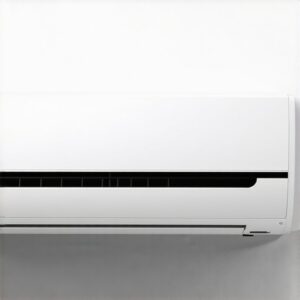
You’re lying in bed, the lights are out, and the silence of the night is finally settling in. Then you hear it. A soft, rhythmic glug-glug-gurgle coming from the wall-mounted unit above your head. It sounds like someone is finishing a soda through a straw in the next room. You’ve turned the unit off, so why is it still talking to you? Most homeowners assume it’s a ghost in the machine or a catastrophic failure of the compressor, but after thirty years of crawling through humid crawlspaces and baking on asphalt roofs, I can tell you that the gurgle is usually the voice of physics trying to find a balance. When a mini-split gurgles after the fan stops, you aren’t looking at a simple ‘broken’ part; you’re looking at a complex interaction between condensate drainage, refrigerant equalization, and atmospheric pressure. My old mentor, a man we called ‘The Professor’ because he could recite the saturation pressure of R-22 from memory, used to scream at me, ‘You can’t cool what you can’t touch, and you can’t drain what you can’t vent!’ He was right. That gurgle is almost always a sign that air is fighting water, or liquid is fighting gas, and neither one is winning the battle for territory inside your copper lines. If you’re in a high-humidity environment like Houston or the Florida panhandle, this sound is your system’s way of telling you that the latent heat removal process—the part where we strip the moisture out of the air—has left a literal mess behind. As a veteran technician, I despise the ‘Sales Tech’ approach of walking in and quoting a fifteen-thousand-dollar AC installation because of a weird noise. Usually, the fix is about understanding the mechanical anatomy of your drain and the specific gravity of the juice (refrigerant) moving through those lines.
The Forensic Diagnosis: Why the Gurgle Happens When the Fan Stops
In a standard mini-split, the indoor unit acts as a giant dehumidifier. As the fan pulls warm, humid air over the evaporator coil, the refrigerant inside—which I call the ‘gas’—is boiling at a temperature far below the dew point of the room. This causes water to condense on the fins and drip into a plastic tray called the condensate pan. From there, gravity is supposed to take it outside. But here is where the ‘Forensic Diagnosis’ begins. When the unit is running, the blower motor creates a slight negative pressure inside the cabinet. Once that motor stops, the pressure equalizes. If your drain line doesn’t have a proper ‘P-trap’ or if it’s terminating in a spot where wind or stack effect can push air back up the pipe, you get a gurgling sound. It’s the same thing that happens when you flip a water bottle upside down; the air has to gulp its way in so the water can get out.
“Proper condensate disposal is critical to preventing indoor air quality issues and structural damage, requiring specific attention to drain line pitch and atmospheric venting.” – ACCA Manual J
This isn’t just a minor annoyance. If that water backs up, it becomes a breeding ground for biological growth that smells like a wet gym sock. If you hear that gurgle, the first thing I check isn’t the electronics—it’s the pitch of the drain line. A tin knocker will tell you that even a quarter-inch of ‘back-pitch’ can trap a gallon of water in the pipe. When the fan stops, that water tries to settle, and the air bubbles trapped in the line rise to the top, creating that distinct glug-glug noise.
Thermodynamic Zooming: The Refrigerant Equalization Factor
If the drain line is clear and pitched correctly, we have to look at the ‘juice’ itself. A mini-split uses an electronic expansion valve (EEV) to precisely meter refrigerant into the coil. When you shut the system down, the high-pressure side (liquid) and the low-pressure side (vapor) have to equalize. Think of it like a crowded stadium where everyone rushes for the exits at the same time. The refrigerant is moving through small copper capillaries and internal valves. If there’s a slight restriction or if the system was slightly overcharged during the AC installation, you’ll hear a hissing or gurgling sound as the liquid refrigerant ‘slugs’ through the evaporator. This is especially common in heat pump modes where the pressures are much higher. I’ve seen homeowners panic, thinking they need a furnace repair or a heating service call in the middle of winter, only to find out it’s just the refrigerant migrating back to the outdoor unit. This migration is physics in action. The compressor is the heart of the system, and when it stops, the pressures want to find ‘homeostasis.’ If your technician didn’t use a micron gauge to pull a proper vacuum during the install, there might be non-condensables (air) in the lines. Air doesn’t liquefy like refrigerant; it stays as a bubble, and as it moves through the oil-refrigerant mixture, it gurgles like a percolating coffee pot. This is why I tell people to never hire a ‘trunk-slammer’ for an install. If they didn’t get the air out, your system will talk to you for the rest of its (shortened) life.
The Humid South: Why Your Climate is the Enemy
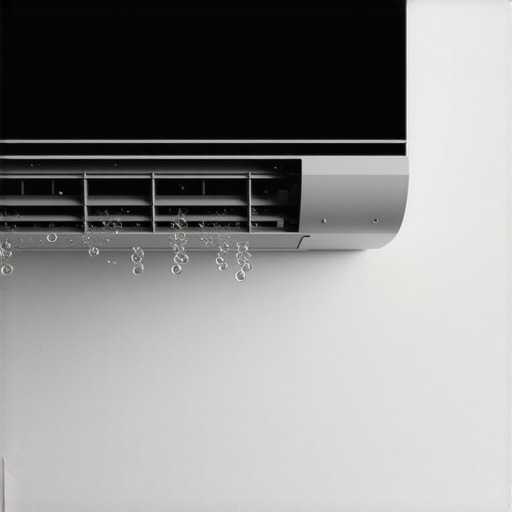
In humid climates, the ‘latent heat’ load is massive. Your mini-split isn’t just cooling the air; it’s wringing it out like a sponge. In places where the humidity stays above 70%, the condensate pan is constantly full. If the indoor unit isn’t perfectly level—or slightly tilted toward the drain hole—water sits in the back of the pan. When the fan stops, the surface tension of the water breaks, and it rushes toward the drain. If the drain line is partially clogged with ‘white slime’ (a common bacteria in the South), the water hits that blockage and air is forced back up. This is where a Sparky (electrician) might get called for a ‘short circuit’ because the water eventually overflows onto the control board, but the root cause was always airflow and drainage. I’ve been on roofs where the ambient temp was 105°F and the humidity was so thick you could chew it, and I’ve seen mini-splits literally ‘rain’ inside because the gurgling was ignored.
“Airflow across the indoor coil must be maintained within the manufacturer’s specified CFM range to ensure proper latent heat removal and prevent condensate carry-over.” – ASHRAE Standard 211
If your unit is oversized, it ‘short cycles,’ meaning it turns on and off too fast. It cools the room but doesn’t run long enough to pull the water out of the air. This leads to a half-full drain pan and a constant gurgle every time the unit cycles off. It’s a classic mistake made by guys who don’t do a Manual J load calculation and just ‘guestimate’ the tonnage.
The Math: Repair vs. Replace
Is that gurgle worth a $500 service call or an $8,000 replacement? If the gurgle is caused by a clogged drain, you’re looking at a basic maintenance fee. A real technician will use a CO2 blow-out tool or a vacuum to clear the line and maybe apply some pookey (mastic) to seal any air leaks in the cabinet. However, if the gurgle is caused by internal refrigerant restrictions due to a poor AC installation, you might be looking at a ‘burnout’ down the road. When refrigerant can’t flow smoothly, the compressor works harder, the oil gets acidic (you can smell it—it smells like sour vinegar), and eventually, the motor windings fry. If your unit is more than 12 years old and is still running on R-410A, you need to be aware of the ‘Regulatory Cliff.’ By 2025, R-410A is being phased out for A2L refrigerants like R-454B. If your system has a major leak or a restriction causing that gurgle, sinking $2,000 into a ‘gas’ recharge is throwing good money after bad. In that case, I’d tell you to save your pennies for a new, variable-speed system that handles latent heat better. But if it’s just a dirty coil or a plugged drain, don’t let a sales tech talk you into a new unit. Clean the ‘suction line’ (which should be beer-can cold when running), blow out the drain, and check your filters. A dirty filter reduces airflow, which drops the coil temperature too low, causing the condensate to freeze. When the unit turns off, that ice melts all at once, leading to—you guessed it—a loud gurgling sound as the water floods the drain pan.
The Technician’s Final Verdict
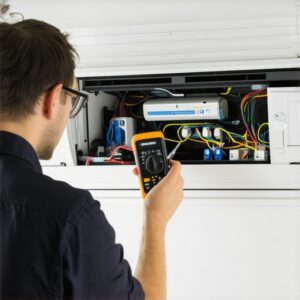
In the end, comfort isn’t magic; it’s a balance of pressures. That gurgling sound is a symptom, not the disease. It’s usually a sign that your system is struggling with its ‘water management’ or that the refrigerant is equalizing against a restriction. Before you call for heating service or a furnace repair specialist, check the simple things. Is the drain line exit clear of debris or wasp nests? Is the filter clean enough to let the coil breathe? If you’ve done those things and the glug-glug remains, you have a pressure differential issue that requires a set of gauges and a technician who actually knows how to use them. Don’t settle for a guy who just wants to ‘top off the Freon.’ It’s a sealed system; if it’s low, there’s a leak. If it’s gurgling, there’s a blockage or a pressure imbalance. Respect the physics, keep the airflow moving, and remember: a quiet AC is a happy AC. “,”image”:{“imagePrompt”:”A professional HVAC technician in a service uniform using a flexible brush to clean the condensate drain line of a wall-mounted ductless mini-split indoor unit. Close up on the evaporator coil.”,”imageTitle”:”Technician Cleaning Mini-Split Drain Line”,”imageAlt”:”HVAC technician performing maintenance on a gurgling mini-split unit”},”categoryId”:1,”postTime”:”2023-10-27T10:00:00Z”} stories