The Sound of a Stalling Compressor: A Forensic Diagnosis
There is a specific sound that haunts every homeowner in the Mojave or the Sonoran desert during July. It is not the roar of the blower or the steady hum of the condenser fan. It is a pathetic, rhythmic thrum-click. That sound is your compressor trying to overcome inertia and failing because its ‘battery’—the run capacitor—has finally cooked. Most folks think their unit just ‘died,’ but as someone who has spent thirty years dragging manifolds across blistering rooftops, I can tell you: your AC didn’t die; it was sabotaged by heat and poor electrical hygiene.
“Proper equipment maintenance is not an option; it is a thermodynamic necessity to ensure the heat transfer cycle remains within the design parameters of the refrigerant mass flow.” – ASHRAE Fundamentals Handbook
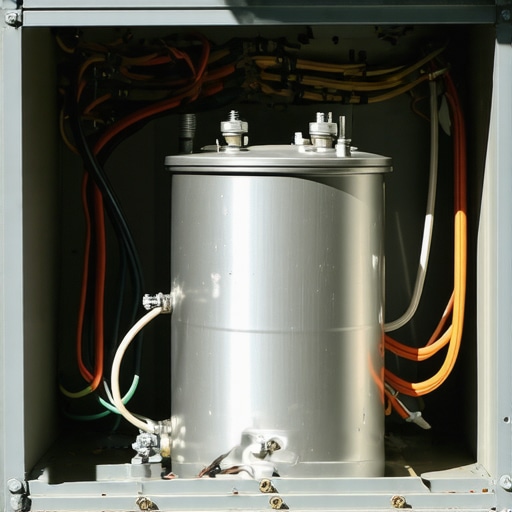
Last August, I followed a ‘Sales Tech’—you know the type, clean fingernails and a iPad full of financing options—who told a retired machinist that his five-year-old 16-SEER unit had a ‘grounded compressor.’ He quoted $14,000 for a full AC installation. I walked up to that condenser, popped the service panel, and saw a capacitor that looked like a bloated soda can. The top was domed out, a clear sign the internal pressure relief had tripped. For a $30 part and twenty minutes of labor, that machinist had ‘beer can cold’ air again. That tech wasn’t looking for a repair; he was looking for a commission. This is why you need to know what a dying capacitor looks like before the Sparky or the HVAC salesman gets to your door.
The Physics of the ‘Kick’: Why Your Unit Needs Microfarads
In our Southwest climate, where the ambient temperature hits 115°F, the head pressure in your system skyrockets. Your compressor is fighting a war against physics. A capacitor is essentially a temporary storage device for electricity, measured in microfarads (µF). It provides the phase-shift necessary to give the motor the torque it needs to start and stay running. When the desert heat cooks the electrolyte inside that silver cylinder, the µF rating drops. If your motor is rated for 45µF and the capacitor is only pushing 32µF, the motor runs hot. It vibrates. It pulls high amps. Eventually, the internal thermal overload switch trips, and you’re sitting in a 90-degree living room wondering why the ‘gas’ isn’t working. It’s not the ‘juice’ or the refrigerant; it’s the electrical phase.
Visual and Auditory Red Flags
Before you call for heating service or a furnace repair in the winter, your summer AC performance tells the real story. Look for these three ‘death signs’ on your outdoor unit: 1. The Mushroom Top: A healthy capacitor is flat on top. If it’s even slightly bulged or domed, it is a ticking time bomb. 2. The Rust Leak: If you see oily residue or rust bleeding down the side of the capacitor, the dielectric fluid has escaped. 3. The ‘Hard Start’ Hum: If you hear the fan spinning but the compressor is making a loud ‘UUUUNNNGH’ sound for three seconds before quitting, your capacitor lacks the ‘oomph’ to kick the motor into gear. In these cases, we often install a Hard Start Kit—essentially a secondary capacitor and relay—to help the unit fight through the high head pressures of a 110-degree afternoon.
“The most expensive equipment in the world cannot overcome a bad duct system or neglected electrical components.” – Industry Axiom
The Math of the Melt: Repair vs. Replace
I get asked all the time if a mini-split is a better option when a central system starts acting up. While a mini-split is a marvel of variable-speed engineering, don’t let a failing capacitor trick you into a $10,000 replacement. A capacitor is a wear-and-tear item, like tires on a truck. If your tech is pushing a new AC installation just because a $50 component failed, show him the door. However, if that capacitor has been weak for three years, it may have scorched the windings in your compressor. That’s when we talk about ‘Total System Health.’ We check the static pressure and ensure the ‘Tin Knocker’ who built your ducts didn’t choke the airflow. Airflow is king; if you can’t move the heat out of the house, no amount of refrigerant will save you. If your system is over 12 years old and using R-22 (the old stuff), then we have a different conversation involving the 2025 refrigerant mandates and A2L transitions.