The Phantom Temperature: Why Your Mini-Split is Lying to You
You spent three grand on a high-efficiency mini-split, expecting surgical precision in your home climate. Instead, you’re sitting on the couch sweating while the digital readout on the wall-mounted head unit smugly claims it’s a crisp 70 degrees. You check your handheld remote; it says 74. You check the Nest thermostat across the room; it says 76. You feel like you’re losing your mind, but I’m here to tell you it’s not a ghost in the machine—it’s physics, and usually, it’s a case of poor sensor logic. As an HVAC tech who has spent three decades dragging gauges through crawlspaces, I’ve seen this ‘temperature gap’ drive homeowners to the brink of insanity. The truth is, your mini-split isn’t broken; it’s just looking at the world through a very narrow, very high-up straw.
The Sales Tech Scam: A $15,000 ‘Solution’ for a $0 Problem
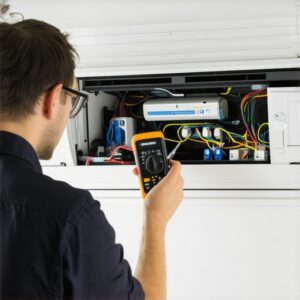
I remember following behind a ‘Sales Tech’ last August in a split-level home. This kid, wearing a shirt so white it had never seen a drop of compressor oil, had quoted a retired schoolteacher $15,000 for a total system replacement because her upstairs mini-split ‘couldn’t keep up’ with the setpoint. He told her the compressor was ‘losing its heart’ and the juice was low. I walked in, grabbed her remote, and saw the ‘I-Feel’ function was turned off. The unit was sensing the temperature at the ceiling—where heat lives—while she was sitting six feet below in a pocket of stagnant air. I enabled the remote sensor, placed it on her end table, and within ten minutes, the inverter ramped up and the room was a meat locker. I didn’t sell her a new unit; I sold her the truth, and I caught that ‘Sparky-turned-salesman’ trying to fleece her for a commission. This is why you need a mechanic, not a closer.
“The temperature of the air in the conditioned space shall be measured at a point not less than 3 feet nor more than 5 feet above the floor and not less than 2 feet from an exterior wall.” – ACCA Manual RS
Thermodynamic Zooming: The Ceiling vs. The Couch
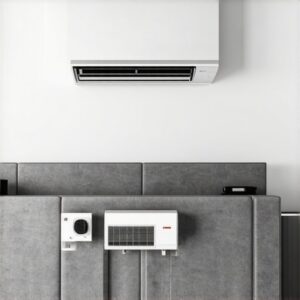
To understand the mismatch, you have to understand stratification. Heat rises. It’s the first thing they teach you before they let you touch a manifold gauge. Your mini-split head is typically mounted 7 to 8 feet off the floor. The return air sensor is located right at the top of that unit, sucking in the warmest air in the room. When the unit reaches 70°F at the ceiling, it thinks its job is done and begins to throttle back the inverter. Meanwhile, at the couch level, you’re still dealing with latent heat and a lack of air movement. If your AC installation didn’t account for vertical temperature gradients, you’re going to have a bad time. The evaporator coil is sweating, dropping the air temperature below the dew point to wring out the humidity, but if that cold air isn’t being thrown far enough into the room because the fan speed is too low, it just drops like a stone right underneath the unit, leaving you in a humid bubble.
The Sensor Wars: Remote vs. Return Air
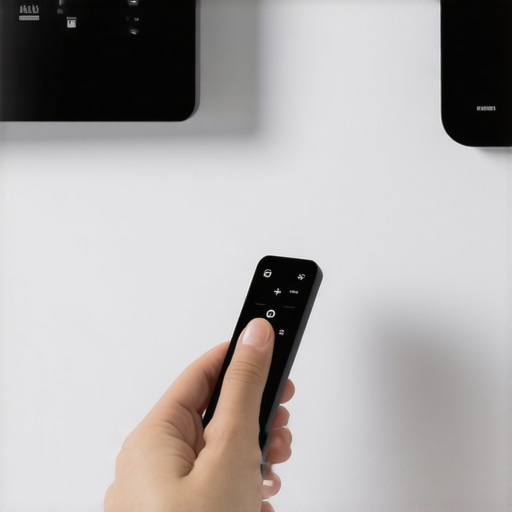
Most modern mini-splits have two ‘brains.’ Brain A is the thermistor located in the return air path of the indoor unit. Brain B is the sensor inside your handheld remote. If the system is set to use Brain A, it is measuring the air that has already floated to the ceiling. If you use Brain B (often called ‘Follow Me’ or ‘I-Feel’ mode), the remote sends a literal ‘ping’ to the head unit every few minutes via infrared or RF, telling it the actual temperature at your location. The problem? If you leave that remote on a granite countertop or in direct sunlight, the system is going to get garbage data. You’ll end up with a compressor screaming at 100% capacity because the remote thinks it’s 85 degrees, while your actual room air is freezing. This is why mini-split owners feel like they are constantly playing tag with their settings.
“Designers shall ensure that the control sensors are located to represent the conditions of the zone they serve, avoiding localized heat sources or stagnant air zones.” – ASHRAE Standard 55
Static Pressure and the ‘Tin Knocker’s’ Revenge
We often see people trying to fix these comfort issues with a furnace repair or a heating service call in the winter, only to find the problem is actually the ductless design itself. If the ‘Tin Knocker’ who installed your traditional ducted system didn’t balance the return air, your mini-split is fighting an uphill battle against the rest of the house’s pressure. Airflow is king. If your mini-split is in a bedroom with the door closed, it creates a pressurized box. The unit can’t move air if it can’t pull air back in. This ‘short cycling’ of air makes the sensor think the room is satisfied when the far corner is still a stagnant swamp. I always tell clients: stop looking at the number on the remote and start feeling the air. If the ‘Suction Line’ isn’t beer-can cold and the air isn’t moving, the number on the screen is just a suggestion.
The Humidity Factor: Why 72 Degrees Feels Like 80
In humid climates, the ‘mismatch’ is often a result of latent heat. If your unit is oversized, it will hit the temperature setpoint (Sensible Heat) too fast and shut down before it has a chance to remove the water from the air (Latent Heat). You end up with ‘Cold and Clammy’ syndrome. The remote says 70, but you’re sticky. You need that coil to stay cold and the fan to stay on a low, constant speed to pull that moisture out. This is where the ‘Pookie’ (mastic) on your ducted system or the proper sealing of the line-set hole in your mini-split comes into play. If you’re sucking in unconditioned attic air through the hole behind the unit, that sensor will never, ever be right.