The Sound of Efficiency vs. The Clunk of the Past
If you have lived in a house with a standard, single-stage air conditioner for more than a decade, you know the sound. It is that violent thud and the subsequent flicker of the lights when the contactor slams shut and the compressor draws a massive amount of ‘juice’ to start its sprint. As a tech who has spent thirty years dragging manifolds through crawlspaces, I am here to tell you that this ‘all-or-nothing’ approach is the reason your upstairs is a furnace and your electric bill looks like a mortgage payment. We are moving into an era where inverter technology is no longer a luxury; it is the baseline for anyone who actually understands the physics of a comfortable home.
The Sledgehammer vs. The Scalpel: A Physics Lesson
I remember my first mentor, a crusty old ‘tin knocker’ who could size a return air drop just by looking at the floor joists. He used to scream at me, ‘You can’t catch a fly with a sledgehammer, kid!’ He was talking about trying to satisfy a thermostat with a unit that only knows 100% capacity. In a traditional AC installation, the unit turns on, blasts the house with sub-40-degree air, and then shuts off. This is what we call ‘short cycling.’ It is brutal on the equipment, and it is even worse for your comfort. An inverter-driven system, however, uses a variable-speed compressor that modulates. It can run at 20% capacity or 100%, adjusting its speed in real-time to match the heat load of the house. It is the difference between a car that only has a ‘stop’ and a ‘floor-it’ setting versus one with a smooth gas pedal.
“Equipment shall be selected to meet the sensible and latent loads of the design condition, but over-sizing is the primary cause of humidity-related failures in humid climates.” – ACCA Manual S (Residential Equipment Selection)
Thermodynamic Zooming: How Inverters Handle Latent Heat
Let’s get into the weeds of why this matters in a humid climate. In places where the dew point is high, the primary enemy isn’t just the temperature—it is latent heat. When a standard AC short-cycles, it cools the air temperature (sensible heat) quickly, but it doesn’t run long enough for the evaporator coil to stay below the dew point and actually wring the water out of the air. You end up with a house that is 72 degrees but 70% humidity—a cold swamp. An inverter system solves this by running longer cycles at lower speeds. Because the refrigerant flow is modulated via the inverter board—which converts AC power to DC and then ‘chops’ it to control the Hertz—the coil stays at a consistent, cold temperature that continuously pulls moisture out of the air. This is why a 2-ton mini-split can often make a room feel more comfortable than a 3-ton builder-grade central unit.
The Regulatory Cliff: Why 2025 Changes Everything
We are currently staring down the barrel of the R-410A phase-out. The EPA is pushing for lower GWP (Global Warming Potential) refrigerants like R-454B and R-32. This shift is driving up the cost of traditional hardware. If you are looking at a furnace repair or a full system swap, the ‘cheap’ single-stage unit is becoming a relic. The new A2L refrigerants require sophisticated sensors and control boards. Since the cost of the ‘iron’ is going up anyway, the price gap between a clunky single-stage unit and a high-efficiency inverter system is shrinking. Buying a non-inverter system today is like buying a rotary phone the year the iPhone came out. You are investing in obsolete technology that won’t be supported by the supply chain in ten years.
The Architecture of a Proper Installation
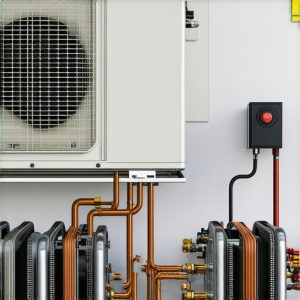
You cannot just slap an inverter-driven heat pump onto a 40-year-old duct system and expect magic. This is where most ‘Sales Techs’ fail you. They want to sell the box and run. A real technician knows that the heating service and cooling performance are limited by the ‘static pressure.’ Inverter systems are sensitive; if your ducts are too small, the variable-speed blower will ramp up to compensate, creating a whistling sound that will drive you crazy. When we perform an AC installation with inverter tech, we have to look at the ‘Pookie’ (mastic) on the joints, the size of the return air, and the integrity of the plenum. We are building a closed-loop system where the indoor and outdoor units ‘talk’ to each other via a communication bus, not just a 24-volt ‘on’ signal from a ‘Sparky’ (electrician).
“Total system airflow must be verified against the manufacturer’s blower performance table to ensure the system operates within the designed sensible heat ratio.” – ASHRAE Standard 211
Mini-Splits and Zoning: The Death of the Hot Room
One of the biggest advantages of inverter technology is seen in mini-split applications. Because these units are inverter-driven by default, they are the masters of ‘zoning.’ Instead of one giant compressor trying to cool the whole house, you have small, quiet units in specific rooms. This eliminates the need for massive trunk lines and the ‘dead zones’ common in older homes. If you are doing a furnace repair and find a cracked heat exchanger, it is often the perfect time to evaluate if a multi-head inverter heat pump is a better long-term play than sticking with a gas-fired dinosaur.
The Verdict: Don’t Buy a Sledgehammer
In the end, comfort is about physics, not magic. If you want a home that is consistently dehumidified, whisper-quiet, and cheap to operate, inverter technology is the only path forward. Don’t let a technician who is afraid of a multimeter talk you into a ‘simple’ system because he doesn’t want to learn how to troubleshoot a DC circuit. Inverter systems are the future of heating service and cooling, and once you feel the difference in the ‘air quality’—not just the air temperature—you will never go back to the ‘thud’ of a single-stage unit again.