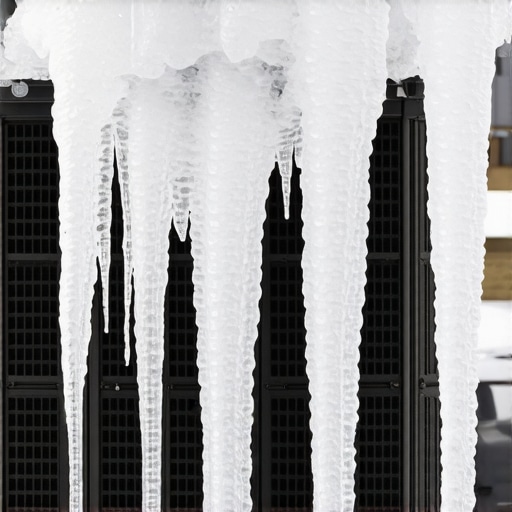
There is a specific, eerie silence that happens in a house when the air conditioner gives up the ghost in the middle of a heatwave. It’s not just the absence of the blower’s hum; it’s the heavy, wet heat that starts to settle into the carpet and curtains. You walk over to the vents, and instead of a crisp 55-degree breeze, you feel nothing. You head outside to the condenser, and there it is: a thick, white shroud of ice wrapped around the suction line, looking like a popsicle in July. Your unit hasn’t just failed; it’s turned itself into a glacier. Most homeowners—and frankly, too many rookie ‘Sales Techs’—think this means they just need more ‘juice’ or a whole new unit. They’re usually wrong.
The Physics Lesson: You Can’t Cool What You Can’t Touch
My old mentor used to scream at me in the back of a sweltering van, ‘You can’t cool what you can’t touch!’ This is why airflow matters more than horsepower. He’d grab a handful of dirt from a neglected filter and shove it toward my face to make the point. The thermodynamics are simple but unforgiving: your AC doesn’t ‘create’ cold; it removes heat. The evaporator coil inside your air handler is designed to be a heat exchanger. When the liquid refrigerant—the ‘gas’—expands into a vapor inside that coil, it drops to a temperature well below the dew point of your home’s air. As the blower motor pushes warm, humid air over those fins, the heat is absorbed into the refrigerant and carried outside. But if that air can’t touch the metal—because of a layer of skin cells and pet dander on the fins, or because the blower is struggling—the coil just keeps getting colder. It drops below 32°F, the condensate freezes, and suddenly you have a block of ice that acts as an insulator, stopping all heat transfer. The cycle doesn’t just stop; it goes into a death spiral.
“The most expensive equipment in the world cannot overcome a bad duct system.” – Industry Axiom
The Forensic Diagnosis: Anatomy of a Frozen Coil
When I show up to a ‘No-Cool’ call and see ice, I don’t reach for the manifold gauges first. I reach for my static pressure probes. If your furnace repair guy doesn’t check static pressure, he isn’t a technician; he’s a parts changer. High static pressure is like trying to breathe through a cocktail straw while running a marathon. In humid climates like the South, latent heat—that’s the moisture in the air—is the real enemy. If your blower isn’t moving enough CFM (Cubic Feet per Minute) because your ductwork is undersized or ‘Pookie’ (mastic) was slapped on poorly by some ‘tin knocker,’ the coil will freeze. We see this often during a new AC installation where the contractor didn’t bother to check if the old ducts could handle the higher static pressure of a modern, high-efficiency blower. It’s not a equipment failure; it’s a physics failure.
The ‘Low Gas’ Paradox
Here is the part that confuses everyone: Low refrigerant actually makes a coil colder before it makes it stop working. When your system has a leak in the evaporator or the ‘suction line,’ the pressure drops. According to the pressure-temperature relationship, as pressure goes down, the boiling point of the refrigerant also goes down. If the pressure is low enough, the refrigerant is boiling at 20°F instead of 40°F. Now, every bit of humidity that hits that coil turns instantly to ice. If you have a ‘Sales Tech’ telling you that you just need a ‘top-off’ every year, he’s scamming you and violating EPA Section 608. A’sealed system’ should never need more gas. Finding the leak is the only real furnace repair or cooling service that matters. If they won’t find the leak, they aren’t fixing the problem; they’re just charging you for a temporary band-aid while your compressor slowly dies from liquid slugging.
“Proper airflow across the indoor coil is essential for efficient heat transfer and preventing system icing.” – ACCA Manual J
Mini-Splits and the New Frontier
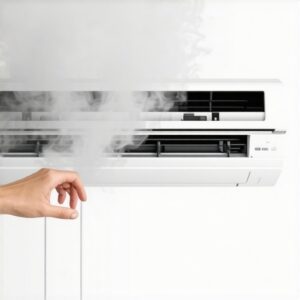
Modern mini-split systems are marvels of engineering, but they are even more sensitive to this airflow-to-thermodynamics ratio. Because they use inverter compressors that ramp up and down, a dirty filter on a mini-split can lead to a frozen head unit faster than you can blink. If you’re looking for a heating service or cooling solution for a bonus room, these are great, but you have to treat them like a laboratory instrument, not a tractor. The coils are densely packed, and even a slight film of dust can disrupt the laminar flow, leading to ice buildup and a messy leak down your wall when it eventually thaws.
The Math: Repair vs. Replace
So, when do you pull the plug? If your system is 12 years old, uses R-22 (the old stuff that costs a fortune), and has a frozen coil due to a leak, you are looking at a $1,500 repair minimum for a system that’s already on its last legs. Between the rising costs of the 2025 A2L refrigerant transition and the sheer energy waste of a failing compressor, an AC installation for a new 16-SEER2 unit often pays for itself in five years. But—and this is a big but—don’t let anyone sell you a new unit without a manual J load calculation. If they just look at your old unit and say, ‘Yep, you need a 3-ton,’ they are guessing with your money. An oversized unit will ‘short cycle,’ meaning it cools the air so fast it doesn’t remove the humidity. You’ll end up with a house that’s 70 degrees but feels like a damp basement. That’s not comfort; that’s a failure of airflow architecture.
Conclusion: Comfort is Physics, Not Magic
If your AC is a block of ice, turn it off immediately. Switch the thermostat to ‘Fan Only’ to help it thaw, and check your filter. If the filter is clean and it still freezes, you have a mechanical issue or an airflow restriction that requires a real technician, not a guy with a clipboard and a sales pitch. Whether it’s a routine heating service check or a major furnace repair, the goal is always the same: keep the air moving. Because if you can’t touch the air, you can’t cool the air. Period. “