The Invisible Thief: Why Airflow is King in the Ductless World
I’ve spent thirty years crawling through blown-in insulation and dragging my gauges across sun-scorched membranes, and if there’s one thing I’ve learned, it’s that most homeowners think their HVAC system is a magic box. They believe it just ‘makes cold.’ That’s the first mistake. Heat isn’t destroyed; it’s moved. In a mini-split system, your wall unit is the frontline soldier in a war of thermodynamics. When you neglect those thin mesh filters, you aren’t just letting a little dust accumulate; you are strangling the life out of your compressor and forcing your ‘gas’ to work twice as hard for half the result.
I remember following a ‘Sales Tech’—one of those guys in a crisp white shirt who wouldn’t know a manifold from a marshmallow—into a home last August. He’d already quoted the homeowner a full mini-split replacement because the unit was ‘icing up.’ He told her the evaporator coil was shot and it was time for a $6,000 upgrade. I walked in, popped the front cover, and pulled out two filters that looked like they’d been used to vacuum a dryer lint trap. I washed them in the kitchen sink, dried them, and the unit’s static pressure dropped back to spec immediately. The ‘Sales Tech’ vanished pretty quick when I showed the lady that her $6,000 problem was actually a thirty-second maintenance oversight. That’s the reality of this trade: the simple things are what keep the heating service bills low and the AC installation lifespans long.
“Proper airflow is the fundamental requirement for all heat transfer processes in residential comfort systems. Without it, the refrigeration cycle fails to meet designed latent and sensible capacities.” – ACCA Manual J Principles
The Physics of the Mesh: Thermodynamic Zooming
When we talk about cleaning a filter, we are really talking about maintaining the ‘Delta-T’—the temperature difference between the air entering the unit and the air leaving it. Your ductless wall unit operates on a tight margin. The evaporator coil inside that plastic housing is designed to drop below the dew point. This is critical in humid climates like the South. As the warm, wet air from your living room hits those cold fins, the moisture (latent heat) condenses into liquid water and drips into the condensate pan. If those filters are clogged with skin cells, pet dander, and ‘pookie’—that’s HVAC slang for the sealant we use, but here I’m talking about general gunk—the air can’t touch the fins. The velocity drops, the coil gets too cold, and suddenly you’ve got a block of ice where your air conditioner used to be. This puts massive strain on your furnace repair budget later in the year because the entire system’s logic gets thrown out of whack.
Step-By-Step: The Professional Way to Clear the Air
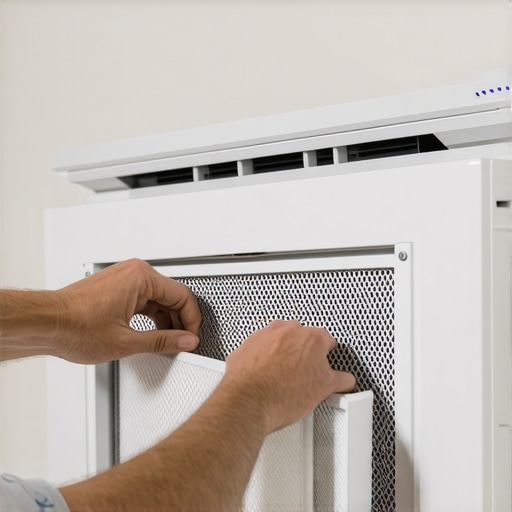
Don’t just yank at the plastic. These units are built with ‘tabs’ that are notorious for snapping if you’re ham-fisted. First, kill the power at the remote, but if you want to be safe like a pro, hit the disconnect or the breaker. Lift the front panel from the sides—never the middle. You’ll see those two screens staring back at you, likely grey and fuzzy. [image-placeholder] These are your primary defense. Slide them out downward. If you see ‘juice’ (refrigerant) oil on the fins behind the filters, stop what you’re doing; you have a leak. But if it’s just dry dust, take those filters to the sink.
Use lukewarm water and a mild detergent. Avoid the ‘Sparky’ approach of using high-pressure air or garden hoses; you’ll tear the mesh. Use a soft brush and move in the opposite direction of the airflow. While those are drying—and they MUST be bone dry before they go back in—take a flashlight and look at the ‘barrel fan’ inside the throat of the unit. If that fan is covered in black spots, you’re looking at bio-growth, a common result of the ‘Short Cycling’ caused by restricted airflow in humid zones. If the air stays too long on the coil because the filter is clogged, the unit never properly dehumidifies, leaving a swampy mess inside your wall.
“Maintaining clean filtration media is the most cost-effective method to ensure the longevity of high-efficiency variable-speed compressors.” – ASHRAE Standard 62.2
Why ‘Topping Off’ is a Lie and Filters are the Truth
I hear it every season: ‘Hey Tech, can you just add a little gas to my system?’ Listen, if an HVAC guy tells you that you need a yearly ‘top off’ of R-410A without finding a leak, he’s a thief. It’s a sealed system. Most of the time, the reason your unit feels like it’s lost its ‘oomph’ is that the static pressure has skyrocketed due to dirty filters. When the air can’t move, the heat exchange can’t happen. The unit runs longer, the electric bill climbs, and eventually, the compressor valves give up the ghost. Before you call for a mini-split emergency repair, check those screens. It’s the difference between a $200 ‘service call’ and a $0 Saturday afternoon chore. Comfort isn’t magic; it’s just physics, and the physics say your unit needs to breathe.