The Death Rattle of Comfort: Signs Your AC Blower Motor is Giving Up the Ghost
I remember my old mentor, a man who had more refrigerant in his blood than red cells, used to scream at me whenever I’d get lazy with a manometer. ‘You can’t cool what you can’t touch!’ he’d bark, pointing at a frost-covered evaporator coil. He was talking about airflow. In this trade, we focus a lot on the ‘juice’—the refrigerant—but the blower motor is the actual heartbeat of your home. It is the lungs that move the air through the heat exchanger during a heating service or across the evaporator during a summer heatwave. If that motor is dragging, the whole system is a $10,000 paperweight. You see, the blower isn’t just a fan; it’s a precision instrument designed to overcome the static pressure of your ductwork, a task that becomes a nightmare if the original AC installation was handled by a tin knocker who was more interested in finishing early than doing the math.
The Thermodynamics of Airflow: Why Your Blower Matters
To understand why a failing blower is a catastrophe, you have to look at the ‘Thermodynamic Zooming’ of the cooling cycle. When your AC is running, the indoor coil drops to a temperature well below the dew point of your home’s air. We call this the saturation temperature. The blower motor’s job is to force warm, humid air over those aluminum fins. As that air touches the cold metal, it gives up its ‘latent heat’—the energy held in water vapor. If the blower motor slows down even by 15%, the air spends too much time on the coil. The temperature of that air drops too far, the moisture freezes, and suddenly you have a block of ice where your airflow used to be. This isn’t just a minor furnace repair issue; it’s a physics failure that can slug your compressor with liquid refrigerant, killing the most expensive part of your unit.
“Total external static pressure must not exceed the manufacturer’s rated limit for the selected blower speed to ensure system longevity and efficiency.” – ACCA Manual D
Sign 1: The Auditory Warning (The Death Screech)
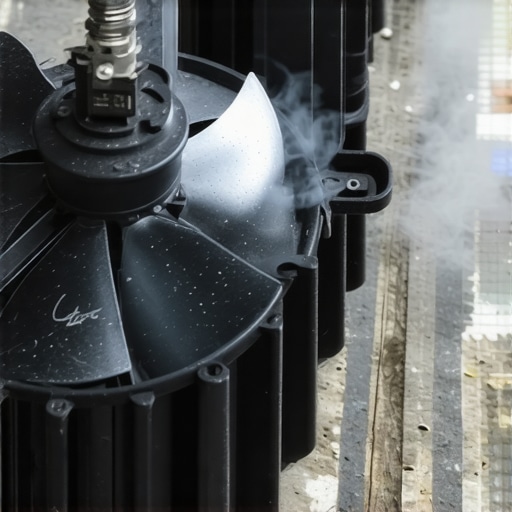
If you start hearing a high-pitched squeal that sounds like a banshee in your attic, your blower motor bearings are screaming for mercy. Most modern motors are ‘permanently lubricated,’ which is industry-speak for ‘we didn’t give you a way to oil them, so when they dry out, you’re buying a new one.’ This is a mechanical friction issue. As those bearings wear down, the motor has to draw more amperage to maintain its RPMs. If you ignore this, the heat generated by that friction will eventually melt the winding insulation. By the time you call for a heating service or cooling check, the motor might be seized solid. In some cases, a mini-split system might exhibit a different sound—a rhythmic clicking—indicating a warped blower wheel or a failed electronic control module (ECM).
Sign 2: The Smell of Electrical Despair
There is a very specific, acrid scent to a burning blower motor. It’s not like toast; it’s an ozone-heavy, metallic stench that tells me the capacitors are bulging or the windings are shorting out. If you smell this coming through your vents, shut the system down immediately at the breaker. Continuing to run a failing motor can cause back-feeding voltage that fries your integrated furnace control (IFC) board. That turns a $600 motor swap into a $1,500 repair. I’ve seen sales techs try to use this smell to scare homeowners into a full $15,000 AC installation, but usually, it’s just a motor that couldn’t breathe because someone forgot to change the 1-inch pleated filter for six months.
Sign 3: Weak Airflow and the ‘Cold Swamp’ Effect
In humid climates, a failing blower motor creates what I call the ‘Cold Swamp.’ Because the motor isn’t pushing enough CFM (Cubic Feet per Minute), the air coming out of the registers feels ice-cold, but it doesn’t reach the far corners of the room. The thermostat eventually hits its setpoint, but the humidity remains at 70%. You feel sticky and chilled at the same time. This is because the blower isn’t moving enough air volume to properly dehumidify the space. If you’re constantly calling for furnace repair because you’re uncomfortable, the ‘sparky‘ might check your voltage, but I’m going to check your static pressure. Often, the motor is fine, but the ductwork is so choked with pookie (mastic) and poor design that the motor is essentially trying to breathe through a cocktail straw.
“The most expensive equipment in the world cannot overcome a bad duct system or a failing air delivery component.” – Industry Axiom
The ECM Revolution vs. The PSC Old Guard
In the old days, we had PSC (Permanent Split Capacitor) motors. They were simple: they were either on or off. They were cheap to replace but sucked electricity like a shop vac. Today, most high-efficiency systems use ECM (Electronically Commutated Motors). These are ‘smart’ motors that can vary their speed. While they are great for comfort, they are prone to ‘module failure.’ The motor itself is often fine, but the brain on the back of the motor gets fried by a power surge or high static pressure. A real tech will try to replace just the module; a sales tech will tell you the whole mini-split or air handler is ‘obsolete’ and needs replacing. Don’t fall for it. Check the ‘gas’ (refrigerant) levels, check the capacitor, and verify the motor’s ‘suction line’ isn’t vibrating excessively before you sign any five-figure contracts. Real comfort is about the physics of air, not the slickness of a sales pitch.