The Airflow Manifesto: Why Your Mini-Split is Lying to You
I’ve spent thirty years crawling through blown-in fiberglass insulation and dragging my gauges across scorched rubber roofs, and if there is one thing I know, it’s that physics doesn’t care about your interior designer’s opinion. You can buy the most expensive, high-SEER2 inverter-driven mini-split on the market, but if you stick that indoor head in a dead-air pocket, you might as well be trying to cool your house with a block of dry ice and a prayer. People treat AC installation like they’re hanging a picture frame. It’s not. It’s fluid dynamics. You are installing a lung. If that lung can’t breathe, the compressor starts hunting, the inverter board gets confused, and your utility bill starts looking like a phone number.
The $22,000 Ghost: A Tale of Sales Tech Malpractice
Last February, during a Buffalo blizzard that had my knuckles cracking like dry kindling, I followed a ‘Sales Tech’—you know the type, the guys who wear white shirts and carry iPads but couldn’t tell a capacitor from a canned ham—into a 1920s Tudor. This young couple was shivering because their old steam boiler had finally given up the ghost. The Sales Tech had quoted them $22,000 to retrofit a full ducted system, tearing out their lath-and-plaster walls to run 6-inch flex duct that would’ve been pinched at every turn. He told them mini-splits wouldn’t work in a cold climate. He was lying. He just didn’t know how to size a heating service solution that didn’t involve a massive commission. I looked at the layout and realized they didn’t need a total teardown; they needed three high-wall heads placed with surgical precision to utilize the home’s natural convective loops. By understanding the ‘Airflow Manifesto,’ I saved them fifteen grand and kept them toastier than that boiler ever did. I caught that tech trying to sell ‘tonnage’ when he should have been selling ‘distribution.’
“Air distribution systems shall be designed to provide the required heating and cooling as determined by the loads, ensuring that conditioned air reaches the occupied zone.” – ASHRAE 90.1 Standards
Thermodynamic Zooming: The Coanda Effect and Why Height Matters
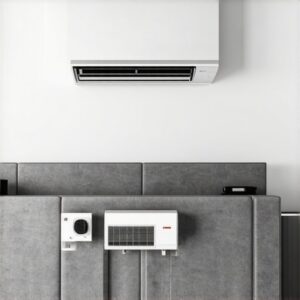
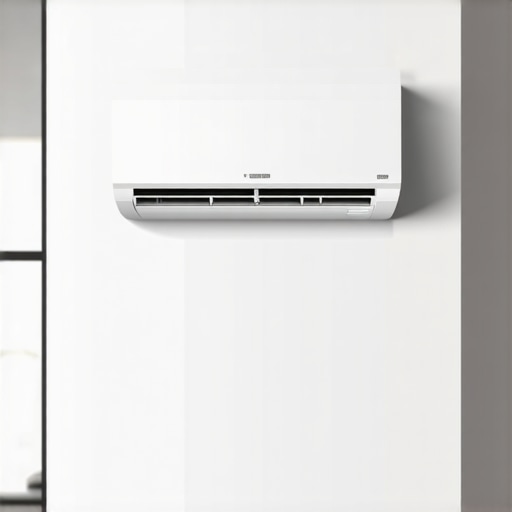
When we talk about mini-split placement, we have to talk about the Coanda Effect. This is the tendency of a fluid jet—in this case, your conditioned air—to stay attached to a convex surface. In a high-wall application, we want that air to hug the ceiling and throw itself across the room. If you mount the head too low, the air hits the floor too fast, bounces, and creates a localized cold spot that tricks the unit’s thermistor into thinking the room is satisfied. The unit shuts down, but you’re still sweating six feet away. This is called short-cycling, and it’s the silent killer of compressors. You need that return air clearance. Most manuals say 2-4 inches from the ceiling, but I want 6 inches. Why? Because that evaporator coil is thirsty for the hot air that gathers at the ceiling. In a heating service context, it’s even more critical. Since heat rises, a head mounted too high during winter will struggle to push that warm air down to where your feet are. You’re looking for the ‘Goldilocks Zone’—roughly 7 to 8 feet off the floor—where it can grab the latent heat from the ceiling but still have enough ‘throw’ to reach the other side of the room.
The Static Pressure Myth: Don’t Box It In
I see it all the time: people try to hide the mini-split head inside a decorative cabinet or tucked behind a soffit. You are killing the static pressure. Even though these units don’t have ductwork, they still rely on a specific pressure differential across the blower wheel. When you restrict the return air, the evaporator coil temperature drops too low. In the summer, that means your condensate starts freezing, turning your unit into an expensive ice machine that eventually leaks ‘juice’ (refrigerant) or, more commonly, overflows the drain pan and ruins your drywall. If I’m doing a furnace repair or a system check, I always check for ‘Pookie’ (mastic) leaks in old ducts, but on a mini-split, the ‘leak’ is often just bad placement causing the coil to sweat like a tin knocker in July. You need at least 20 inches of clear space in front of the unit. If you put it over a bookshelf, the air just bounces back into the intake, and the machine lies to itself about the room temp.
The North/Cold Reality: Polar Vortex Physics
In cold climates like Chicago or the Northeast, mini-split heads aren’t just for cooling; they are primary heat sources. During a polar vortex, the outdoor unit’s defrost cycle is a battle against thermodynamics. If your indoor head is placed in a drafty hallway, it’s going to be constantly calling for max BTU output, which can lead to ice buildup on the outdoor coil. You want the head in the largest open area of the house to allow the ‘sensible heat’ to migrate through doorways. And for the love of all that is holy, don’t mount it directly above a thermostat for a different heating service. They’ll fight each other like cats in a bag. Your furnace will think it’s 80 degrees while your bedroom is 40. [image_placeholder] This diagram shows the ideal vertical and horizontal clearances to ensure the ‘suction line’ stays ‘beer can cold’ in August and the heat exchanger doesn’t stress out in January.
“Proper equipment sizing and selection are critical to maintaining indoor environmental quality and system longevity.” – ACCA Manual S
The Physics of Comfort vs. The Magic of Sales
At the end of the day, a mini-split is just a heat mover. It’s moving energy from where you don’t want it to where you do. In a furnace repair, we’re often dealing with combustion and cracked heat exchangers, but with mini-splits, we’re dealing with pure airflow. If you have a room with vaulted ceilings, don’t put the head at the peak. You’ll never feel that air. Put it at the standard 8-foot mark. If you’re doing a new AC installation, talk to your sparky (electrician) about a dedicated circuit, because these inverters hate voltage drops. Don’t let a ‘Sales Tech’ tell you that ‘bigger is better.’ A 24,000 BTU head in a 200 sq ft room is a recipe for a moldy, humid nightmare because it will never run long enough to pull the moisture out of the air. Comfort is physics, not magic. Respect the airflow, and your equipment might actually last the fifteen years it’s rated for.