Why Your Service Trucks Are in One Town But Your Google Ranking Is Stuck in Another
It is the ultimate frustration for any HVAC business owner. You have five meticulously maintained service trucks dispatched across the county. Today, three of them are in the affluent suburbs of [Town A], replacing condensers and performing duct cleanings. Yet, when a homeowner in [Town A] searches for “AC repair near me,” your business is nowhere to be found in the Google Map Pack. Instead, your google business profile seo seems to have hit a brick wall at the town line. You only appear for searches in [Town B], the specific municipality where your office or home-base is registered. This “Proximity Paradox” creates a massive disconnect between where your physical labor happens and where your digital presence exists. Despite your service area settings being configured correctly, you remain tethered to a single point on the map, losing out on high-intent leads in the very areas where your trucks are already driving. Breaking this tether requires a sophisticated approach to google business profile optimization that goes beyond simply checking boxes in a dashboard.
The Proximity Paradox: Why Google Ignores Your Service Area Settings
Many HVAC contractors believe that by going into their Google Business Profile (GBP) settings and selecting a 50-mile radius or listing twenty specific zip codes, they are telling Google where they want to rank. Unfortunately, research from industry leaders like Sterling Sky and BrightLocal has consistently shown that “Service Areas” in a GBP are largely descriptive, not a primary ranking signal. In the eyes of the algorithm, the “Service Area” is a courtesy to the user to let them know if you’ll drive to their house; it does not actually expand the “radius of relevance” for your rank google business profile efforts.
This is the heart of the Proximity Paradox. Google’s local algorithm is built on the concept of the “centroid.” This is the exact latitude and longitude of your verified physical address. Even if you are a Service Area Business (SAB) and have chosen to hide your address from the public, that hidden point remains the epicenter of your ranking power. As a user moves further away from that centroid, your visibility drops off exponentially. This is often caused by 5 Google Maps Errors That Are Actually Hiding Your Business From Customers, where the business assumes the digital boundary matches their physical one. Google prioritizes the closest “verified” entity to the searcher to ensure the fastest response time and the most local experience, often ignoring the fact that your trucks are literally parked on the searcher’s street.
The 2025-2026 Algorithm Shift: Proximity, Relevance, and Prominence
As we move through 2025 and look toward 2026, the local search landscape has shifted. The legacy of the “Vicinity Update” continues to haunt SABs, but recent updates in early 2025 have placed an even stronger emphasis on what I call the “Hyper-local Relevance” factor. While proximity is still the heaviest weighted factor, Google is getting better at identifying businesses that are “prominent” in specific neighborhoods, even if they aren’t headquartered there. To compete, you need a professional google maps ranking service that understands these nuances.
The three pillars of local SEO – Proximity, Relevance, and Prominence – now interact in a more complex way. Proximity is how close you are to the searcher. Relevance is how well your business matches the search query (e.g., “emergency 24/7 furnace repair”). Prominence is how important your business looks to Google based on information from across the web. The 2025 algorithm updates have increased the weight of “consistent NAP (Name, Address, Phone) data” and the “quality of local reviews.” If you want to rank higher on google maps in a town ten miles away, you have to prove to Google that you are more relevant and prominent in that town than the guy whose office is around the corner from the searcher. This isn’t just about keywords; it’s about digital footprints that prove your presence in those outlying areas.
Why “Service Area” Businesses (SABs) Face a Steeper Climb
If you are an HVAC contractor running your business from a home office or a warehouse without a retail storefront, you likely have a “hidden address” profile. While this protects your privacy, it puts you at a distinct disadvantage. Recent data shared across professional SEO communities like Reddit’s /r/localseo confirms that “Service-area only” profiles do not remove the physical-location requirement; they simply mask it. Google still uses that hidden address to calculate the distance between you and the customer.
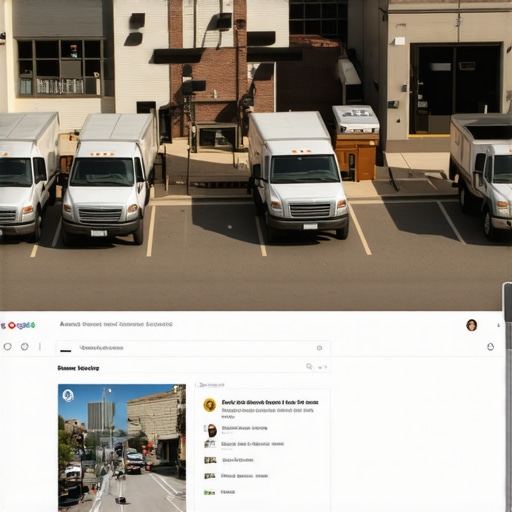
Brick-and-mortar competitors with a visible shop in the target town will almost always outrank an SAB from the next town over, all other things being equal. This is why “Proof of Work” is becoming the gold standard for google business profile ranking. If Google can’t see a building with your sign on it in [Town A], you must provide digital evidence that you are active there. This is where many businesses fail; they treat their GBP as a “set it and forget it” directory listing. In reality, Why Posting Photos of Your Actual Service Vans Boosts Your Ranking on Google Maps becomes a critical strategy. When you upload a photo of your branded truck in front of a recognizable landmark in a target town, you are providing the algorithm with the geographic metadata it needs to associate your business with that location.
Strategies to Break the “Tether” and Rank in Neighboring Towns
To improve google maps ranking in areas outside your immediate vicinity, you must move from a passive strategy to an aggressive, hyperlocal one. Here are the four core strategies I recommend to my clients to expand their reach:
1. Hyperlocal Content and City-Specific Landing Pages
Your website is the “brain” that feeds information to your Google Business Profile. If your website only mentions your home office town, Google will never feel confident showing you for other areas. You need dedicated landing pages for every major town you serve. These shouldn’t be “cookie-cutter” pages. They should include local landmarks, specific neighborhood names, and even local weather considerations that affect HVAC systems in that specific area. This is The Hidden Code That Shows Your HVAC Services to Homeowners in the Next Town Over – it’s about creating a semantic link between your brand and the target geography.
2. Geo-Tagged Media and Real-Time Proof of Work
Stop using stock photos of happy families sitting by a vent. Google’s AI can recognize stock photography instantly, and it provides zero ranking value. Instead, have your technicians take photos of every completed job. When these photos are taken on-site, they contain EXIF data (GPS coordinates). While Google claims they strip this data upon upload, there is significant evidence that the initial upload of geo-tagged media helps increase google business profile visibility in those specific coordinates. It proves your trucks were actually there.
3. Niche and City-Specific Citations
Standard citations like Yelp and Yellow Pages are the bare minimum. To break the proximity barrier, you need mentions on local chamber of commerce sites, local neighborhood blogs, and town-specific business directories. When Google sees your business name and phone number associated with [Town A] on multiple local websites, it builds the “Prominence” needed to rank you there. Using local seo tools can help you identify where your competitors are getting these local nods.
4. Review Signals with Geographic Keywords
A review that says “Great job!” is good. A review that says “Great AC repair in [Town A], they arrived at my house on Maple Avenue within an hour!” is gold. Encourage your customers to mention their city or neighborhood in their reviews. Google’s NLP (Natural Language Processing) parses these reviews to understand your service boundaries. This is one of the most effective ways to get more calls from google maps from specific high-value neighborhoods.
The Role of Technical Local SEO Tools
You cannot fix what you cannot measure. Most HVAC owners look at their “Insights” tab in the GBP dashboard and see a total number of views, but that doesn’t tell the whole story. You need a google maps rank tracker that provides a “grid view” of your rankings. A grid view shows you exactly where your ranking drops off – perhaps you are #1 at your office, but two blocks away you drop to #10. This granular data is essential for gmb ranking service providers to determine where the “digital tether” is strongest.
Using local seo software like SEO Viper Tools allows you to audit your profile for technical inconsistencies that might be holding you back. Sometimes, the issue isn’t proximity at all, but a “filtered” listing. If there are three other HVAC companies in your same office complex or immediate block, Google may “filter” you out to avoid redundancy. Understanding these technical hurdles is why Why Most Local SEO Tools Are a Total Waste for Small HVAC Shops is a common sentiment; you need tools that actually track the map pack grid, not just traditional organic rankings. You need a dedicated gmb seo tools suite to see the world as Google Maps sees it.
Conclusion: Moving Your Digital Presence to Where Your Trucks Are
In the competitive world of HVAC and local services, proximity is king, but it is not an absolute dictator. While Google’s algorithm naturally prefers the “closest” business, you can override this preference by building overwhelming relevance and prominence in your target towns. By utilizing hyperlocal content, geo-tagged “proof of work,” and strategic review generation, you can effectively move your digital presence to match the actual location of your service trucks.
Don’t let your business be invisible in the neighborhoods that drive your revenue. It’s time to perform a comprehensive google business profile audit and implement a strategy that breaks the proximity barrier. Whether you choose to do this in-house or hire a specialized local seo agency, the goal remains the same: ensuring that when a homeowner’s AC fails, they see your truck on the map, not just on their street. Start today by optimizing your profile for where you *want* to be, not just where you are parked.