The Invisible Killer in the 2026 HVAC Landscape
I’ve spent three decades crawling through fiberglass-filled attics and balancing on 45-degree pitch roofs in the middle of heatwaves. I’ve seen the industry transition from the heavy-duty mechanical beasts of the 90s to the computer-on-wheels systems we’re installing today. If you’re looking at an AC installation in 2026, you aren’t just buying a compressor and some coils; you’re buying a highly sensitive piece of laboratory-grade electronics. And if you don’t protect that brain with a dedicated surge protector, you are effectively throwing ten thousand dollars into a lightning storm. Most ‘Sales Techs’—those guys who show up in a clean uniform just to sell you a new unit instead of fixing a $5 capacitor—won’t tell you this because they’d rather see your board fry in three years so they can sell you another one.
The $2,200 Lie: A Narrative Diagnosis
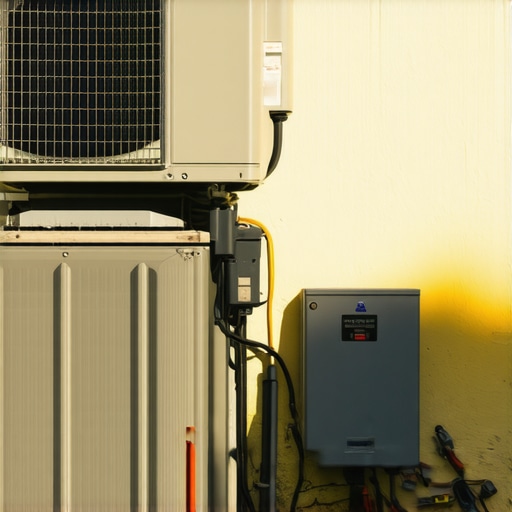
Last August, I followed a ‘Sales Tech’ from one of those big-box franchise companies to a house in the suburbs. The homeowner, a retired shop teacher who knew his way around a wrench, was quoted $2,200 for a new inverter control board on a three-year-old high-efficiency system. The previous tech told him the unit was ‘just reached its end of life’ due to a ‘random internal failure.’ I walked up to the outdoor disconnect, pulled the cover, and smelled it immediately. It wasn’t the sweet, metallic smell of a refrigerant leak; it was the acidic, ozone-heavy stench of a fried microprocessor. A small power spike from a utility transformer down the street had bypassed the standard breaker and cooked the IGBTs on the inverter board. I didn’t sell him a new board right away. I checked the line voltage and found a loose neutral in the service panel that was causing micro-surges every time the dryer kicked on. A $200 surge protector and a lug tightening saved that man thousands. That’s the difference between a technician and a salesman.
“The most expensive equipment in the world cannot overcome a bad duct system, nor can it survive unstable electrical input without proper mitigation.” – Industry Axiom adapted from ACCA Manual J principles
Thermodynamic Zooming: Why Inverters are Fragile
In the old days, an AC was either ‘On’ or ‘Off.’ When it turned on, the compressor ran at 3,600 RPM, the suction line got ‘beer can cold,’ and it stayed that way until the thermostat was satisfied. Modern 2026 systems, especially mini-split units and high-end central air, use inverter technology. This means the system converts AC power to DC power and then uses Pulse Width Modulation to vary the speed of the motor. This is great for your electric bill because it allows the evaporator coil to stay exactly at the temperature needed to hit the dew point, removing latent heat (humidity) without ‘short cycling’ the house into a cold, damp swamp. However, those DC conversion boards are packed with diodes and transistors that can be obliterated by a voltage spike as small as 50 volts. In dry, high-heat environments like the Southwest, where the grid is stressed and sensible heat loads keep units running at high head pressures for 12 hours straight, these electronics are under constant thermal and electrical stress.
The Regulatory Cliff: R-454B and the A2L Transition
By 2026, the AC installation world has fully shifted away from R-410A to A2L refrigerants like R-454B. These are ‘mildly flammable’ compared to the old gas we used to use. Because of this, 2026 units are required to have leak detection sensors and integrated shut-off logic built into the main PCB. If a power surge damages these sensors or the logic board, the system will ‘fail-safe’ and lock out your heating service or cooling entirely. You won’t just be hot; you’ll be stuck waiting for a proprietary chip that’s likely on backorder from overseas. The furnace repair you thought was simple now involves a complete electronic overhaul because the 2026 standards require the indoor and outdoor units to communicate constantly.
“Standard 15 provides the requirements for the safe design, construction, installation, and operation of refrigeration systems using A2L refrigerants, necessitating robust electrical protection for safety-critical sensors.” – ASHRAE Standards
Static Pressure and Electrical Load
Most homeowners don’t realize that airflow and electricity are linked. When your tin knocker (duct guy) undersizes your return air, the blower motor has to work harder to pull air through the filter. This increases the amperage draw. Higher amperage creates more heat in the wires. When you combine that heat with a dirty condenser coil and a small spike from the grid, you get a catastrophic failure. I always tell my apprentices: ‘You can’t cool what you can’t touch.’ If the air isn’t moving, the heat isn’t moving. If the heat isn’t moving, the juice (refrigerant) isn’t evaporating, and your compressor is basically trying to compress a liquid—which it can’t do. That strain causes a massive electrical ‘inrush’ that can fry a weakened board. A surge protector acts as a sacrificial lamb, taking that hit so your $12,000 investment doesn’t have to.
The Verdict: Don’t Skip the ‘Sacrificial Lamb’
Whether you are getting a mini-split for a sunroom or a full AC installation for a 3,000-square-foot home, the surge protector is non-negotiable in 2026. Make sure your technician uses real pookie (mastic) to seal your ducts to keep the static pressure low, and ensure a sparky or a qualified HVAC tech installs a Type 2 Surge Protective Device (SPD) at the outdoor disconnect. It’s the difference between a minor ‘pop’ during a thunderstorm and a total system write-off. Comfort is a matter of physics, and physics doesn’t care about your budget when a power surge hits.