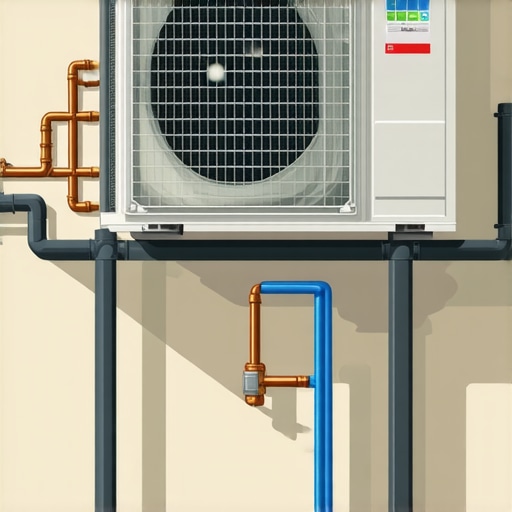
The 2026 Reality: Why Your New AC Is Not Your Father’s Air Conditioner
If you are looking at an AC installation in 2026, you aren’t just buying a box that blows cold air; you are navigating a regulatory minefield that has fundamentally changed the physics of residential cooling. We have officially moved past the R-410A era and into the world of A2L refrigerants like R-454B. These units run higher pressures, utilize larger evaporator coils to meet SEER2 mandates, and—most importantly for your drywall—produce a staggering amount of condensate. This is why a secondary drain pan is no longer an ‘optional’ upsell from a ‘Tin Knocker’; it is a structural necessity.
The Narrative: Following the ‘Comfort Advisor’ Carcass
Last August, I followed a ‘Sales Tech’—one of those guys who carries a tablet instead of a manifold gauge—into a house where he’d just quoted $21,000 for a full system replacement because of a ‘catastrophic coil failure.’ The homeowners were frantic. I crawled into the crawlspace, squinting through the dust, and found the ‘failure’ was nothing more than a gunked-up primary P-trap and a rusted-out, shallow emergency pan that didn’t have a safety switch. The unit was fine; the drainage was a crime scene. That ‘Sales Tech’ was ready to rip out a perfectly good compressor because he didn’t understand that the secondary pan is the heartbeat of a safe install. I cleared the line, installed a deep-profile secondary pan with a redundant float switch, and charged them for a standard service call. That’s the difference between sales and service.
Thermodynamic Zooming: The Physics of the Wet Coil
When your AC is humming, the evaporator coil is performing a violent act of heat exchange. As the ‘gas’ (refrigerant) expands into the coil, it drops the temperature of the copper well below the dew point of the return air. In humid climates, this is where latent heat is conquered. We aren’t just lowering the sensible temperature you see on a thermometer; we are wringing gallons of water out of the air. This water—condensate—drips into the primary plastic tray. If your ‘Tin Knocker’ didn’t level that unit perfectly, or if the ‘Pookie’ (mastic) used to seal the plenum blocks the exit port, that water stays in the unit. In the 2026 high-efficiency models, these coils are packed so tightly that even a slight airflow imbalance can spray water past the primary pan. You need that secondary pan to catch the ‘overspray’ that occurs when the static pressure is high.
“The most expensive equipment in the world cannot overcome a bad duct system or improper drainage management.” – Industry Axiom
The A2L Transition and the ‘Mildly Flammable’ Factor
2026 is the year of R-454B. This stuff is categorized as A2L, which the EPA calls ‘mildly flammable.’ While it’s perfectly safe when handled by a pro, these units now come with built-in sensors to detect leaks. If your unit is sitting in a pool of stagnant water because of a failed drainage system, you are inviting corrosion that can lead to those very leaks. A secondary drain pan keeps the chassis dry and prevents the ‘sour smell’ of a microbial colony growing under your furnace repair or air handler. If the primary clogs and you don’t have a secondary pan with a shut-off switch, the ‘juice’ (refrigerant) lines will eventually vibrate against the wet casing, leading to a pinhole leak that will cost you $2,000 in gas alone.
Why Mini-Split Systems Aren’t Exempt
People think a mini-split is a different beast, but the physics remains the same. Even a wall-mounted head produces condensate. When we do a multi-zone heating service or cooling install, the drain lines are the most common point of failure. A secondary pan in a concealed ducted mini-split setup is the only thing standing between a beautiful ceiling and a soggy mess of moldy insulation. Don’t let a ‘Sparky’ or an unlicensed handyman tell you it’s ‘just a little water.’ In 2026, with the cost of materials skyrocketing, a water-damaged furnace repair can easily exceed $4,000.
“Condensate disposal systems shall be provided for all equipment and appliances that produce condensate in order to prevent damage to the building structure.” – International Mechanical Code (IMC)
Static Pressure: The Silent Killer of Drain Pans
If your ductwork is too small—a common problem when people upgrade to high-SEER units without fixing their ‘tin’—the static pressure rises. High static pressure can actually ‘suck’ the water right out of the primary drain pan and blow it down the supply trunk. This is where a secondary pan earns its keep. It’s the safety net for a system that’s fighting against restricted airflow. If you hear a ‘slurping’ sound when your unit shuts off, your static pressure is high and your secondary pan is likely the only reason your floor isn’t rotting. Always ensure your tech checks the ‘Suction Line’—it should be ‘beer can cold’—but the secondary pan should stay bone dry. If it’s wet, you have a problem that a simple tune-up won’t fix.
The 2026 Bottom Line
Don’t be the homeowner who saves $300 on an installation by skipping the secondary pan and the float switch, only to spend $10,000 on mold remediation. In the A2L era, the equipment is more sensitive, the refrigerant is more expensive, and the stakes for your home’s structural integrity are higher than ever. Demand a secondary pan, insist on a dual-switch safety system, and never trust a tech who doesn’t check the level of your drain lines with more than just a quick glance. Comfort is physics, and physics doesn’t care about your budget.