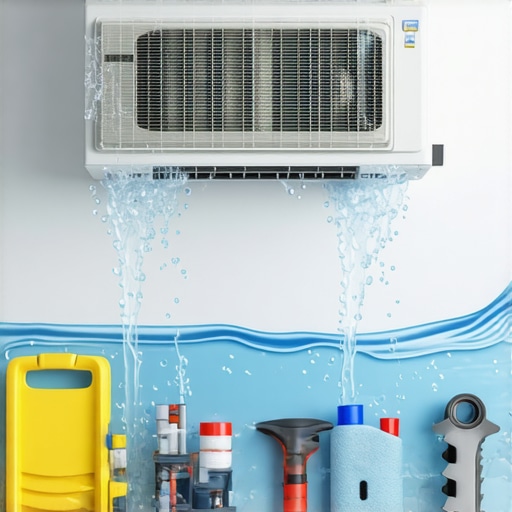
The Sudden Squelch: Why Your High-Tech Mini-Split is Acting Like a Window Shaker
You spent thousands on a 2026-grade, high-efficiency ductless system, thinking you had escaped the era of rattling furnaces and leaky ductwork. Then you walk into your living room and feel that unmistakable, cold squelch of soaked carpet. There is water on the floor. Before you call a ‘Sales Tech’ who will try to convince you that your two-year-old unit is a ‘total loss’ and needs a full AC installation replacement, take a breath. I’ve spent thirty years in crawlspaces and on blistering roofs, and I can tell you right now: water is a physics problem, not a death sentence for your equipment. Mini-splits are marvels of engineering, but they are also absolute magnets for condensate issues if the laws of thermodynamics are ignored.
The Physics Lesson: You Can’t Cool What You Can’t Touch
My old mentor, a man who smelled exclusively of juice (refrigerant) and burnt electrical tape, used to scream at me, ‘You can’t cool what you can’t touch!’ He was talking about airflow. In a 2026 mini-split, the evaporator coil is packed tighter than a sardine can to meet modern SEER2 requirements. This coil’s job is to drop below the dew point of the ambient air. When that warm, humid air hits those fins, the latent heat is stripped away, and the water vapor turns into liquid condensate. On a humid 95-degree day, that unit is essentially a dehumidifier that happens to provide cooling. If that water has nowhere to go, it’s coming out of the plastic housing and onto your hardwood floors. It’s not magic; it’s a failure of the drainage geometry.
“The most expensive equipment in the world cannot overcome a bad duct system—or in the case of a mini-split, a failure to respect the condensate path.” – Industry Axiom
Fix 1: The Biological Sludge in the Gravity Drain
The most common culprit I see in the field isn’t a mechanical failure; it’s a science experiment. Your condensate drain line is a dark, damp PVC pipe—the perfect breeding ground for ‘algae snot.’ Over time, this biofilm builds up until the 1/2-inch or 3/4-inch line is completely choked. In the new A2L refrigerant systems (like R-454B or R-32), the coils run slightly different temperatures than the old R-410A units, sometimes resulting in even more aggressive condensation cycles. If your drain is gravity-fed, even a tiny bit of Pookie (mastic) or debris can create a dam. The Fix: You don’t need a new unit. You need a nitrogen blast or a wet-vac to clear the line. If you’re feeling brave, look for the termination point outside. If it’s not dripping while the unit is running, the ‘snot’ has won. Clear it, and the water stays in the pipe.
Fix 2: The Lift Pump Heart Attack
Not every mini-split can rely on gravity. If your indoor head is on an interior wall, the installer likely tucked a small condensate pump behind the shroud or in the ceiling. These pumps are the weak link in any mini-split setup. They consist of a tiny float switch and a motor. When the reservoir fills, the float rises, the motor kicks on, and it pumps the water to a remote drain. When these fail—and they do—the water has nowhere to go but over the internal drain pan. I’ve seen ‘Sales Techs’ quote a full heating service overhaul when the reality is a $150 pump reached its end of life. You can hear a failing pump; it usually sounds like a tiny, rhythmic grinding or a high-pitched screech before it dies. If it’s silent and the pan is overflowing, the pump has likely lost its prime or the motor is burned out.
Fix 3: The ‘Beer Can Cold’ Trap (Low Charge and Ice)
Old-timers used to talk about charging a system until the suction line was ‘beer can cold.’ In 2026, we use digital manifolds and subcooling calculations because the new refrigerants are far more sensitive. If your mini-split is low on gas due to a tiny flare leak, the evaporator coil temperature will actually drop below freezing. Instead of water dripping into the pan, it turns into a block of ice on the coil. This is where the disaster happens: eventually, the ice block gets so thick it chokes off the airflow. When the unit cycles off or goes into a defrost mode, that massive chunk of ice melts all at once, overwhelming the drain pan and sending a literal waterfall down your wall. If you see frost on the indoor fins, don’t look for a mop; look for a leak. This requires a professional AC installation tech who actually knows how to use a leak detector, not just someone who wants to ‘top it off.’
“Proper refrigerant charge is essential for maintaining the sensible-to-latent heat ratio required for occupant comfort.” – ACCA Manual J Standards
Fix 4: The Tilted Chassis and the Mismatched Pan
This is a tin knocker‘s nightmare. Mini-split heads must be perfectly level—or in some specific brands, slightly pitched toward the drain hole. If the mounting bracket was installed by a Sparky (electrician) or a DIYer who didn’t use a level, the water will pool on the ‘high’ side of the internal drain pan. Eventually, the water level exceeds the lip of the plastic pan before it ever reaches the drain hole. I once followed a tech who told a homeowner they needed a furnace repair (on a heat pump!) because of a leak. All I did was pop the cover, adjust the leveling screws on the plate, and the leaking stopped instantly. It’s about the geometry of the fluid dynamics. If the chassis is warped or the plastic has cracked due to improper handling during AC installation, you might need a bit of waterproof sealant, but you rarely need a whole new system.
The 2026 Reality: A2L Refrigerants and Sensor Errors
We are currently in the middle of the biggest shift in HVAC history with the phase-out of R-410A. The 2026 models are designed with A2L refrigerants which are ‘mildly flammable.’ These units now come equipped with leak sensors. Sometimes, what looks like a ‘water leak’ is actually the unit shutting down and throwing a code because it detects refrigerant in the condensate—which can happen if a coil pinhole develops. This is why specialized heating service is more critical now than ever. You can’t just hack these systems together with duct tape and a prayer. You need to understand the relationship between the suction line pressure and the thermal expansion valve (TXV) behavior. If your tech doesn’t know what a micron gauge is, show them the door.
Conclusion: Maintenance vs. The Sales Pitch
If you have water on the floor, remember that your mini-split is essentially ‘sweating’ because it’s working hard against the humidity. In humid climates, the latent heat load is massive. Keeping your filters clean is the easiest way to prevent these leaks. When filters are clogged, airflow drops, the coil temperature plummets, and you’re back to the ‘ice block’ scenario. Don’t fall for the ‘Sales Tech’ scam where a minor drainage issue becomes a $10,000 replacement. Most of the time, a bit of cleaning, a level, or a new $100 pump is all that stands between you and a dry floor. HVAC isn’t magic; it’s physics. And physics doesn’t care about a sales quota.