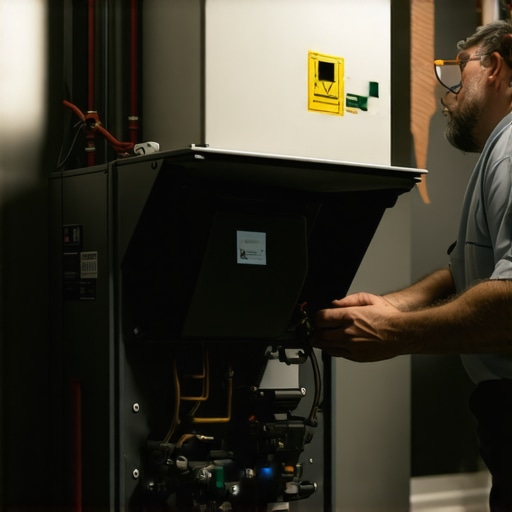
The silence is what wakes you up at 3:14 AM. Not a bang, not a whistle, but the absolute, crushing absence of the low-frequency hum you’ve tuned out for three months. That’s the sound of a furnace that has finally given up the ghost in the middle of a sub-zero January. I’ve spent thirty years crawling through spider-infested crawlspaces and balancing on frost-slicked rooftops, and I can tell you this: machines don’t just ‘die’ on a whim. They scream for help for weeks, sometimes months, before the final mechanical cardiac arrest. Most homeowners just don’t know the language of failure. If you’re heading into 2026 thinking your ten-year-old box is ‘just fine’ because it’s still blowing air, you’re the prime target for a Sales Tech—those guys who wear clean shirts and try to sell you a $15,000 system when you probably just needed a $200 blower capacitor. But to catch those issues, you have to understand the physics of the box.
The Physics of Heat Transfer: A Lesson from the Trenches
My old mentor, a guy we called ‘Iron Lung’ Pete, used to scream at me whenever I looked at a thermostat first. ‘You can’t cool what you can’t touch, and you can’t heat what you can’t move!’ he’d bellow. This is the fundamental law of HVAC. People think a furnace creates ‘cold’ or ‘heat’ like a magic trick. It’s actually just a massive energy exchange. In a furnace, we’re talking about taking chemical energy (natural gas or propane), turning it into thermal energy through combustion, and then transferring that heat through the thin metal walls of a heat exchanger to the air moving over it. If that air isn’t moving fast enough, or if the metal is compromised, the physics breaks down. This is where most heating service calls start. If the Tin Knocker—that’s what we call the ductwork guys—didn’t size your return air drops correctly, your furnace is literally gasping for breath. Imagine trying to run a marathon while breathing through a cocktail straw. That’s your furnace with a dirty 1-inch pleated filter or undersized ducts.
“The most expensive equipment in the world cannot overcome a bad duct system.” – Industry Axiom
Warning Sign 1: The ‘Boom’ of Delayed Ignition
If you hear a loud ‘thud’ or ‘boom’ when your furnace kicks on, stop reading this and go look at your burners. That sound is a tiny explosion. In a healthy furnace, the gas valve opens, the hot surface igniter glows white-hot (around 2,500°F), and the gas ignites instantly. But over time, carbon deposits—the soot of the HVAC world—build up on the burner ports. This clogs the path of the flame. The gas starts to pool inside the combustion chamber. When the flame finally jumps across those clogged ports, it ignites a large cloud of gas all at once. That ‘boom’ is the sound of your heat exchanger expanding under sudden, violent pressure. Do this enough times, and you’ll crack the metal. A cracked heat exchanger isn’t just a repair; it’s a death sentence for the unit because it starts leaking carbon monoxide into your living room. In 2026, with higher efficiency standards, these tolerances are tighter than ever. If you hear the boom, your heating service tech needs to pull those burners and scrub them with a wire brush before you’re looking at a full AC installation and furnace replacement package.
Warning Sign 2: Short Cycling and the Limit Switch Dance
Is your furnace turning on and off every five minutes? That’s called short cycling, and it’s usually the result of the ‘High Limit Switch’ doing its job. Think of the limit switch as the furnace’s brain-stem reflex. If the internal temperature of the furnace gets too hot—because there’s not enough air moving across the heat exchanger to strip the heat away—the limit switch kills the gas valve to prevent the whole thing from melting down. This is often where the ‘Sales Tech’ will tell you the ‘board is bad.’ It’s rarely the board. It’s usually a restricted air filter, a clogged secondary heat exchanger (if you have a 90%+ AFUE unit), or Pookie—that’s the mastic sealant we use—blocking a transition. Thermodynamics dictates that if you can’t move the BTUs into the ductwork, they stay in the box. And heat in the box is the enemy of every component, from the control board to the blower motor bearings.
Warning Sign 3: The Acrid Smell of Electrical Decay
If your furnace starts smelling like a ‘Sparky’ (electrician) left a soldering iron on, you’re smelling the breakdown of insulation. Modern furnaces in 2026 use ECM (Electronically Commutated Motors) which are great for efficiency but hate heat and static pressure. When a blower motor has to work too hard because the ductwork is too small, the windings inside the motor get hot. This cooks the varnish off the copper wires. That ‘electrical’ smell is the precursor to a seized motor. If you catch it early, you might just need a technician to adjust the static pressure or clean the squirrel cage fan. If you wait, that motor—which can cost upwards of $1,200 for the part alone—will fry itself on the coldest night of the year. I’ve seen homeowners try to mask the smell with air fresheners. Don’t be that person. That scent is the smell of your wallet burning.
Warning Sign 4: The Yellow Ghost (Flame Color Matters)
A healthy furnace flame should be a crisp, steady blue. It should look like a miniature blowtorch. If you see a lazy, flickering yellow or orange flame, you have an oxygen problem. This is incomplete combustion. This usually means your burners are dirty or your venting is obstructed. In the North, we often see birds nesting in the PVC exhaust pipes during the off-season, or ice blocking the intake. When the furnace can’t get enough fresh air, the flame turns yellow, and it starts producing massive amounts of Carbon Monoxide (CO).
“A furnace shall be installed so that the combustion products are completely exhausted to the outside atmosphere.” – NFPA 54 / ANSI Z223.1
If that flame is dancing around, it might also indicate a cracked heat exchanger. The blower motor air is leaking into the combustion chamber and ‘blowing’ the flame. This is the ultimate red flag. In 2026, many newer systems have sensors to detect this, but older furnaces don’t. You need a technician with a combustion analyzer—not just a guy with a flashlight—to prove the system is safe.
The 2026 Regulatory Cliff: Repair vs. Replace
We are currently in the middle of the A2L refrigerant transition. While this primarily affects AC installation and mini-split systems, it impacts your furnace choice too. If your furnace is over 15 years old and needs a major repair like a heat exchanger or a blower motor, you have to look at the math. In 2026, the cost of equipment is skyrocketing due to new safety sensors and mildly flammable refrigerants (like R-454B) used in the cooling side of dual-fuel systems. If you’re looking at a $1,500 repair on a unit that’s only 80% efficient (AFUE), you’re literally throwing money into the flue pipe. A new 96% AFUE furnace might save you 16 cents on every dollar of gas, which adds up fast when the polar vortex hits. However, don’t let a Sales Tech talk you into a 5-ton unit for a 2,000 square foot house. Oversizing is a plague. An oversized furnace will heat the house so fast it never finishes its cycle, leading to massive temperature swings and early component failure.
The Airflow Manifesto: Why Mini-Splits Are Winning
Sometimes, the furnace isn’t the answer. If you have that one room that’s always a meat locker while the rest of the house is a sauna, your ductwork is the problem, not the furnace. This is why mini-split installations are exploding in 2026. They bypass the ‘Tin Knocker’s’ mistakes entirely. By using a dedicated indoor head for each zone, you get exact thermal control without losing 20% of your energy to leaky ducts in an unconditioned attic. Whether you stick with a traditional furnace or move to a high-efficiency heat pump, remember: maintenance isn’t a ‘scam tune-up.’ It’s a forensic cleaning of the flame sensor (to prevent that annoying 3-second shutoff), a check of the Suction Line (the large copper pipe that should be ‘beer can cold’ in summer), and a verification of gas pressure. Take care of the physics, and the machine will take care of you.