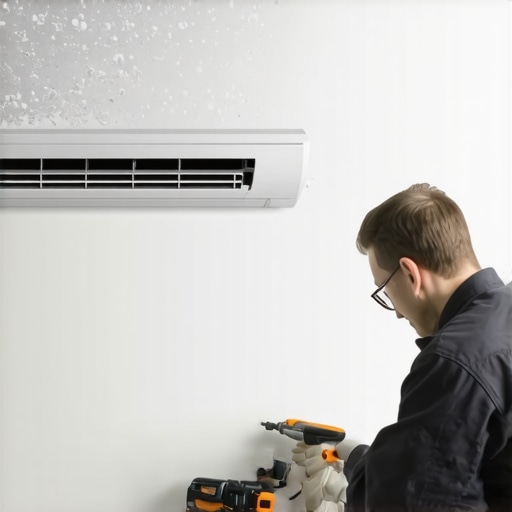
The Ghost in the Machine: When the Heat Stops
There is a specific kind of silence that happens at 3 AM in a northern winter. It’s not a peaceful silence; it’s the sound of a compressor that has given up the ghost because it’s encased in six inches of solid ice. My old mentor, a man who had more refrigerant in his lungs than oxygen, used to scream at me every time I grabbed a manifold gauge set: ‘You can’t cool what you can’t touch, and you damn sure can’t heat with a block of ice!’ He was right. Most technicians walk up to a frozen mini-split and immediately reach for the juice (refrigerant), thinking there is a leak. But if you don’t understand the physics of the evaporator—or in this case, the outdoor coil acting as an evaporator—you’re just guessing. Airflow is the absolute monarch of this industry, and in 2026, as we transition to new A2L refrigerants, understanding the Thermodynamic Zooming of your system is the only thing that will keep you from a $12,000 AC installation mistake.
“Heat pumps shall be sized to satisfy the load of the space while ensuring the defrost cycle is capable of maintaining coil efficiency under local design conditions.” – ACCA Manual S
The Forensic Anatomy of a Frozen Coil
To understand why your mini-split looks like a prop from Frozen, we have to look at the mechanical anatomy. In heating mode, your mini-split reverses the refrigeration cycle. The outdoor unit, which usually rejects heat, is now the cold side. It’s trying to ‘steal’ heat from the outdoor air. Even at 10°F, there is heat to be found, but the coil temperature has to be significantly lower than the ambient air to facilitate that transfer. When that coil drops below the dew point, moisture in the air flashes into frost. This is normal. What isn’t normal is when that frost turns into a glacier. Thermodynamic Zooming tells us that if the refrigerant cannot boil off completely because the coil is insulated by ice, liquid refrigerant slugs back to the compressor. That’s the ‘death rattle’ sound you hear right before the bearings seize. Whether you need a heating service or a full furnace repair replacement, the diagnosis starts with the delta-T across that outdoor coil.
Fix 1: The Airflow Manifesto (Clear the ‘Tin Knocker’ Traps)
The number one reason a mini-split freezes in winter isn’t a mechanical failure; it’s a lack of respect for physics. A mini-split needs to move a massive volume of air to extract heat. If you’ve let your ‘Pookie’ (mastic) covered ductwork—or in this case, the high-wall head unit—get clogged with dust, the indoor coil can’t reject the heat it’s carrying. This causes the outdoor unit to work overtime, dropping the suction pressure and skyrocketing the ice accumulation. Pro tip: Check the outdoor clearance. If you’ve allowed snow to drift against the chassis, the fan is just spinning in a vacuum. I’ve seen AC installation jobs where the unit was tucked under an eave with no gutters. Rain drips onto the fan, freezes the blades solid, and the motor burns out trying to fight the weight. This isn’t a ‘sales tech’ pitch; it’s basic geometry.
“The removal of latent heat is secondary to the management of sensible heat during peak winter loads, yet moisture accumulation on heat exchange surfaces remains the primary cause of system derating.” – ASHRAE Standard 62.2
Fix 2: The Reversing Valve and the ‘Gas’ Reality
If your unit is a block of ice, your defrost board might be ‘brain dead.’ Most modern units use a thermistor to tell the board when the coil is too cold. If that sensor is out of calibration, the unit never enters defrost mode. In a proper defrost cycle, the unit temporarily flips back to cooling mode, sending hot gas (refrigerant) to the outdoor coil to melt the ice. If you hear a loud ‘whoosh’—that’s the reversing valve doing its job. If you don’t hear it, you’re looking at a heating service call. Don’t let a sparky (electrician) tell you it’s a breaker issue if the fan is spinning but the air is cold. It’s a logic failure. By 2026, many units will be using R-454B. These A2L refrigerants are ‘mildly flammable,’ meaning the leak sensors will shut the system down if they detect a drop in pressure. If you have a slow leak, the system will freeze up long before the sensor trips, leading to a massive ice-over that can warp the aluminum fins on your coil.
Fix 3: Managing the 2026 Regulatory Cliff
We are entering a new era of AC installation. The old R-410A units are being phased out, and the price of ‘old’ juice is going to the moon. If your mini-split is more than 10 years old and it’s freezing up every week, ‘topping it off’ is a fool’s errand. You are throwing money into a hole. A modern heating service professional should be checking your static pressure and your EEV (Electronic Expansion Valve) operation. If the EEV is stuck, the refrigerant flow is restricted, causing the evaporator to starve and the temperature to plummet into the freezing zone. This is where a furnace repair mentality is different from a mini-split mentality; you can’t just ‘adjust the flame.’ You have to diagnose the digital pulses going to the valve. If your technician doesn’t have a multimeter out, they aren’t fixing it; they’re just guessing.
The Final Verdict: Physics vs. Magic
In the end, your mini-split isn’t magic. It’s a heat mover. If it’s frozen, you’ve either blocked the air, lost the gas, or the brain (the PCB) has forgotten how to defrost. Don’t wait until the polar vortex hits to check your drain pan heater. If that little heating element fails, the melted ice from a defrost cycle will just re-freeze in the bottom of the unit, eventually building up until it hits the fan blades. That’s a ‘tin knocker’s’ nightmare. Keep the filters clean, keep the outdoor unit clear of snow, and stop treating your thermostat like a gas pedal. Set it, forget it, and let the inverter do the work it was designed to do.