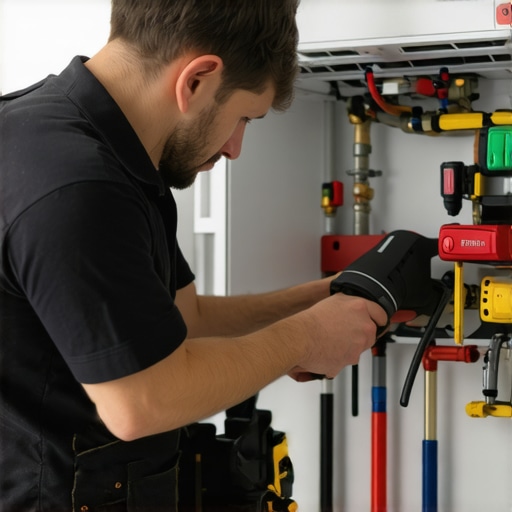
Is Your 2026 Heating Service Missing These 3 Steps? Why Your Furnace Might Be Failing Under the Radar
The house is silent. Not the good kind of silent where the kids are asleep, but the heavy, cold silence of a blower motor that refused to kick on at 3:00 AM. In my thirty years of crawling through fiberglass-filled attics and dodging wasps on windy rooftops, I’ve learned that silence has a specific temperature: about 54 degrees Fahrenheit. That is the point where the average homeowner stops being a ‘DIY expert’ and starts looking for a savior. But here is the problem: in 2026, the guy who shows up at your door is more likely to be carrying a tablet with a financing app than a set of manifold gauges. I call them ‘Sales Techs.’ They aren’t there to fix your heating service issues; they are there to find a reason to condemn your unit.
I remember a call last November. I followed one of these ‘Comfort Advisors’ into a house in a suburban neighborhood where the wind was whipping off the lake. He’d told an elderly couple that their eight-year-old furnace had a ‘lethal’ crack in the heat exchanger and quoted them $14,500 for a total AC installation and furnace replacement. He even showed them a blurry photo of a crack on his phone. When I got there, I pulled the blower and did a proper inspection. There was no crack. The ‘crack’ was a piece of hair caught in his camera lens. The actual problem? A $30 flame sensor coated in carbon and a primary limit switch that was tripping because the filter hadn’t been changed since the Reagan administration. I cleaned the sensor, swapped the filter, and the unit roared to life. This is why I preach the gospel of actual physics over sales pitches.
“The most expensive equipment in the world cannot overcome a bad duct system.” – Industry Axiom
The 2026 Heating Landscape: Why Old Rules Don’t Apply
We are living in a new era of HVAC. As of 2025, the industry completed its transition to A2L refrigerants like R-454B. If you have a mini-split or a hybrid heat pump system, your 2026 heating service must account for these mildly flammable refrigerants. We aren’t just checking for ‘juice’ (refrigerant) anymore; we are calibrating safety sensors that didn’t exist three years ago. If your tech isn’t talking about A2L mitigation, they are living in the past. Furnace repair has evolved from simple mechanical fixes to complex atmospheric management.
Step 1: The Forensic Combustion Analysis (The ‘Blood Test’)
Most techs walk up to a furnace, look at the blue flame, and say, ‘Looks good, Bill.’ That is total nonsense. A blue flame doesn’t mean a thing if the stoichiometric ratio of oxygen to fuel is off. In 2026, a legitimate heating service must include a full combustion analysis. This is where we stick a probe into the flue pipe to measure CO, CO2, and O2 levels. We are looking at the ‘lungs’ of the machine. If the CO levels are climbing, it means the secondary heat exchanger is likely soot-plugged, or the gas manifold pressure is too high. Thermodynamic Zooming tells us that if the manifold pressure is set to 3.5 inches of water column (the standard) but your tin knocker didn’t size the vent pipe correctly, you’re essentially choking the fire. The furnace ‘over-fires,’ the 409 stainless steel heat exchanger cells expand too far, and eventually, they fatigue and crack. A combustion analysis catches this before the CO detector starts screaming.
Step 2: External Static Pressure Benchmarking (The ‘Blood Pressure’)
This is where the ‘Airflow Architect’ side of me gets fired up. Airflow is the soul of the system. You can have a 98% AFUE furnace, but if the ductwork is garbage, it’s a 70% system in practice. During a 2026 heating service, your tech should be taking static pressure readings. Think of it like a doctor checking your blood pressure. We drill two small holes—one before the filter and one after the heat exchanger. If the total external static pressure is above 0.5 inches of water column (iwc), your furnace is struggling. It’s like trying to run a marathon while breathing through a cocktail straw. High static pressure is the #1 killer of expensive ECM blower motors. It causes them to ramp up their RPMs to compensate, which generates heat and eventually fries the control board. If your tech doesn’t own a manometer, show them the door.
“Ventilation shall be provided by natural or mechanical means, or a combination of both… to ensure the health and safety of occupants.” – ASHRAE Standard 62.2
Step 3: A2L Sensor Calibration and ‘Pookie’ Integrity
With the rise of mini-split technology and hybrid AC installation, we are dealing with high-pressure systems that use R-454B. These units come with leak detection sensors. If those sensors drift out of calibration, your system will lock out, leaving you in the cold even if there is no leak. A 2026 service call must verify the integrity of these sensors. Furthermore, we need to check the ‘Pookie’ (mastic). I’ve seen tin knockers use silver tape on high-velocity ducts that peels off within two seasons. Proper mastic sealing on the return air drop ensures that you aren’t sucking in freezing air from the crawlspace or attic, which drops your sensible heat capacity and makes the furnace run longer cycles. Longer cycles mean more wear and tear, more gas usage, and a shorter lifespan for the inducer motor.
Repair or Replace: The 2026 Mathematical Reality
When does a furnace repair become a bad investment? In the cold climates of the North, we look at the ‘Heat Exchanger vs. Age’ ratio. If the unit is over 15 years old and the inducer motor or the gas valve fails, you are looking at a $800 to $1,200 repair. Given that the average lifespan of a modern high-efficiency furnace is 18-20 years, you’re better off putting that money toward a new AC installation and heating package. However, if the ‘Sparky’ (electrician) finds a simple wiring fault or a bad capacitor, you fix it every time. Don’t let a sales tech tell you that a ‘dirty coil’ means you need a new $12,000 system. If it can be cleaned, clean it. If the physics of the heat transfer still work, keep it running.
The Final Verdict
Comfort isn’t magic; it’s physics. It’s the movement of BTUs from a source to a sink. If your 2026 heating service consists of a guy with a vacuum and a rag, you’re missing the three critical steps that actually preserve your equipment. Demand a combustion analysis, insist on a static pressure test, and ensure your A2L sensors are verified. Anything less is just an expensive visit from a guy in a clean uniform. Stay warm, keep the static low, and never trust a ‘blue flame’ until the analyzer confirms it.“,