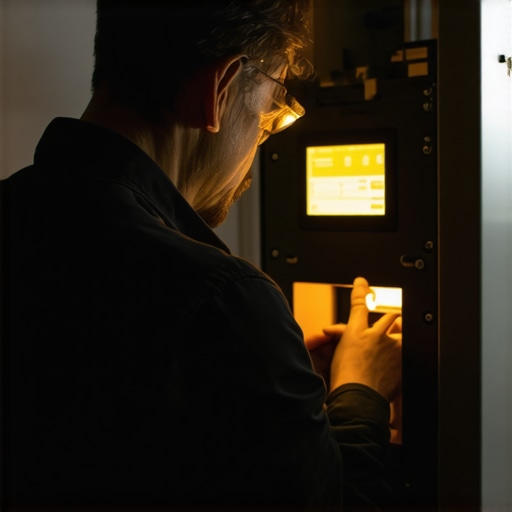
The Anatomy of Winter Desperation: Why Your Furnace Fails When You Need It Most
The silence is what hits you first. It’s 3:00 AM in the middle of a January cold snap, and that rhythmic rumble of the inducer motor has vanished. You realize the house has a distinct chill, a biting edge that tells you the thermal envelope is failing. As an HVAC veteran with three decades in the trenches, I’ve seen this movie a thousand times. Most homeowners think their furnace is a ‘magic box’ that creates heat. In reality, it is a complex sequence of thermodynamic events where any single failure—a clogged pressure switch, a carbon-caked flame sensor, or a seized blower—turns your sanctuary into an ice box. We aren’t just doing heating service; we are managing a controlled explosion to keep the frost at bay.
The $12,000 Ghost: A Tale of the Sales Tech Scam
I followed a ‘Sales Tech’ last winter who had just finished telling a retired shop teacher that his heat exchanger was ‘shot’ and the unit was leaking carbon monoxide. The quote for a new AC installation and high-efficiency furnace was $14,500. The customer was shaking. I walked down to that basement, pulled the burner assembly, and performed a visual inspection with a borescope. There wasn’t a crack in sight. The ‘death trap’ was actually just a dirty flame sensor that had oxidized, preventing the furnace from sensing the pilot and causing it to lockout after three attempts. A five-minute cleaning with a piece of steel wool, and the unit fired up perfectly. That tech wasn’t a mechanic; he was a shark in a polo shirt. This is why you need a technician who understands the physics of combustion, not just the commission on a sales sheet.
“The most expensive equipment in the world cannot overcome a bad duct system.” – Industry Axiom
The Physics of the North: Heat Exchangers and Carbon Monoxide
In our climate, we deal with extreme temperature differentials. When the outdoor ambient temperature is -10°F and your heat exchanger is hitting 140°F, the metal undergoes massive thermal expansion and contraction. This is where furnace repair becomes a matter of life and death. An 80% AFUE furnace vents through a metal chimney, relying on the buoyancy of hot air to carry combustion byproducts out. If that venting is restricted, or if the secondary heat exchanger in a 90%+ unit is clogged with scale, you get ‘flame rollout.’ That’s when the fire literally reaches out of the cabinet looking for oxygen. I’ve smelled the metallic singe of a melting limit switch enough times to know that ‘reliable comfort’ isn’t about the brand on the box—it’s about the precision of the manifold pressure and the integrity of the flue.
Airflow is King: Why Your Mini-Split is Struggling
Many folks are moving toward a mini-split setup for supplemental heat. They’re brilliant pieces of engineering—variable speed inverters that can pull heat out of thin air even at 5°F. But here is the catch: they are incredibly sensitive to static pressure and dirt. Unlike a traditional ‘tin knocker’ duct system that can handle a bit of resistance, a mini-split’s small blower wheel will lose its CFM (Cubic Feet per Minute) capacity if the filters aren’t pristine. When I walk into a house where the customer complains the ‘heat feels thin,’ I usually find a blower wheel caked in dust. It changes the airfoil shape, reducing the latent heat transfer. You can have all the ‘juice’ (refrigerant) in the world, but if you can’t move the air, you’re just spinning your wheels.
Thermodynamic Zooming: The Sensible Heat Ratio
In the North, we care about Sensible Heat. That’s the temperature change you see on the thermometer. When we perform a heating service, we are looking at the ‘Temperature Rise’—the difference between the return air coming in at 68°F and the supply air leaving the plenum. If that rise is too high, the heat exchanger overheats and cracks; if it’s too low, you get condensation in a non-condensing furnace, which eats the ‘Pookie’ (mastic) and the metal from the inside out with acidic condensate. It’s a delicate balance of gas pressure and airflow. If a sparky (electrician) wired your blower motor to the wrong speed tap, your furnace might be ‘short cycling,’ turning on and off so fast it never reaches steady-state efficiency.
“Standard practice for residential system design requires that the heating and cooling loads be calculated according to the procedures in Manual J.” – ACCA Manual J
The 2025 Transition: R-410A is Dead
If you are looking at a full AC installation paired with your furnace this year, you need to know about the regulatory cliff. We are moving away from R-410A to A2L refrigerants like R-454B. These are ‘mildly flammable,’ which sounds scary but really just means the units now require leak sensors and specific mitigation boards. The price of the old ‘gas’ is skyrocketing. If a tech tells you that you just need a ‘top off’ every year, they are robbing you. It’s a sealed system. A leak is a mechanical failure, not a maintenance item. You wouldn’t ‘top off’ a flat tire every morning; you’d find the nail.
Decision Matrix: Repair vs. Replace
When does furnace repair stop making sense? If your unit is over 15 years old and the inducer motor or the main control board fails, you’re looking at a $800 to $1,200 bill. That’s 15% of the way to a new, high-efficiency system with a 10-year warranty. However, if it’s just a capacitor or a dirty burner, don’t let a sales tech talk you into a $15,000 debt. Reliability comes from the ‘Suction Line’ being ‘beer can cold’ in the summer and the gas manifold being set to exactly 3.5 inches of water column in the winter. Real HVAC work is done with a manometer and a multimeter, not a glossy brochure.
I really appreciated the detailed insight into the importance of proper airflow and the risks of neglecting maintenance, especially with mini-splits. It’s easy to forget that even the most advanced systems require regular upkeep to perform at their best. I’ve personally seen how dusty blower wheels can dramatically reduce heating efficiency, and it’s a good reminder that simple cleaning can significantly extend the lifespan of equipment. Regarding the decision to repair or replace, has anyone here found a good rule of thumb beyond age and major component failures? Sometimes, a furnace still runs fine but is over two decades old; in those cases, do you prefer proactive replacement for efficiency gains or maintenance-based repair? Would love to hear about different experiences, especially from those who’ve made the switch early versus later in the equipment’s lifecycle.