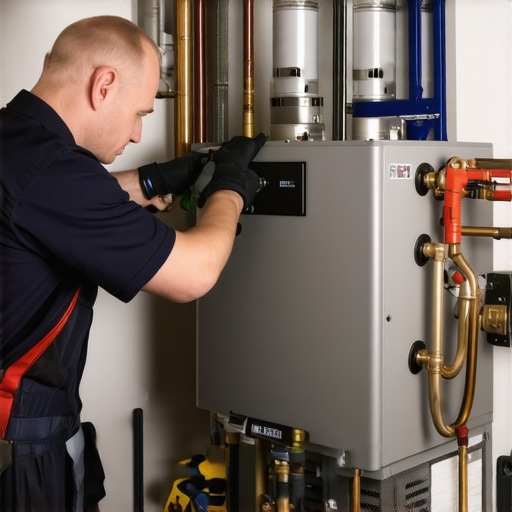
The Sound of a Silent Furnace in Mid-January
There is a specific kind of silence that wakes you up at 3:00 AM. It is not the peaceful silence of a sleeping house; it is the heavy, hollow silence of a furnace that has stopped mid-cycle. You hear the thermostat click, you hear the inducer motor groan, but the whoosh of ignition never follows. That is the sound of a decision you have to make: repair or replace? As someone who has spent three decades crawling through crawlspaces and sniffing out cracked heat exchangers, I can tell you that 2026 has changed the math on this decision significantly. We are no longer just talking about a blower motor or a dirty flame sensor. We are talking about a massive regulatory shift in the HVAC industry that affects every AC installation and heating service call in the country.
The Narrative: The Case of the $14,000 Ghost Crack
Last February, I followed a ‘Sales Tech’ from one of those big-box franchises to a house in a working-class neighborhood. The previous tech had told a homeowner—a retired teacher—that her 12-year-old furnace had a ‘lethal’ crack in the heat exchanger and she needed to sign for a $14,000 system immediately or he’d have to shut off her gas. She was terrified. I pulled the blower, stuck my inspection camera into the cells, and found… nothing. Not a scratch. The real culprit? A clogged condensate trap that was backing up water and tripping the pressure switch. A $150 repair. This is the reality of the industry today. The ‘Sales Techs’ want to sell you a shiny new box because they get a commission. My job is to tell you if that box is actually broken or if it just needs a mechanic who knows how to use a multimeter instead of a sales brochure.
The Forensic Anatomy of a Failing System
When we look at furnace repair, we have to look at the ‘The Big Three’: the Heat Exchanger, the Control Board, and the Inducer Assembly. The heat exchanger is the lungs of your system. If it’s breached, you aren’t just losing efficiency; you are risking carbon monoxide poisoning. But here is the Thermodynamic Zooming perspective: a furnace doesn’t just ‘make heat.’ It facilitates a chemical reaction between natural gas and oxygen, then transfers that energy through metal walls to your home’s air. In a high-efficiency 95% AFUE (Annual Fuel Utilization Efficiency) furnace, we have a secondary heat exchanger. This is where the ‘magic’—and the most trouble—happens. It pulls the latent heat out of the exhaust gasses, condensing them into water. If your heating service tech doesn’t check the pH of that condensate, they aren’t doing their job. Acidic water eats secondary exchangers from the inside out.
“The most expensive equipment in the world cannot overcome a bad duct system.” – Industry Axiom
If your furnace is struggling, the problem might not even be the furnace. It is often the static pressure. Think of it like a human heart trying to pump blood through clogged arteries. If your tin knocker (duct guy) built a return air drop that is too small, your furnace will overheat every single cycle. This is called ‘Limit Tripping.’ It’s the leading cause of premature heat exchanger failure. You can spend $10,000 on a new unit, but if the ductwork is trash, that new unit will be dead in seven years.
The 2026 Regulatory Cliff: R-454B and the A2L Transition
Why is 2026 different? Because we are currently in the middle of the ‘Great Refrigerant Transition.’ If you are considering a full HVAC upgrade—meaning both a furnace repair and a new AC installation—you are now dealing with A2L refrigerants like R-454B or R-32. These are ‘mildly flammable.’ The industry is moving away from R-410A (the old gas/juice). This means new systems now require leak sensors and specialized control boards that can shut the system down if a leak is detected. This has driven the price of equipment up by 20-30% in just two years. If you have an old R-22 system, you are essentially driving a car that uses leaded gasoline; the parts are becoming museum pieces.
The Repair vs. Replace Math
So, when do you pull the trigger? I use the $5,000 Rule. Take the age of the furnace and multiply it by the cost of the repair. If the result is over $5,000, replace it. For example, a $600 inducer motor on a 10-year-old furnace equals $6,000. That is replacement territory. But it’s not just about the money; it’s about the physics of comfort. A modern mini-split or a variable-speed furnace can modulate. Instead of being 100% ON or 100% OFF, it can run at 40% capacity, trickling heat into the house to maintain a perfect 72 degrees without the ‘blast of hot air’ followed by a ‘cold chill’ cycle. This is especially vital in cold climates where a cracked heat exchanger isn’t just an inconvenience—it’s a pipe-bursting emergency.
“Proper sizing and installation of HVAC systems are more critical for energy efficiency than the equipment’s rated efficiency itself.” – ACCA Manual J Standards
The Airflow Manifesto: Why Your New Unit Might Fail
If you decide on a new heating service installation, don’t let the tech just ‘swap the box.’ Demand a Manual J load calculation. Most furnaces in America are oversized, which sounds good but is actually a disaster. An oversized furnace ‘short cycles.’ It heats the air so fast that the walls and furniture stay cold. It never reaches its steady-state efficiency. It’s like driving a Ferrari only in school zones. You want a unit that runs long, slow cycles. And for the love of all that is holy, make sure your installer uses Pookie (mastic) on the plenum joints. Duct tape is for wrapping Christmas presents; mastic is for sealing air. If the sparky (electrician) hasn’t checked your circuit breaker’s ampacity for the new blower motor, you’re looking at a fire hazard.
Final Verdict for 2026
If your furnace is under 12 years old and the repair is under $800, fix it. If your heat exchanger is rusted out, or if you are still running an 80% AFUE unit and your gas bills are skyrocketing, it is time to move to a 96% or 97% condensing model. And if you’re in a climate where the suction line gets ‘beer can cold’ in the summer but the furnace screams in the winter, consider a dual-fuel heat pump system. Just remember: the ‘Sales Tech’ wants your signature, but the ‘Airflow Architect’ wants your static pressure to be 0.5 inches of water column. Choose the guy who carries a manometer, not just a tablet.