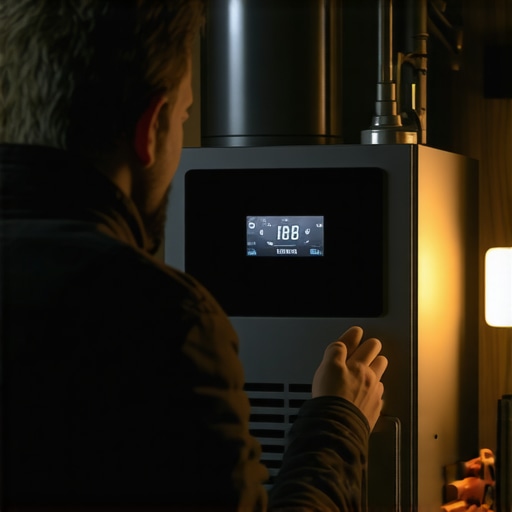
The Silence of a Dead Furnace: A 3 AM Reality Check
There is a specific sound every homeowner in the North dreads. It is not a bang or a crash; it is the absence of sound. It is the silence that happens when the induced draft motor tries to spin up, clicks three times, and then goes dark while the wind howls outside at sub-zero temperatures. As a technician who has spent thirty years crawling through frozen crawlspaces and sniffing for the metallic tang of a cracked heat exchanger, I can tell you that most people wait until that silence happens to care about their heating service. By then, you are not just paying for a furnace repair; you are paying the ’emergency tax’ to a guy who probably just wants to sell you a whole new box instead of fixing the one you have.
The $300 Ghost: A Tale of the Sales Tech Scam
I remember a call last February in the middle of a polar vortex. I followed a ‘Sales Tech’ from one of those big-box franchises. He had told a young couple that their five-year-old furnace was a ‘death trap’ due to a cracked heat exchanger and quoted them $9,500 for a rush AC installation and furnace combo. They were shivering, terrified of carbon monoxide, and ready to sign the financing papers. I stepped in for a second opinion. I pulled the burner assembly and looked at the flame sensor. It was covered in a thin layer of silica oxidation—basically just dust from the combustion process. I cleaned it with a piece of dollar bill (because emery cloth is too abrasive for some coatings), and the unit fired up perfectly. That ‘cracked heat exchanger’ was actually just a dirty sensor that would have cost them $300 in a ‘diagnostic fee’ if the first guy had been honest, or $150 if they had just maintained it. Instead, they almost lost ten grand. This is the reality of the industry as we head toward the 2026 regulatory shifts.
“The heat exchanger must be inspected annually for signs of corrosion, physical damage, or cracks that could allow combustion products to enter the living space.” – ACCA Standard 4 (Maintenance of Residential HVAC Systems)
Thermodynamic Zooming: Why Your Furnace Fails
To understand why your furnace is going to quit right before the 2026 freeze, you have to understand the physics of the heat exchange. In a high-efficiency gas furnace, we are dealing with two stages of heat extraction. First, the primary heat exchanger takes the brunt of the flame—sensible heat. But then, the secondary heat exchanger (the one that makes it ‘high efficiency’) pulls out the latent heat. This causes the flue gases to condense into a mildly acidic liquid. If your ‘tin knocker’ didn’t pitch that drain line correctly, that acidic water backs up into the inducer housing. The pressure switch—the ‘brain’ of the airflow circuit—detects the blockage and shuts everything down to prevent flame rollout. You think it’s a dead motor; I know it’s just a clogged plastic tube. But if you don’t know the difference, a ‘Sales Tech’ will charge you for the motor anyway.
The 2026 Freeze and the Regulatory Cliff
Why am I talking about 2026? Because the EPA and DOE are tightening the screws. We are moving away from R-410A refrigerant toward A2L ‘mildly flammable’ refrigerants like R-454B. While this primarily affects your AC installation, the integrated systems—the air handlers and the furnaces that talk to them—are becoming increasingly complex and expensive. If you have an old 80% AFUE furnace, the parts are becoming ‘legacy’ items. If you wait until the 2026 freeze to realize your heat exchanger is actually rotted out, you will be forced into a high-efficiency system that requires new venting, new ‘Pookie’ (mastic) on every joint to satisfy static pressure requirements, and a much higher price tag.
“A heating system’s seasonal efficiency is significantly degraded by duct leakage, improper gas pressure, and restricted airflow.” – ASHRAE Standard 103
The Mini-Split Alternative: Physics of Zoning
I see a lot of folks in the Northeast and Midwest switching to a mini-split setup for supplemental heat. Here is the technical truth: a heat pump is just an air conditioner running in reverse. It uses a reversing valve to swap the roles of the evaporator and condenser. In the old days, these units were useless below 40°F. Today, ‘Hyper-Heat’ technology allows them to pull sensible heat out of the air down to -15°F. If you are worried about your central furnace failing, adding a mini-split to your main living area isn’t just a luxury; it’s a redundancy strategy. It keeps the ‘juice’ (refrigerant) moving and provides a backup that doesn’t rely on a cracked heat exchanger or a failing gas valve.
The Anatomy of a Proper Heating Service
If you want to avoid the $300 mistake, you need to demand a real technical audit, not a ‘tune-up.’ A real tech checks the following:
- Static Pressure: If the ‘tin knocker’ who built your house undersized the return air, your furnace is ‘suffocating.’ This causes the heat exchanger to overheat and crack. It’s like running a marathon while breathing through a straw.
- Flame Rectification: We measure this in microamps. If your flame sensor is reading below 2.0 microamps, your furnace will ‘short cycle’ and eventually lockout.
- Temperature Rise: We measure the air temp before and after the coil. If it’s too high, your blower motor is dying or your filter is a ‘brick’ of dust.
Don’t Be the Victim of a ‘Sparky’ or a Salesman
I’ve seen it all—guys using duct tape where they should have used ‘Pookie,’ and ‘Sparkies’ (electricians) wiring up contactors that hum like a hornet’s nest because the voltage drop is too high. The 2026 freeze is coming, and the cost of equipment is only going up. Clean your flame sensor, check your condensate drain, and for heaven’s sake, change your filters. Airflow is the only thing keeping your furnace from becoming a very expensive paperweight. Comfort isn’t magic; it’s physics. And physics doesn’t care about your budget when the temperature hits zero.