The Sound of a $12,000 Mistake
Most homeowners think a new AC installation is like buying a refrigerator—you plug it in, and it works. That logic is the fastest way to flush ten grand down the condensate drain. I’ve spent thirty years on hot shingles and in crawlspaces, and I can tell you that the brand name on the cabinet matters about 10% as much as the hands that installed it. If the crew just ‘dropped and swapped,’ you haven’t bought a cooling system; you’ve bought a ticking time bomb of compressor failure and astronomical utility bills. Let’s talk about what actually happens when the ‘Tin Knockers’ show up at your door.
The Narrative: The Tale of the ‘Sales Tech’ Sabotage
Last season, I followed a ‘Sales Tech’ from a big-box franchise who had convinced a retired teacher she needed a full replacement because her five-year-old coil was ‘leaking’ (it wasn’t). He quoted her $16,000 for a high-efficiency system. When I arrived for a second opinion, I found the unit was fine, but the original installation was a disaster. They hadn’t used a micron gauge during the vacuum, leaving non-condensables in the line set that eventually cooked the oil. I caught the ‘Sales Tech’ trying to hide a $30 capacitor in his palm to justify the ‘leak’ story. This is why you verify. This is why you watch the process. If you don’t know what a proper AC installation looks like, you’re just writing a blank check to a predator.
The Thermodynamics of Proper Airflow
Airflow isn’t just a breeze; it’s the vehicle for heat transfer. When we talk about cooling, we aren’t actually ‘adding cold.’ We are removing heat. The evaporator coil must drop below the dew point to wring out the latent heat—that’s the humidity that makes you feel like you’re breathing through a wet sock. If your crew didn’t measure your ductwork, they’re guessing.
“The most expensive equipment in the world cannot overcome a bad duct system.” – Industry Axiom
The Nitrogen Purge: The Line Between Professional and Hack
Watch the technicians when they start brazing the copper lines. Do you see a black tank of dry nitrogen hooked up? If they are brazing without a nitrogen purge, they are oxidizing the inside of the copper. This creates ‘soot’ (cupric oxide) that flaked off and headed straight for your compressor’s valves or the TXV (Thermal Expansion Valve). It’s like throwing a handful of sand into an engine. A true pro purges nitrogen at 2-3 PSI while brazing to keep the ‘juice’ lines clean. If you don’t see that tank, they’re killing your unit before it even starts.
The Vacuum Test: Not a ‘Rule of Thumb’
Once the lines are brazed, they have to pull a vacuum. This isn’t just to see if it holds; it’s to boil off moisture. Water is the enemy of ‘gas’ (refrigerant). If moisture stays in the system, it reacts with the POE oil to create hydrofluoric acid. That acid eats the motor windings from the inside out.
“A system shall be evacuated to a level of 500 microns or less to ensure the removal of moisture and non-condensables.” – ACCA Manual Standard 5
If the tech tells you, ‘I just run the pump for twenty minutes,’ they are lying to you. You cannot measure a vacuum with a standard manifold gauge set. They need a digital micron gauge. If it doesn’t hit 500 microns and hold, the system is contaminated.
The Regulatory Cliff: The R-410A Sunset
We are currently standing at the edge of the A2L transition. R-410A is being phased out for mildly flammable refrigerants like R-454B and R-32. This means the installation crew needs to be more precise than ever. These new systems require specific sensors and ventilation protocols. If your ‘Sparky’ or HVAC crew is still treating a 2024/2025 install like a 1995 R-22 ‘gas’ charge, you’re going to have safety issues. Verify that they are EPA Section 608 certified and trained on A2L protocols. This isn’t just furnace repair or basic heating service; this is high-stakes chemistry.
Static Pressure: The Silent Killer
After the unit is running, the tech should be out there with a manometer. They need to check the Total External Static Pressure (TESP). Think of this like blood pressure for your HVAC system. If the static pressure is too high (usually over 0.5 inches of water column for residential units), the blower motor has to work twice as hard and will burn out prematurely. It also means you aren’t getting the CFM (Cubic Feet per Minute) required to cross the coil. This leads to the ‘short cycling’ we see in humid climates, where the unit turns on and off so fast it never removes the humidity, leaving your house a cold, clammy swamp.
Pookie and Tin: The Art of the Seal
Check the plenum—the big box where the ducts connect to the furnace or air handler. Do you see ‘Pookie’ (gray mastic sealant) or just silver tape? Tape fails in three years. Mastic lasts forever. If you see air whistling out of the seams in the attic, you are literally paying to cool the squirrels. A mini-split installation avoids some of this ductwork drama, but even then, the flared connections must be torqued to spec, not just ‘tightened until she grunts.’ If they aren’t using a torque wrench on a mini-split, they will leak ‘juice’ within two seasons.
The Commissioning Report
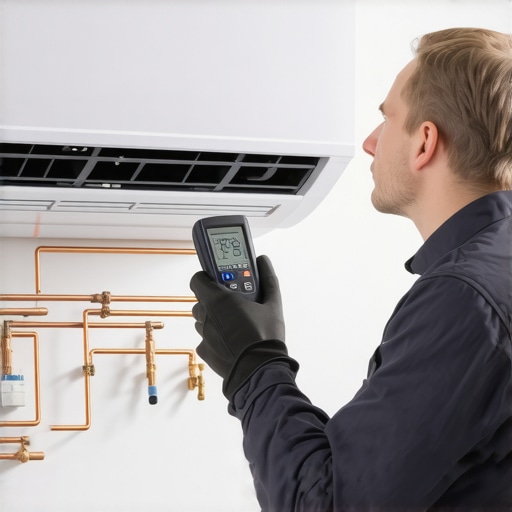
Before you sign that final check, demand the commissioning sheet. A real professional will record the Superheat and Subcooling. This is the only way to know the refrigerant charge is perfect. ‘Beer can cold’ is not a measurement; it’s a symptom of a lazy tech. They should also verify the temperature drop (Delta T) across the coil. In a standard setup, you’re looking for a 16 to 20-degree difference. If they can’t show you these numbers on a digital manifold or a tablet, they didn’t finish the job.