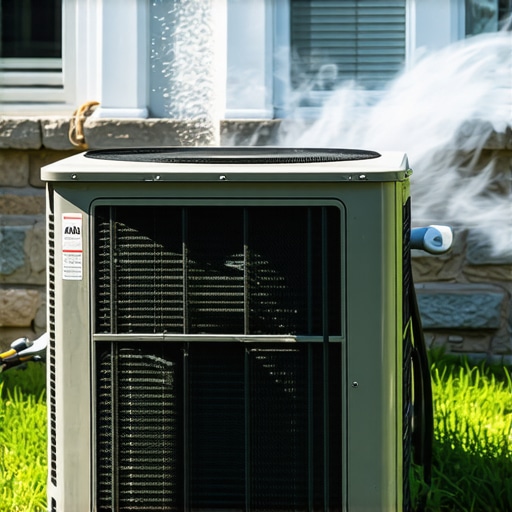
You hear it before you feel it. That low-frequency hum of the indoor blower motor still pushing air, but the soul of the machine—the cool, crisp relief of 55-degree supply air—has vanished. You walk to the vent, and it is blowing lukewarm. In the trade, we call this the Afternoon Ghost. It is 3 PM, the sun is a hammer, and your condenser outside just threw in the towel. If you call the big-box companies, they will send a Sales Tech in a starched white shirt who hasn’t seen the inside of a furnace repair cabinet in five years. He will tell you the compressor is grounded and try to pivot you into a $16,000 AC installation before he even hooks up his gauges. Do not fall for it.
The Case of the $12,000 Bad Compressor Scam
I remember a call three years ago at a local bakery in the middle of a July heatwave. The owner was nearly in tears. A Comfort Consultant—that is corporate-speak for a salesman—told her she needed a full system swap because her unit was leaking juice faster than she could pump it in. I walked up to that rooftop unit, popped the panel, and did not see a leak. I saw a capacitor that looked like a bloated can of soup. A $40 part. The Sales Tech did not even check the microfarads; he just saw a commission check. I swapped the cap, hosed down the coils, and that unit is still humming today. That is why you need to understand the physics of why your system is failing when the heat hits the sensible peak.
Thermodynamic Zooming: The Afternoon Heat Rejection Crisis
To understand why your AC quits in the afternoon, you have to understand heat rejection. Your AC does not make cold; it moves heat.
“Air-conditioning systems shall be sized to provide the cooling and heating required for the space to be conditioned as determined by a heat loss and heat gain calculation.” – ACCA Manual J
When the ambient temperature outside hits 110°F, your condenser coil is trying to dump heat into air that is already saturated with energy. This raises the head pressure. If your coil is even slightly restricted by dust or Pookie (mastic) residue from a sloppy Tin Knocker, the refrigerant—the Gas—cannot condense back into a liquid. The compressor starts pulling high amps, gets the internal windings hot enough to smell that acidic, sour burnout scent, and eventually hits the thermal overload switch. It shuts down to save its own life, leaving you with nothing but a fan blowing hot air.
The Forensic Diagnosis: Why It Quits When It Is Hot
If your unit works fine in the morning but fails when the sun hits the peak, we are looking at a few usual suspects. First is the capacitor. This is the battery for your motor. Heat kills them. When the afternoon sun beats on the service panel, the internal chemistry of the capacitor breaks down. Second is the condenser coil. If it is packed with pet hair or dirt, the unit cannot breathe. It is like trying to run a marathon while breathing through a straw. This is why a regular heating service check-up in the spring is vital; we clean those coils before the hammer drops in August.
The Mini-Split Alternative and Efficiency
Sometimes, the old central air unit just cannot keep up with the modern thermal load of a house with poor insulation. That is where a mini-split system shines. These units use variable-speed compressors that do not just slam on and off. They ramp up and down, maintaining a constant temperature without the massive amp draws that fry components in the afternoon heat. For many homeowners, adding a mini-split to a hot master bedroom is cheaper than a full AC installation for a system that is already struggling.
Static Pressure: The Silent Killer
One room is freezing, the other is hot, and by 4 PM, the whole system just stops. This is often a result of high static pressure.
“The design of the duct system shall be based on the calculation of the pressure drop of the most restrictive path.” – ASHRAE Standards
If your ducts are too small, the blower motor has to work twice as hard. This creates a backup of heat at the evaporator coil. In the afternoon, when the load is highest, the system simply cannot move enough air to prevent the coil from dropping below the dew point and turning into a block of ice. Once that coil is a popsicle, no air gets through, and your suction line—which should be beer can cold—starts sweating like a Sparky looking at a circuit diagram. The system eventually shuts down on a high-pressure or low-pressure limit.
The Verdict: Repair or Replace?
If your technician immediately jumps to a new unit without checking the contactor or the Gas levels, get a second opinion. A simple hard start kit can often give an aging compressor the boost it needs to overcome afternoon head pressure. However, if your furnace repair technician finds a cracked heat exchanger or a grounded compressor, then the math shifts. Modern units are moving toward R-454B refrigerants as the industry moves away from R-410A. Buying now might save you from the regulatory price hikes coming in 2025. Comfort is physics, not magic. Keep your coils clean, your filters fresh, and do not let a salesman talk you out of a perfectly good machine just because it needs a little TLC.