The Sound of a Wet Disaster: When Your New System Fails the Humidity Test
I’ve spent the last three decades crawling through attics that felt like the inside of a preheated oven and basements that smelled like a damp grave. If there is one thing I’ve learned, it’s that your brand-new, high-efficiency AC installation is only as good as the physics supporting it. You spent $12,000 on a shiny new condenser and an air handler with more computer chips than a Silicon Valley server room, yet here you are, looking at water dripping from your ceiling. You see the insulation around your ducts looking like a wet, gray sponge. You call the guy who installed it, and he tells you ‘it’s just the humidity.’ That’s a load of horse manure. Air doesn’t just sweat for no reason; it sweats because someone ignored the psychrometric chart.
The ‘Sales Tech’ and the $14,000 Condensation Lie
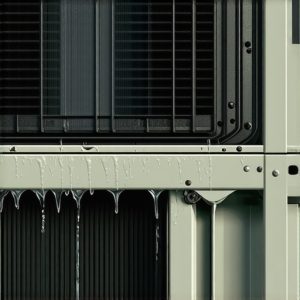
Last August, I followed a ‘Sales Tech’—you know the type, clean uniform, smells like expensive cologne, never actually touched a manifold gauge—who told a homeowner that their sweating plenum was a sign of a ‘porous’ cabinet and they needed a complete heating service overhaul and a new 20-SEER unit. I walked in with a simple psychrometer and a flashlight. The ‘porous’ cabinet was actually a massive air leak where the tin knocker failed to apply enough pookie (mastic) to the supply plenum. The unit was sucking in 110°F attic air, hitting the dew point instantly. I fixed the ‘unrepairable’ system with a five-dollar bucket of sealant and some fiberglass wrap. He wanted $14,000; I charged for a service call. That’s the difference between a salesman and a technician.
“The most expensive equipment in the world cannot overcome a bad duct system.” – Industry Axiom
Thermodynamic Zooming: The Physics of the Sweat
To understand why your insulation is failing, we have to look at the evaporator coil. The goal of your AC is to remove latent heat—that’s the sticky humidity that makes 80 degrees feel like 95. As the juice (refrigerant) expands into the evaporator coil, the surface temperature of that copper drops to about 40-45°F. This is well below the dew point of the air in your home. As the blower motor pushes warm, humid return air over those cold fins, the moisture wrings out like a wet rag. This is why you have a primary drain line. However, if your AC installation was done by a hack, that cold air is cooling the metal of your ducts way too fast. If that metal isn’t thermally isolated from the hot, humid air in your attic or crawlspace by at least R-8 insulation, the moisture in the ambient air will condense on the outside of the duct. Once that fiberglass gets wet, its R-value drops to nearly zero. Now you have a runaway train of condensation.
The Airflow Manifesto: Why Your Unit is Oversized
One of the biggest crimes in this industry is oversizing. Most contractors don’t perform a Manual J load calculation. They just look at your old unit and go one size up ‘to be safe.’ If you have a 3-ton load and they install a 4-ton unit, you are in trouble. The unit will ‘short cycle,’ meaning it hits the temperature setpoint on the thermostat in ten minutes and shuts off. But here’s the kicker: it takes about 15 to 20 minutes of runtime for a coil to reach its peak dehumidification capacity. An oversized unit cools the air (sensible heat) but leaves the water (latent heat). Your house feels like a cold, dark swamp. This excess moisture in the air makes the temperature delta between your supply registers and the room air so sharp that the registers themselves start dripping. You don’t need a furnace repair; you need someone to check your blower speed and static pressure.
“Designers shall use the procedures outlined in ACCA Manual J to calculate the heating and cooling loads of the building.” – ACCA Standard 5
The Anatomy of the Failure: Pookie, Static, and the Suction Line
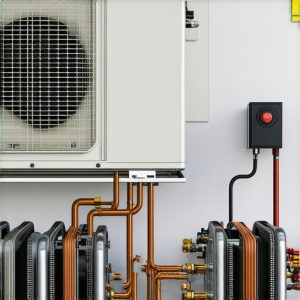
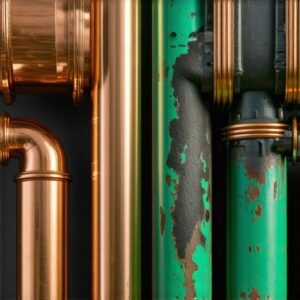
Check your suction line—that’s the larger, insulated copper pipe. In a perfect world, it should be ‘beer can cold’ and sweating under the insulation. But if that insulation is torn or missing, it’s a constant drip. More importantly, look at the connections. If the sparky or the installer didn’t seal the electrical whip entry point into the air handler, hot air is being pulled directly into the cabinet. This causes internal condensation that rots out your control board. If you have a mini-split, the drain lines are even more temperamental. A single kinking of that 5/8-inch hose and you have a waterfall behind your drywall. Airflow is king. If your static pressure is too high because your ducts are too small, the air moves too slowly, the coil gets too cold (maybe even freezes), and the sweating becomes an absolute flood.
The 2025 Regulatory Cliff: R-454B and Your Future Repairs
We are currently in a massive transition. The old R-410A gas is being phased out for A2L refrigerants like R-454B. These new systems are more sensitive to airflow than anything we’ve seen in 30 years. If your current installer can’t explain why your ducts are sweating now, they certainly won’t be able to handle the new sensors and mildly flammable refrigerants coming down the pike. If you are getting a heating service or a new cooling setup, demand a static pressure test. If they don’t know what a manometer is, show them the door. Your comfort isn’t a matter of luck; it’s a matter of fluid dynamics. Stop letting ‘Sales Techs’ tell you that a dripping vent is normal. It’s a sign of a system that’s choking to death on its own cold air.