The Ghost in the Machine: Diagnosing a Dying AC Capacitor
My old mentor, a grizzled veteran who refused to wear anything but starch-pressed khakis even in a 130-degree attic, used to grab me by the collar and bark, ‘You can’t cool what you can’t touch!’ He wasn’t just talking about the juice (refrigerant) hitting the evaporator coils; he was talking about the physics of movement. In the Southwest, where the mercury hits 115°F before lunch, the movement of heat is a life-or-death struggle for your equipment. If the blower doesn’t push air or the fan doesn’t pull heat, you aren’t an HVAC tech; you’re just a guy watching metal melt. And at the heart of that movement is a small, silver cylinder that most homeowners ignore until the house feels like a pizza oven: the capacitor.
The Thermodynamic Zoom: Why the Capacitor is Your Compressor’s Life Support
To understand why your AC is struggling, we have to look at latent heat versus sensible heat. In a dry climate like ours, we deal mostly with sensible heat—the stuff you feel on your skin. To move that heat out of your living room, the system relies on a phase-change cycle. The compressor is the heart, pumping gas at high pressure to the condenser. But here is the catch: motors are lazy. To get a heavy compressor or a condenser fan spinning from a dead stop against high head pressure, you need a massive ‘kick’ of torque. That is where the capacitor comes in. It is a temporary storage device that holds an electrical charge, dumping it all at once to overcome the inertia of the motor. Without that kick, the motor just sits there, hums, and cooks its internal windings.
“The most expensive equipment in the world cannot overcome a bad duct system, nor can it survive a failure in its starting components.” – Adapted from ACCA Manual J Principles
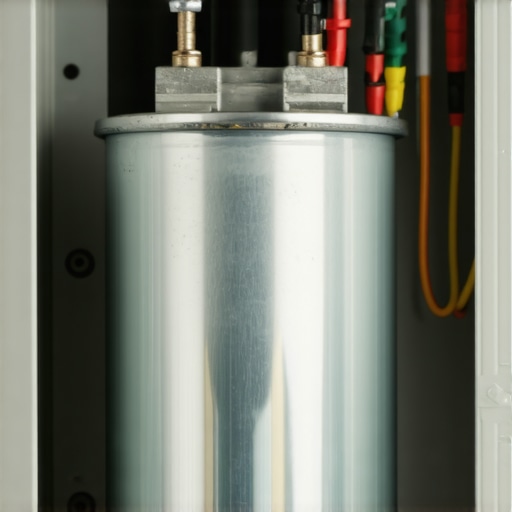
When I’m out on an AC installation or a heating service call, I see these silver cans bulging like they’re about to pop. In the Southwest, the heat is the primary enemy. The dielectric fluid inside the capacitor literally boils over years of 120-degree summers. When that happens, the ‘microfarads’ (the unit of measurement for electrical storage) drop. Your motor might still start, but it’s working harder, drawing more amps, and getting hotter. Eventually, the compressor’s internal thermal overload switch will trip, and you’ll be left with a silent outdoor unit and a rising thermostat.
The Forensic Diagnosis: Sensory Signs of a Dying Capacitor
You don’t need a multimeter to know your system is in trouble, though a Sparky would tell you otherwise. Use your senses. First, listen for the Sound of Silence. If you hear a rhythmic ‘click… hummmmm’ coming from your outdoor unit, but the fan isn’t spinning, that’s a classic sign. The contactor has pulled in, the juice is flowing, but the capacitor doesn’t have the ‘oomph’ to get the motor moving. If you catch it early, you might hear a high-pitched screeching or a chatter. That’s the motor struggling with inconsistent voltage. Second, look at the physical shape. A healthy capacitor is flat on top. A dying one looks ‘pregnant’—the top will be domed or mushroomed. That is the internal pressure relief valve trying to keep the can from exploding.
Third, smell the air. I’ve walked into backyards where the air smells slightly like ozone or burnt plastic. That’s the smell of a motor’s insulation starting to bake because it’s running on a weak capacitor. If you let it go, you won’t just be looking at a $200 repair; you’ll be looking at a full furnace repair or a total system swap because the acid from a burnt-out compressor has contaminated the entire lineset. [image_placeholder_1]
The Math of the ‘Sales Tech’ Scam
I despise the ‘Sales Techs’ who populate the big-box companies nowadays. They see a weak capacitor as an opportunity to sell you a $15,000 mini-split or a new 5-ton split system. They’ll tell you the ‘juice is low’ or the ‘compressor is grounded.’ Don’t buy it. A capacitor is a wear-and-tear item, like the tires on your truck. If your system is less than 12 years old and it’s not cooling, there is an 80% chance it’s a $150 to $300 electrical fix. However, in our dry heat, I always recommend a ‘Hard Start Kit.’ This is essentially a secondary capacitor and a relay that gives the compressor an extra boost, reducing the time it spends in ‘locked rotor amps.’ It saves the equipment and your wallet.
“All electrical connections and components shall be inspected annually to ensure the integrity of the vapor-compression cycle.” – ASHRAE Standard 180
Climate Reality: The Southwest Heat Soak
In regions like Arizona or Nevada, we deal with ‘Heat Soak.’ Even after the sun goes down, the attic and the outdoor cabinet stay at 110 degrees. This constant thermal stress means your capacitors will likely only last 4 to 6 years. If you haven’t had a professional check the microfarad readings on your capacitors during your spring heating service or AC tune-up, you’re playing Russian Roulette with your comfort. I’ve seen tin knockers install the most beautiful ductwork in the world, perfectly balanced with Pookie (mastic) on every seam, only to have the system fail because a $40 part gave out during a July monsoon. Don’t let a small electrical component turn your home into a kiln. Watch for the bulge, listen for the hum, and keep your coils clean to lower that head pressure.