The Sound of a 5-Ton Mistake
You know the sound. It’s that deep, heavy thump of a 5-ton compressor slamming on like a freight train, followed by a hurricane-force blast of air through registers that are whistling for mercy. To the untrained homeowner, that sound means ‘power.’ To me, after thirty years of hauling manifolds through fiberglass-filled attics and smelling the acidic, sour stench of a burned-out compressor, that sound is the death knell of comfort. I spent my early years as a ‘tin knocker’ apprentice, and my mentor, a guy we called ‘Iron Lung’ Joe, used to smack the side of a return plenum with a wrench whenever a customer asked for a ‘stronger’ unit. He’d scream, ‘You can’t dry what you can’t touch, kid!’ It took me a decade to realize he was talking about the physics of the evaporator coil and why AC installation is a science of subtraction, not addition.
The Physics of the ‘Cold Swamp’
We need to talk about why your house feels like a basement in a horror movie even when the thermostat says 68 degrees. In the trade, we look at heat in two ways: sensible heat (the temperature you see on the dial) and latent heat (the moisture in the air). When you go for a massive AC installation because you think ‘bigger is better,’ you’re committing a thermodynamic crime. A massive unit has so much sensible capacity that it reaches the setpoint on your thermostat in ten minutes. We call this ‘short cycling.’ The problem? An evaporator coil needs time—usually 10 to 15 minutes of continuous run-time—to drop below the dew point and start pulling moisture out of the air. If the unit shut off after eight minutes, that coil is still dripping wet, the humidity stays in your living room, and now you’re living in a ‘cold swamp.’ It’s clammy, it’s gross, and it’s the perfect breeding ground for biological growth in your ductwork.
“Equipment capacity must be matched to the calculated load; oversizing leads to poor dehumidification and reduced efficiency.” – ACCA Manual J, Section 1-4
Thermodynamic Zoom: The Latent Heat Struggle
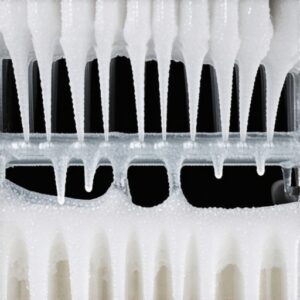
Let’s get technical for a second. When the mini-split or central air handler kicks on, the refrigerant (the ‘juice’ or ‘gas’ as some old-timers say) starts boiling in the evaporator coil. This coil needs to get cold enough to attract water molecules. Think of a cold beer can on a July afternoon—that’s condensation. Now, imagine if you only took that beer can out of the fridge for thirty seconds and then put it back. It wouldn’t even get damp. That is exactly what an oversized AC does. It doesn’t run long enough to let the water roll off the fins and into the drain pan. Instead, that moisture just sits on the coil and gets blown right back into the house the next time the fan kicks on. This is why you need a tech who understands heating service and cooling loads, not just a ‘Sparky’ or a ‘Sales Tech’ looking to pad his commission with a more expensive, larger unit.
The High Static Pressure Nightmare
Airflow is king. Period. Most of the ‘bad units’ I see in the field are actually just victims of terrible ductwork. If you put a 5-ton unit on a duct system designed for 3 tons, you’re creating high static pressure. It’s like trying to blow a gallon of water through a coffee straw. The blower motor works overtime, the compressor starts ‘slugging’ liquid refrigerant back to the crankcase, and suddenly you’re calling for an emergency furnace repair or AC overhaul because your heat exchanger or compressor gave up the ghost. I’ve seen guys try to fix this by slathering ‘Pookie’ (mastic) over every leak, but you can’t duct-tape your way out of bad physics. If the duct is too small, the unit can’t ‘breathe,’ and your humidity levels will skyrocket because the air is moving too fast across the coil to actually get dehumidified.
“Moisture removal occurs only when the evaporator coil temperature is below the dew point of the entering air and the system maintains sufficient residence time.” – ASHRAE Fundamentals Handbook
The Modern Solution: Why Less is More
In the humid South, we fight latent heat like it’s a war. This is where mini-split technology and variable-speed compressors have changed the game. Instead of a ‘dumb’ compressor that is either 100% on or 100% off, these systems ramp up and down. They’ll run at 30% capacity for two hours, sipping electricity and constantly wringing water out of the air. It’s the difference between a long, slow dehumidification cycle and a violent, short blast of cold air. If your current tech hasn’t performed a Manual J load calculation, they aren’t doing AC installation; they’re just guessing with your money. Don’t be fooled by the ‘Sales Tech’ who tells you that a larger unit will ‘cool the house faster.’ Sure, it’ll drop the temp, but you’ll be sitting there in a sweater with sweat still sticking to your skin because the humidity is at 70%.
The Verdict: Respect the Physics
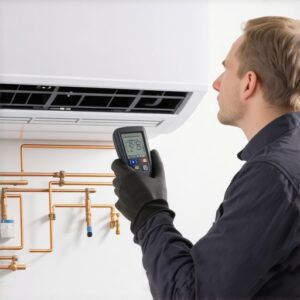
If your unit is short-cycling and your skin feels sticky, you don’t need more ‘juice’ and you don’t need a bigger unit. You need a tech who knows how to measure static pressure and check the ‘suction line’ to ensure it’s ‘beer-can cold’ without being oversized. Comfort isn’t a number on a plastic box on the wall; it’s the result of proper air-to-coil contact time. Stop buying the hype of bigger tonnage. Trust the physics, trust the ‘Tin Knockers’ who know their CFM, and stop turning your home into a cold, damp cave.