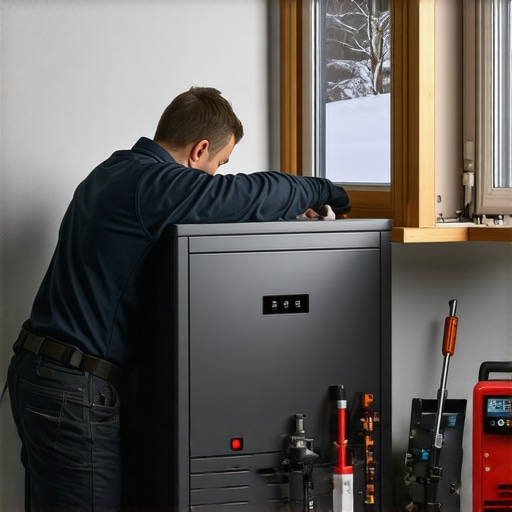
The Sound of Silence at 3 AM
There is a specific kind of silence that wakes an HVAC man up in the dead of winter. It isn’t the silence of a peaceful night; it’s the absence of the rhythmic, low-frequency hum of the centrifugal blower and the faint tink-tink-tink of expanding metal. When that sound stops during a sub-zero cold snap, your house starts losing its battle against entropy immediately. By the time you realize the thermostat is blank, the thermal mass of your drywall is already trending toward the dew point. I’ve spent thirty years crawling through blown-in fiberglass insulation to reach furnaces that died because of a $15 part, and with the 2026 freeze predicted to be a record-breaker, you cannot afford to wait for the ‘no-heat’ emergency call. We aren’t talking about a simple furnace repair here; we are talking about mechanical forensics.
“The most expensive equipment in the world cannot overcome a bad duct system or a neglected combustion circuit.” – Industry Axiom
Last season, I followed a ‘Sales Tech’—one of those guys in a crisp white shirt who carries a clipboard instead of a nut driver—into a home where he’d just quoted a retiree $14,000 for a full heating service replacement. He told her the heat exchanger was ‘compromised’ based on a 30-second visual. I pulled the burner assembly and found a spider had spun a tiny web in the burner orifice. Total cost of the fix? A blast of compressed air and a $90 service fee. I caught him in the driveway and told him to find a new trade before I called the state board. This is why you need to understand the guts of your machine before the ‘Sparky’ or the ‘Tin Knocker’ shows up at your door.
Step 1: The Flame Sensor Rectification Test
Your furnace has a ‘brain’ called the Integrated Furnace Control (IFC). One of its most vital senses is the flame sensor. This is just a stainless steel rod that sits in the path of the flame. Through a process called flame rectification, the furnace sends an AC voltage to the rod; the flame itself conducts electricity and converts it to a tiny DC microamp signal back to the board. If that rod is coated in microscopic carbon or silica, the board thinks there’s no fire and shuts the gas valve for safety. To prevent a 2026 lockout, pull that sensor and clean it with a piece of Scotch-Brite. Do not use sandpaper; the grit stays on the metal and glazes over under heat, killing the signal again. We want those microamps hovering between 2.0 and 5.0 for a rock-solid furnace repair foundation.
Step 2: Scrutinizing the Heat Exchanger’s Integrity
The heat exchanger is the ‘lungs’ of your system. In a North/Cold climate like ours, these metal cells expand and contract thousands of times a season. If you have a cracked heat exchanger, the blower motor will push air into the combustion chamber, causing ‘flame rollout’ where fire literally licks out of the cabinet. This isn’t just a breakdown; it’s a Carbon Monoxide factory. Look for ‘wavering’ flames when the blower kicks on. A healthy flame is a crisp, steady blue. If it’s dancing or turning orange, you have a breach. This is the only time I’ll tell a homeowner to stop and call for a professional heating service immediately. Physics doesn’t negotiate with CO levels.
Step 3: The Inducer Motor and Pressure Switch Logic
Before the igniter even glows, the inducer motor must create a vacuum to prove the flue is clear. This is sensible heat management. I’ve seen birds’ nests in flues cause more furnace failures than actual mechanical parts. If that motor sounds like a bag of marbles in a blender, the bearings are shot. You can’t ‘juice’ a sealed bearing with oil; it needs replacement. Check the small vacuum tubing leading to the pressure switch. If there’s a single drop of condensate water in that tube, the switch won’t close, and the furnace will sit in a permanent ‘pre-purge’ loop. It’s a $2 tube causing a $10,000 headache.
Step 4: Static Pressure and the Airflow Manifesto
Airflow is the undisputed king of HVAC. If your furnace is ‘short cycling’—turning on and off every five minutes—it’s likely hitting the High Limit switch. This happens because the air can’t get out of the furnace fast enough, and the heat builds up until it reaches a safety threshold. Most people think a ‘thick’ 4-inch pleated filter is better, but if your ductwork wasn’t designed for it, you’re essentially suffocating your blower.
“Total external static pressure is the ‘blood pressure’ of your HVAC system; exceeding 0.5 inches of water column is a recipe for premature component failure.” – ACCA Manual D
If you’re planning an AC installation or furnace upgrade, make sure your ‘Tin Knocker’ actually measures the static pressure instead of just eyeballing the ‘Pookie’ on the seams.
Step 5: The Hot Surface Igniter (HSI) Inspection
Most modern furnaces use a silicon nitride igniter that glows orange to light the gas. These are fragile. If you see a small white ‘crack’ or a black spot on the element, it’s about to fail. It’s like a lightbulb filament; it only has so many ‘on’ cycles. Replacing this now is a $50 insurance policy against a midnight emergency call-out fee during the 2026 freeze. Remember: never touch the element with your bare hands. The oils from your skin create a hot spot that will shatter the nitride the first time it hits 2,000 degrees.
Step 6: Condensate Drain Lines and the Secondary Heat Exchanger
If you have a high-efficiency (90%+ AFUE) furnace, your unit creates water as a byproduct of extracting latent heat from the flue gases. This water is acidic. If the drain line is clogged or the ‘trap’ is full of gunk, the water backs up into the secondary heat exchanger. I’ve seen furnaces ‘drown’ from the inside out. Clear your drain lines with a shop vac and make sure the pitch is correct. If that water freezes in an unconditioned crawlspace during the big freeze, your furnace is dead in the water—literally.
Step 7: The Hybrid Strategy (Mini-Splits and Dual Fuel)
For those preparing for the absolute worst, a mini-split backup or a dual-fuel heat pump setup is the smartest move. If the gas lines ever fail or the furnace goes down, a cold-climate heat pump can still pull heat out of the air down to -15°F. It’s about redundancy. During a heating service checkup, ask about the ‘balance point’—the temperature where the heat pump hands the job over to the gas furnace. Optimizing this can save you 30% on your winter utility bills.
The Math of Repair vs. Replace
When is it time to pull the plug? If your furnace is over 15 years old and the repair bill exceeds $800, you’re throwing good money after bad. A new 96% AFUE unit will pay for itself in gas savings alone over the next six winters. But don’t let a Sales Tech bully you into a new unit just because of a dirty flame sensor or a bad capacitor. Use your head, trust the physics, and make sure your ‘Gas’ is flowing before the mercury drops.