The Ghost in the Machine: Why Your Mini-Split is Failing You
I’ve spent thirty years crawling through blown-in insulation and dragging my knuckles across the jagged edges of galvanized ductwork. I’ve seen the industry transition from R-22 that smelled like money to the high-pressure headaches of R-410A, and now we are staring down the barrel of the 2026 transition to A2L refrigerants like R-454B. Most homeowners think a mini-split is a ‘set it and forget it’ appliance. They treat it like a toaster. But after three decades of AC installation and countless late-night calls for emergency heating service, I can tell you: a mini-split is a high-performance race car engine bolted to your wall. If you don’t maintain the physics of heat transfer, the physics will eventually maintain your bank account—usually by draining it.
My old mentor, a man we called ‘Iron Mike’ who could smell a leak from the curb, used to bark at me every morning: ‘Kid, you can’t cool what you can’t touch!’ He wasn’t talking about the air; he was talking about the surface area of the evaporator coil. If that coil is choked with dust, skin cells, and pet dander, the ‘gas’ (that’s refrigerant for the uninitiated) can’t boil off. When that happens, you aren’t just losing efficiency; you’re risking a liquid slug back to the compressor that will turn your expensive inverter into a very heavy paperweight. This isn’t just about furnace repair or basic mini-split cleaning; it’s about understanding the thermodynamic dance of latent versus sensible heat.
“Equipment shall be sized according to the heating and cooling loads calculated by Manual J or other approved methods.” – ACCA Manual J Section 1-1
The Forensic Diagnosis: Anatomy of a Mini-Split Failure
In a humid climate like the Gulf Coast or the coastal Southeast, the enemy isn’t just the heat; it’s the water. A mini-split is a dehumidification factory. When it’s working right, it’s pulling gallons of moisture out of the air, dropping that air temperature below the dew point. But if the static pressure is off because you haven’t touched the filters, that moisture stays on the coil. It mixes with dust and creates a biological ‘mat’ that smells like a wet basement. This is where most ‘Sales Techs’ will try to sell you a whole new $15,000 system. They’ll look at a dirty blower wheel and tell you the ‘juice’ is low or the compressor is shot. Don’t believe them. Most of the time, the machine is just choking for air. You don’t need a new unit; you need the right tools and a little respect for the refrigeration cycle.
Tool 1: The Precision Fin Comb (The Aerodynamic Restorer)
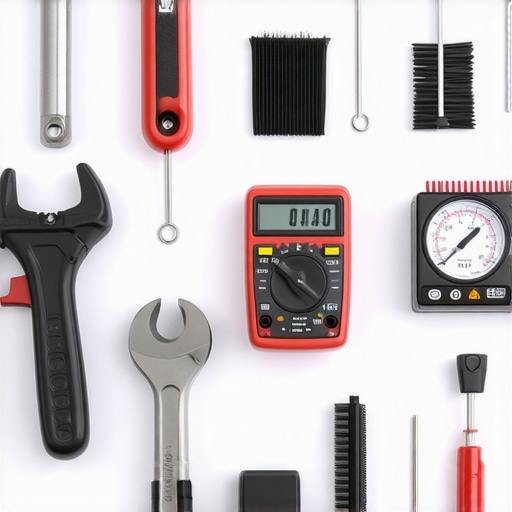
Those aluminum fins on your outdoor condenser are thinner than a soda can. One stray weed whacker or a curious neighborhood kid can flatten them, killing your subcooling. A fin comb allows you to straighten those paths so the fan can actually pull heat away from the high-pressure gas. Without airflow, your head pressure spikes, your compressor works double-time, and your electric bill starts looking like a mortgage payment. It’s the difference between breathing through a straw and taking a deep breath after a long climb.
Tool 2: The Digital Multimeter (The Electrical Stethoscope)
Don’t go poking around unless you know how to discharge a capacitor, or you’ll meet a ‘Sparky’ in the emergency room. However, for 2026 maintenance, a multimeter is non-negotiable. Modern mini-splits use DC inverter technology. You need to verify that the communication wire (the ’14-4′ cable) isn’t throwing ghost signals. If the voltage between terminal 2 and 3 is fluctuating wildly, you’ve got a board issue, not a mechanical one. Checking for continuity in the sensors can save you from a $500 ‘diagnostic fee’ from a tech who’s just guessing with your money.
Tool 3: The Non-Conductive Coil Jet Flush
You cannot just blast a mini-split with a garden hose. You’ll bend the fins and soak the electronics. You need a dedicated pressurized sprayer with a 90-degree wand. This allows you to get behind the ‘A-coil’ geometry of the indoor head. When you see that grey sludge pouring out of the condensate line, you’re seeing the ‘latent load’ that was stealing your comfort. In humid zones, this sludge is the number one cause of water dripping down your wallpaper. It’s not a leak; it’s a blockage. It’s the HVAC equivalent of a clogged artery.
Tool 4: The Eccentric Flaring Tool & Torque Wrench
This is where the ‘DIY’ becomes ‘Professional.’ The new A2L refrigerants like R-32 or R-454B operate at pressures that would make an old R-12 tech weep. If your flare joints aren’t perfect, they will leak. A standard plumbing flaring tool won’t cut it. You need an eccentric tool that burnishes the copper. And for heaven’s sake, use a torque wrench. ‘Tight enough’ isn’t a measurement. If you over-tighten, you thin the copper and it cracks under the vibration of the compressor. If you under-tighten, the gas escapes. Use a drop of Nylog on the threads—it’s the ‘pookie’ of the refrigeration world—and torque it to spec.
“The refrigeration system shall be constructed, installed, and maintained to prevent the escape of refrigerant into the atmosphere.” – ASHRAE Standard 15
Tool 5: The Condensate Line Vacuum Attachment
In 2026, we are seeing more ‘intelligent’ drain sensors. If the water backs up even a fraction of an inch, the unit throws a P5 error and shuts down. Instead of blowing air through the line (which just compacts the debris), use a vacuum attachment to suck the ‘bio-slime’ out from the exterior exit. It’s a five-minute fix that prevents a thousand-dollar ceiling repair. I’ve seen ‘Tin Knockers’ spend hours re-pitching a line when all it needed was a good shop-vac to the exit port.
Tool 6: The Infrared Thermometer (The Delta T Validator)
Physics doesn’t lie. If the air going into the top of the unit is 75°F and the air coming out of the louvers is 55°F, you have a 20-degree ‘Delta T.’ That is the gold standard of sensible heat removal. If that split is only 10 degrees, you either have a refrigerant restriction or a failing TXV (Thermostatic Expansion Valve). An infrared thermometer allows you to see the ‘suction line’ temperature. You want it ‘beer can cold’ but not icing over. If you see ice, stop the unit. You’re starving it for air or you’ve got a leak that needs a pro.
Tool 7: Electronic Leak Detector (Sniffer) for A2L Gases
By 2026, the old soap bubbles trick won’t be enough for the new mildly flammable refrigerants. You need a heated diode or ultrasonic leak detector calibrated for the new gas blends. These sensors can pick up a leak that is losing only 0.1 ounces per year. In the old days, we just ‘topped off the Freon.’ Those days are dead. Refrigerant is a sealed system. If it’s low, there is a hole. Period. Finding that hole with a sniffer is the only way to ensure your system lasts the 15 years it’s supposed to, rather than the 5 years most ‘hack’ installs survive.
The Verdict: Maintenance is the Only Insurance
You can spend $8,000 on a new high-efficiency AC installation, but if you treat it with the same neglect as your old furnace, it will die just as fast. The transition to 2026 standards means the equipment is more sensitive, the refrigerants are more expensive, and the tolerances are tighter. Don’t be the person who calls me in August because their ‘house feels like a swamp’ despite the AC running 24/7. That’s short-cycling. That’s a system that can’t move the latent heat because the coils are blanketed in dust. Buy the tools, learn the physics, and treat your airflow like the king it is. Comfort isn’t a setting on a thermostat; it’s the result of clean coils, tight flares, and a healthy respect for the laws of thermodynamics.