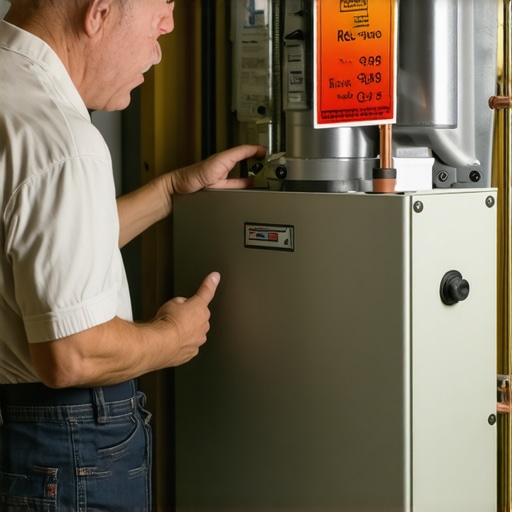
The Anatomy of a Mid-Winter Breakdown
The silence is what hits you first. It’s 3 AM in the middle of a January cold snap, and that familiar, rhythmic rumble of your furnace has been replaced by a dead, hollow chill. You walk to the thermostat, cycle the switch, and hear the click—but the fan doesn’t spin, and the burner doesn’t roar. Most homeowners feel a surge of panic right then. They see dollar signs and visions of a $15,000 AC installation or full system replacement. But after thirty years of crawling through crawlspaces and sniffing out cracked heat exchangers, I can tell you that the panic is exactly what the ‘Sales Techs’ are banking on. In the HVAC trade, we call them ‘Clipboards.’ They aren’t there to fix your heating service issues; they are there to find a way to condemn your equipment before the ‘Sparky’ or the ‘Tin Knocker’ even gets a chance to look at it.
The Sales Tech Scam: A Case of the $12,000 Dust Bunny
I remember following a tech from one of the big ‘Orange Van’ companies last winter. He’d told a retired couple that their seven-year-old high-efficiency furnace was ‘bleeding carbon monoxide’ and needed immediate replacement. When I got there, I pulled the burner assembly and looked at the flame sensor. It was just coated in a thin layer of silica—literally just dust from the basement air. I cleaned it with a piece of dollar bill, popped it back in, and the unit fired up with a perfect, blue flame. The ‘Sales Tech’ had quoted them for a whole new mini-split system and furnace combo for twelve grand. All they needed was five minutes of actual furnace repair. This is the reality of the 2026 market: as equipment prices skyrocket due to new refrigerant mandates, the pressure to sell instead of repair has reached a fever pitch.
“The most expensive equipment in the world cannot overcome a bad duct system.” – Industry Axiom
1. The ‘Cracked Heat Exchanger’ Ghost
The most common way a tech overcharges you is by claiming your heat exchanger is cracked. This is the ‘Nuclear Option’ because it involves safety. If the heat exchanger—the metal box where the fire lives—is cracked, carbon monoxide can leak into your air stream. It’s serious, but it’s also the easiest lie to tell. A real tech will show you the crack with a scope or show you the ‘flame rollout’ where the fire literally licks back out of the furnace because the pressure is wrong. If they just point at a smudge of soot and say ‘it’s toast,’ they are trying to hustle you into a new AC installation. Thermodynamic zooming shows us that a heat exchanger fails due to poor airflow; if your static pressure is too high because your ducts are too small, that metal expands and contracts until it snaps. Replacing the furnace without fixing the ducts is just setting a timer for the next failure.
2. The ‘A2L’ Regulatory Scare
By 2026, we are fully into the era of R-454B and other A2L refrigerants. These are ‘mildly flammable’ compared to the old R-410A. Some techs will use this to tell you that your current 410A system is ‘illegal’ or ‘unfixable.’ That is a flat-out lie. While the ‘Gas’ (refrigerant) is getting more expensive, the EPA Section 608 regulations do not mandate the replacement of existing systems. They want you to panic-buy a new mini-split or furnace before the prices ‘double again.’ If a tech starts talking about 2026 regulations as a reason you can’t replace a simple inducer motor, show them the door.
3. The ‘Beer Can Cold’ Diagnostic
When it comes to heating service that involves heat pumps, watch out for the tech who doesn’t use his gauges. In the old days, guys would touch the suction line and say if it’s ‘beer can cold,’ it’s fine. In 2026, with variable speed compressors and electronic expansion valves (EEVs), you can’t ‘feel’ a charge. An overpriced repair often involves ‘topping off the juice.’ If a tech adds refrigerant without finding a leak, they are stealing from you. Refrigerant is not like oil in a car; it’s a sealed system. If it’s low, there’s a hole. Charging you $400 for two pounds of gas without a leak search is just a temporary band-aid on a gunshot wound.
“Design heating and cooling loads shall be determined in accordance with ASHRAE/ACCA Standard 183.” – ACCAs Manual J
4. The Markup on ‘Pookie’ and Parts
Check the line items. I’ve seen companies charge $600 for a dual-run capacitor that costs $20 at a supply house. Yes, you pay for the expertise and the truck, but 2026 pricing has become predatory. Another red flag is an astronomical charge for ‘sealing.’ They might use a bucket of ‘Pookie’ (mastic) to seal a plenum and charge you a grand for it. While sealing is vital for maintaining static pressure and ensuring the evaporator coil drops below the dew point to remove latent heat, it shouldn’t cost as much as a new blower motor.
5. Ignoring the Static Pressure
The biggest sign of an overpriced, lazy repair is the tech who never looks at your filter or your returns. Most ‘overheating’ furnaces in the North/Cold zones aren’t broken; they are suffocating. If your furnace is short-cycling (turning on and off rapidly), it’s usually because the internal limit switch is tripping to prevent the heat exchanger from melting. A ‘Sales Tech’ will sell you a new furnace repair kit or a new board. A real tech will tell you that your 1-inch pleated filter is too restrictive and you need a 4-inch media cabinet to let the machine breathe. Physics doesn’t care about your service contract; if you can’t move the CFM (Cubic Feet per Minute) required by the AFUE rating, the machine will die.
Decision Time: Repair or Replace?
In 2026, the ‘Math of the Mechanical’ is simple. If the repair cost is more than 50% of the value of the unit, and the unit is over 12 years old, consider the AC installation. But if you have a 10-year-old furnace with a bad ignitor or a failed contactor, don’t let a ‘Sparky’ with a clipboard talk you into a $15,000 debt. HVAC is about moving heat, not moving money from your pocket to theirs. Clean your coils, change your filters, and remember: if a tech doesn’t own a manometer, he isn’t an architect of airflow—he’s just a parts changer.