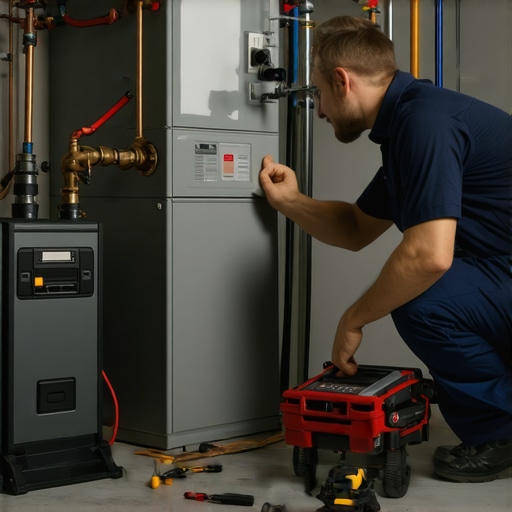
The Physics of Survival: Why Your Furnace is More Than a Metal Box
Listen, I’ve spent three decades crawling through crawlspaces and sweating in mechanical rooms, and if there is one thing I’ve learned, it’s that your furnace doesn’t care about your comfort—it only cares about the laws of thermodynamics. As we look toward the winter of 2026, the stakes are higher. We are seeing more high-efficiency equipment than ever, but ironically, the more complex these machines get, the more they fail because people treat them like a ‘set it and forget it’ toaster. My old mentor used to scream at me, ‘You can’t heat what you can’t touch!’ He was talking about the boundary layer of air on a heat exchanger. If your heating service professional isn’t talking about heat transfer coefficients or static pressure, they aren’t a tech; they’re a part-swapper looking for a commission. Airflow is the lifeblood of the system. If the air can’t reach the metal, the metal gets too hot, and that’s when the molecules in the steel start to dance themselves right out of a solid state, leading to a cracked heat exchanger. This isn’t just about being cold; it’s about the chemistry of combustion. If you don’t get your furnace repair done right, you’re not just losing efficiency; you’re risking a carbon monoxide event that no alarm can fix after the fact.
“The most expensive equipment in the world cannot overcome a bad duct system.” – Industry Axiom
1. The Forensic Diagnosis of the Heat Exchanger
In 2026, we are dealing with aging 80% AFUE units and the first generation of high-efficiency furnaces that are starting to show their age. When I perform a furnace repair diagnostic, I’m looking for the tell-tale signs of thermal fatigue. Think of your heat exchanger like a paperclip. If you bend it back and forth enough times, it snaps. Every time your furnace kicks on, that metal expands; every time it shuts off, it contracts. If your airflow is restricted because some tin knocker didn’t size the return air drops correctly, that metal is over-expanding. I’ve seen cracks so small they only open up when the metal is glowing, allowing lethal combustion gases to bypass the venting and enter your breathing air. You need a technician who uses a combustion analyzer, not just a flashlight. We’re looking for the ‘sour’ smell of incomplete combustion—that acidic tang that tells me your burner alignment is off. If the flame is licking the side of the cell, you’re on a fast track to a red-tagged unit.
2. Static Pressure: The Silent Furnace Killer
Most homeowners think a dirty filter just means dusty air. Wrong. A dirty filter increases the Total External Static Pressure (TESP). Imagine trying to run a marathon while breathing through a cocktail straw. That is what your blower motor feels like when you use those high-MERV ‘allergy’ filters without a properly sized plenum. If the static pressure gets too high, the blower motor—the heart of your system—has to work twice as hard, drawing more ‘juice’ (amps) and overheating the windings. I’ve seen sparkies replace perfectly good motors because they didn’t realize the ductwork was choked down. You need to check the ‘Pookie’ (mastic) on your joints. If your ducts are leaking, you’re heating your attic or crawlspace while your bedroom stays at 60 degrees. This is why AC installation and heating setups must be balanced. If the duct is too small for the AC’s CFM requirements, it’s definitely too small for the furnace’s rise.
3. The Ignition Cycle and Sensor Integrity
The days of standing pilots are long gone. Today, we deal with Hot Surface Igniters (HSI) and flame rectification circuits. Your furnace has a little rod called a flame sensor. It’s a simple piece of metal, but it works on the principle of ionization. If that rod gets a microscopic layer of carbon or silica buildup, the control board can’t ‘see’ the flame. It will shut the system down after four seconds to prevent an explosion. I’ve seen ‘sales techs’ try to sell a whole new furnace for a dirty sensor that just needed a light scrub with a Scotch-Brite pad. This is a critical part of any heating service. We also need to look at the inducer motor. That little fan is responsible for pulling the toxic gases out of the heat exchanger. If the bearings are screeching like a banshee, that’s the sound of a looming 2 AM emergency call in January. It’s better to replace a failing inducer now than to wait for the pressure switch to fail when it’s 10 below zero.
“Design for the coldest day, not the average day. A system that cannot maintain the design temperature rise is a liability, not an asset.” – ASHRAE Standards
4. Venting, Condensate, and the 2026 Efficiency Standards
If you have a high-efficiency unit (90% AFUE or higher), you are essentially running a chemistry lab in your basement. These units create acidic condensate as they strip the latent heat from the flue gases. If your drain lines are clogged or if the pitch of the PVC venting is wrong, that acidic water backs up into the secondary heat exchanger. I’ve seen the ‘gas’ (refrigerant) lines on hybrid systems corrode just because a condensate pump failed and leaked onto the copper. In 2026, we are seeing more dual-fuel setups where a mini-split heat pump handles the mild days and the furnace takes over during the polar vortex. Making sure these two systems ‘talk’ to each other through the correct crossover temperature is vital. If your heat pump is trying to run when it’s -5°F, you’re just spinning your electric meter for nothing.
5. The Mini-Split Integration and Hybrid Balance
The future of 2026 is the hybrid home. You might have a traditional furnace for the main house but a mini-split for that frosty sunroom or the new ADU. The maintenance check for these is different. We’re looking at inverter boards and EEVs (Electronic Expansion Valves). These aren’t your grandpa’s window units. They require surgical cleanliness. A ‘beer can cold’ suction line isn’t enough of a diagnostic anymore; we need to see the subcooling and superheat numbers in real-time. If you’re planning a new AC installation alongside your heating upgrade, you have to ensure the evaporator coil is matched perfectly to the furnace’s CFM. A mismatch here will lead to ‘slugging’ the compressor, which is a fancy way of saying you’re trying to compress a liquid—and physics won’t allow that without a catastrophic failure.
The Math of 2026: Repair vs. Replace
I get asked every day: ‘Is it worth fixing?’ If the repair cost is more than 30% of the value of a new system and the unit is over 12 years old, you’re throwing good money after bad. With the 2025 transition to A2L refrigerants (like R-454B) now fully in effect for 2026, the cost of parts for older R-410A systems is climbing. However, don’t let a tech scare you into a $15,000 system if all you need is a $50 capacitor or a thorough coil cleaning. Real HVAC work is about forensic analysis. It’s about understanding that every BTU of heat we move has to come from somewhere and go somewhere. If your tech doesn’t bring a manometer and a multimeter to the ‘tune-up,’ they’re just a glorified janitor with a tool bag. Keep your filters clean, keep your ‘Pookie’ sealed, and don’t let the sales guys talk you out of a solid piece of American iron if it’s still got life in it. Comfort isn’t magic; it’s physics. And physics doesn’t take a day off.
This article really underscores how important it is to treat furnace maintenance as a critical part of homeownership, not just a once-in-a-while task. I’ve seen many cases where neglecting simple checks, like inspecting the heat exchanger or verifying static pressure, leads to costly failures down the line. My experience has shown that regular professional diagnostics can extend the life of even older units, especially as they age past the 10-year mark. The point about proper duct sealing and balancing really resonated with me—I used to ignore duct leaks until I realized how much energy was wasted heating unconditioned spaces. I’m curious about others’ experiences with hybrid systems; have any of you integrated mini-splits with traditional furnaces? What challenges or improvements have you encountered? I’m definitely considering adding a mini-split to my sunroom and would love to hear some practical insights.